Home Sports Surfaces Testing About Request a Quote
Process Explained

How Does UV
Printing Work?

No plates, no drying rack, no waiting. UV printing sprays UV-curable ink through digital printheads and hardens it instantly with UV light as the print goes down — here's what that actually involves.

Request a Quote →
The Short Answer

UV Printing in One Sentence

A UV printer fires microscopic droplets of UV-curable ink onto a substrate through digital inkjet printheads, and a UV light source — LED or mercury-vapor — cures each layer to a solid film within a fraction of a second of it landing, so there's no drying time, no plate-making, and no dependency on the substrate absorbing the ink the way conventional printing requires.

Step by Step

The Process, From File to Finished Piece

Four stages, and the whole job usually runs in one continuous pass through the press.

  1. RIP the file. Raster Image Processing software converts the design into instructions the printheads can act on — color separations, ink layer order, and droplet placement for the specific substrate and resolution.
  2. Load and register the substrate. Rigid pieces sit flat on a vacuum table under the gantry; roll materials feed through a roll-to-roll transport. Either way, the piece is registered so the printheads track across it accurately.
  3. Print and cure in the same pass. Piezo printheads fire ink droplets in precise, repeatable amounts as the carriage sweeps across the substrate, and a UV lamp mounted right behind the printheads cures each pass almost immediately — the ink never sits wet for long.
  4. Layer as needed. Depending on the substrate and design, the carriage makes multiple passes — white ink underbase, then color, then an optional clear coat — building up the final image layer by layer rather than in one shot.
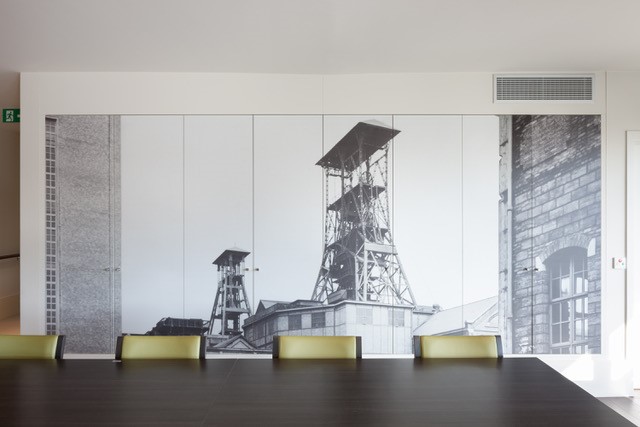
UV printed panels showing layered, full-color output
White Ink & Color

Why White Ink Is Its Own Layer, Not a Color

On anything that isn't bright white to begin with, color alone won't read correctly — that's what the white layer fixes.

The Layer Stack

CMYK ink is translucent by design, which is fine on white paper but reads muddy or invisible on a dark, clear, or colored substrate. A white ink underbase gets printed first wherever the design needs color to read accurately, then CMYK goes down on top of it, and an optional clear or gloss layer finishes the stack for extra scratch and UV protection. Skipping white ink on a dark substrate doesn't save a step — it just means the artwork won't look right.

Flatbed vs. Roll-to-Roll

Rigid substrates — glass, wood, metal, tile, composite panel — run on a flatbed press, where the piece stays still on a vacuum table while the print carriage moves over it. Flexible roll materials — vinyl, canvas, some fabrics — run roll-to-roll instead, feeding continuously under a fixed printhead and cure lamp. Some presses are hybrid and handle both in one machine.

Where the Process Has Real Limits

UV ink cures into a film that sits on the surface rather than soaking into it, which is exactly why it works on glass and metal — but that same rigidity is a liability on substrates that flex, fold, or stretch in use. Leather, fabric, and rubber need a more flexible ink formulation or added topcoat, or the cured film can crack at a fold line that the substrate itself handles fine. See our printing on leather and fabric guide and UV printing on rubber and silicone guide for how that's handled.

Cure lamps also generate some heat even on LED systems, so thin, heat-sensitive substrates like foam board still need dialed-in settings rather than a one-size print profile.

Core Components

What's Actually Doing the Work

Four parts of the system, and what each one is responsible for.

🖥️

RIP Software

File to Instructions

Converts the design into color separations and droplet placement the printheads can execute.

💧

Piezo Printheads

Drop-on-Demand

Fire precise, repeatable microscopic ink droplets only where the design calls for them.

💡

UV Lamp

LED or Mercury-Vapor

Cures each ink layer to a solid film within a fraction of a second of it landing.

🎨

Layer Stack

White, Color, Clear

White underbase for opacity, CMYK for color, optional clear coat for protection and finish.

Request a Quote →
FAQ

How UV Printing Works — Common Questions

What makes UV ink cure instantly instead of air-drying?

UV-curable ink contains photoinitiators that trigger a chemical reaction when hit with UV light, turning liquid ink into a solid film in a fraction of a second. Conventional ink dries by evaporation or absorption, which takes time and needs an absorbent surface — UV ink needs light instead, which is why it cures fully on substrates like glass or metal.

What's the difference between LED and mercury-vapor UV curing?

Both cure with UV light, but LED lamps run cooler and switch on and off instantly, while mercury-vapor lamps output more total UV energy but generate more heat. LED is the safer choice for heat-sensitive substrates like foam board; mercury-vapor still gets used where its higher output cures certain inks faster on heat-tolerant materials.

Why can UV printing put full color on glass, metal, and plastic when other processes can't?

Because UV ink cures on the surface instead of absorbing into it, it doesn't depend on a porous substrate the way water-based or solvent ink does. Non-porous materials like glass and polished metal simply don't absorb conventional ink — UV light-cured ink solidifies on contact regardless.

Does UV printing use plates or screens like other processes?

No. It's a digital inkjet process — the file goes straight from computer to printheads with no plate, screen, or die made in between, which is why it's viable for one-offs and short runs with no per-job setup cost. See our UV printing cost guide for how that plays out in pricing.

Can UV-printed ink crack or peel over time?

It can, if the substrate flexes more than the cured film tolerates or the surface wasn't properly primed. UV ink is an advantage on rigid substrates but needs a flexible ink formulation on materials that stretch or fold — talk to us before printing a flexible substrate with a rigid-ink profile.

Explore More

Related Reading

Have a Substrate You're Not Sure About?

Tell us the material and the use case. We'll confirm whether it's a fit for the process and what prep it needs.