Home Sports Surfaces Testing About Request a Quote
Process & Chemistry

Is UV Printing
Eco-Friendly?

UV-cured ink emits far fewer VOCs than solvent-based ink because it cures by light instead of evaporating. That's a real advantage, not a slogan — and it comes with real caveats worth knowing before you put it in a proposal.

Ask About Low-VOC Printing →
The Short Answer

Is UV Printing Eco-Friendly?

Mostly yes on the VOC question, and no on the idea that it's an unqualified "green" process. UV-curable ink cures by an almost instant light-triggered chemical reaction rather than drying through solvent evaporation, so it doesn't release the volatile organic compounds that solvent-based inks emit as they dry over hours or days. That's a genuine, well-documented advantage for indoor air quality and for job sites where a print needs to go back into an occupied space quickly. What it isn't is a blanket environmental certification: the curing lamps draw real electricity, the uncured ink still contains reactive chemistry that needs to be handled correctly before it cures, and "eco-friendly" as a marketing phrase means nothing without the paperwork behind it. If a client needs to check a box for a LEED submission or a GREENGUARD requirement, that's a documentation question we answer directly, not a claim we make by default.

The Actual Chemistry

Why Curing By Light Changes the VOC Math

Solvent-based ink is designed to dry by evaporation. The pigment is carried in a liquid solvent that has to leave the film for the ink to set, and that departing solvent is exactly what volatile organic compounds are — carbon-based chemicals that evaporate at room temperature and end up in the air of whatever room the print is drying in. A large solvent-printed job can keep off-gassing measurably for hours or days after it comes off the printer, which is why solvent print shops need ventilation systems and why solvent-printed graphics traditionally needed time to "gas out" before installation in a tight space.

UV ink skips that mechanism entirely. It's formulated from reactive monomers and oligomers that don't evaporate — they polymerize, meaning UV light triggers a chemical reaction that locks the liquid ink into a solid film in a fraction of a second under the curing lamp. There's no solvent to leave the film because there's essentially no solvent in the formulation to begin with. That's the specific reason UV-cured ink is described industry-wide as containing little to no VOCs next to a solvent-based equivalent, and it's also why a UV-printed panel can be handled, packed, and installed immediately after it comes off the press instead of sitting in a drying rack. See our UV printing vs. solvent printing guide for the fuller process comparison beyond just the VOC question.

That's the honest version of the claim, not the marketing version. The trade-off worth knowing before you assume "UV equals green across the board": the curing lamps — mercury-vapor or, on newer equipment, LED-UV arrays — draw meaningful electricity to generate the light dose that triggers the cure, so the energy side of the ledger isn't zero just because the VOC side is low. And the uncured ink itself contains reactive acrylate chemistry that needs correct handling before it cures; it's the cured, finished film that's chemically inert, not the liquid in the cartridge.

No solvent evaporation stage — cures in place under UV light
No extended off-gassing period after the print comes off press
Cured film is chemically inert; uncured ink needs correct handling
Curing lamps use real electricity — not a zero-energy process
Substrate recyclability is a separate question from ink chemistry
Ask Us About Low-VOC Requirements →
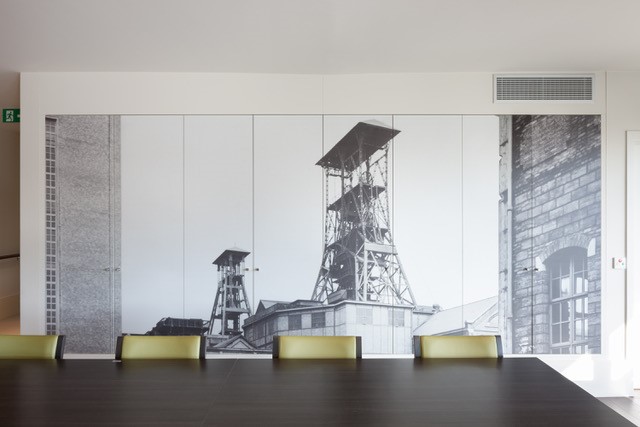
UV printed interior office panels in an occupied indoor space
Fit Check

Where the Low-VOC Advantage Actually Matters — and Where It Doesn't Decide Anything

A Strong Fit

  • Occupied buildings where signage or panels need to go up without a drying-out period — daycares, healthcare facilities, hospitality
  • Fast-turnaround retrofits where a room can't be closed off for off-gassing time
  • Projects documenting low-VOC finishes as part of a broader sustainability story
  • Interior work in tight, poorly ventilated spaces where solvent odor would be a real complaint, not just a nuisance

Worth a Second Look

  • Projects that need a specific certification (LEED credit, GREENGUARD) — confirm what documentation actually exists before promising it to a client or inspector
  • Anywhere "eco-friendly" is being used as the sole selling point rather than one accurate fact among several

Not the Deciding Factor

  • Overall carbon footprint of the job — that's driven more by substrate sourcing, freight, and lamp energy than by the ink alone
  • End-of-life recyclability — that's a substrate question (aluminum composite vs. PVC foam board vs. wood), not an ink question

What to Confirm Before It Goes on a Spec Sheet

  • Whether a specific certification is actually required, or whether "low-VOC" alone satisfies the requirement
  • Substrate choice, if recyclability or embodied carbon is part of the sustainability brief
  • Timeline — the real win for an occupied space is often the skipped off-gassing period, not the VOC number itself
Industry Reality

"Low-VOC" Is Real. "Zero-Impact" Isn't a Thing.

The comparison that gets cited most often in the print industry is straightforward: traditional solvent-based inks release volatile organic compounds into the air as the carrier solvent evaporates during drying, while UV-curable inks contain little to no VOCs because they cure through polymerization instead. That's not a fringe claim — it's the standard explanation vendors and print trade publications give for why UV-cured ink is treated as the lower-VOC option next to solvent printing, and it lines up with the basic chemistry: no evaporation step means no evaporating solvent to measure.

Where it gets oversold is the leap from "low VOC" to "eco-friendly, full stop." UV curing needs a real energy input — mercury-vapor or LED-UV lamps drawing power for every pass — and some sources in the industry point out that the energy demand of UV curing can make its overall footprint less favorable than a genuinely lower-energy process on certain jobs, even with the VOC advantage intact. Eco-solvent ink, a separate category from standard solvent ink, is often marketed as addressing VOCs at a lower energy cost than UV curing, which tells you the honest picture: every process trades one variable for another, and none of them is a free environmental win across every metric at once.

Our position is the same one we take on durability claims: we'll tell a client what the ink chemistry actually does and doesn't do, and if a job needs certified documentation rather than a general chemistry explanation, we'll say so rather than let "UV-cured" stand in for a certification we don't hold.

What Goes Wrong

Common Mistakes When "Eco-Friendly" Gets Assumed Instead of Checked

Treating "UV-cured" as an automatic LEED credit. Sustainability point systems require documentation, not a print process name. A UV-printed panel supports a low-VOC materials submission; it doesn't automatically satisfy one without the actual product data behind it.

Assuming zero odor because VOCs are low. A fresh UV print can have a brief, mild odor from the uncured chemistry right as it passes under the lamp. That's not the same phenomenon as hours-to-days solvent off-gassing, but a client expecting literally no smell at all can be caught off guard if nobody explains the difference up front.

Ignoring the substrate in the sustainability story. A client focused on the ink can miss that the bigger environmental lever on a given job is often the substrate choice — a recyclable aluminum panel tells a different end-of-life story than PVC foam board, regardless of which ink printed it.

Using "eco-friendly" as the entire pitch. It's one accurate, defensible fact about UV ink chemistry. Standing on it alone, without the durability, cost, or design case that actually wins most jobs, tends to read as greenwashing even when the underlying chemistry claim is true.

Where This Fits Best

Occupied Spaces That Can't Wait for a Print to Air Out

The clearest, most defensible version of the low-VOC advantage isn't a certification — it's a schedule. A UV-printed panel goes back into service faster because there's no off-gassing window to wait through.

🏫

Daycare & Childcare

Faster Reoccupancy

Rooms with young children benefit most from skipping an extended off-gassing period. See our daycare and childcare centers guide.

🏥

Healthcare Facilities

Lower Odor Disruption

Signage retrofits in active clinical spaces need to go up with minimal disruption. See our medical and healthcare facilities guide.

🏢

Occupied Offices

No Closed-Off Time

Wayfinding and brand panel installs that don't require clearing a floor to let a print off-gas.

🧪

Documentation

SDS on Request

We provide the safety data sheet behind the claim rather than a slogan — ask before you spec it into a sustainability submission.

Ask What Documentation We Can Provide →
FAQ

Is UV Printing Eco-Friendly — Common Questions

Is UV-cured ink actually VOC-free?

Not entirely, but close in practical terms. Solvent ink dries by evaporation, which is exactly what releases VOCs. UV ink cures by an instant light-triggered reaction instead, so there's no solvent evaporating off after the print comes off the machine — which is why it's described as containing little to no VOCs next to a solvent equivalent, not as a literal zero.

Does UV printing have LEED or GREENGUARD certification?

Not automatically. Low-VOC chemistry is real, but LEED credits and GREENGUARD certification require actual documentation — safety data sheets, emissions testing, or a certifying body's sign-off — not just the fact that a process is UV-cured. Tell us up front if a submission needs specific paperwork and we'll confirm what's available.

Why does a fresh UV print sometimes smell like something, if VOCs are low?

Low VOC after cure isn't the same as zero smell during cure. UV ink contains reactive monomers and photoinitiators that can have a brief, mild odor in the seconds under the curing lamp before polymerization locks them into the film — a short event, not the hours-to-days off-gassing of a solvent print drying in a room.

Is UV printing a good fit for occupied spaces like daycare centers or medical offices?

Yes, largely because there's no extended off-gassing window after installation the way there can be with solvent-printed graphics. A panel can go back into a room with kids or patients in it much sooner. See our daycare and childcare centers guide and medical and healthcare facilities guide.

Does "UV-cured" mean the ink or coating is environmentally safe to dispose of?

Cured UV ink is chemically inert since the reactive monomers have already polymerized into a solid film. Whether the panel itself is recyclable depends on the substrate underneath — aluminum composite, PVC foam board, or wood — not on the ink. Ask us about substrate options here.

Explore More Surfaces

Related Guides

Need Low-VOC Documentation for a Project?

Tell us the substrate, the space, and what your sustainability submission actually requires. We'll tell you what we can document and what we can't.

Website by Rank Easy Digital — websites, SEO & AI search visibility for your business. Get a free consult →