Home Sports Surfaces Testing About Request a Quote
Sports Application

UV Printing for
Basketball Courts.

Court color, every line set, the center-court logo and sponsor art printed into the playing surface in one run. No striping crew, no stencils, no tape lines peeling off a shared floor.

Tell Us About Your Court →
The Short Answer

Can a Basketball Court Be Printed Instead of Painted?

Yes, on modular polypropylene court tile, VersaCourt and vinyl sports surfaces. Instead of a base color, a separate line-striping pass and stenciled logos, the whole court design goes into one print file: key and lane colors, the three-point arc for your level, a second sport’s lines in a contrasting color, and any team or sponsor artwork. The coated print finish that goes on every Polyprint court recorded no observable change after 3000 hours of EN ISO 16474-3 UV weathering and a 6H pencil hardness in lab testing. What printing does not do is repair a bad base. A cracked or heaving slab needs its own fix before any surface goes on top of it.

Why Courts Get Printed

Painted Lines Are a Maintenance Schedule

A painted outdoor court starts wearing the day it opens. Lines scuff where players cut, water sits in low spots and lifts the coating, and every repaint means a striping crew, masking, and a court that is closed until it cures. Taped lines on an indoor multi-use floor are worse: they peel at the edges, collect dirt and leave adhesive behind when they are pulled.

Printing moves the design into the surface itself. The lines are part of the same print as the court color, so there is no separate line layer to wear through on its own, and you can run as many line sets and colors as the design needs without adding a striping pass for each one. That matters most on three kinds of projects: new modular courts where the surface is going down anyway, multi-sport floors where several sports share one surface, and branded courts where the logo is meant to stay put for years.

Ask About Your Court →
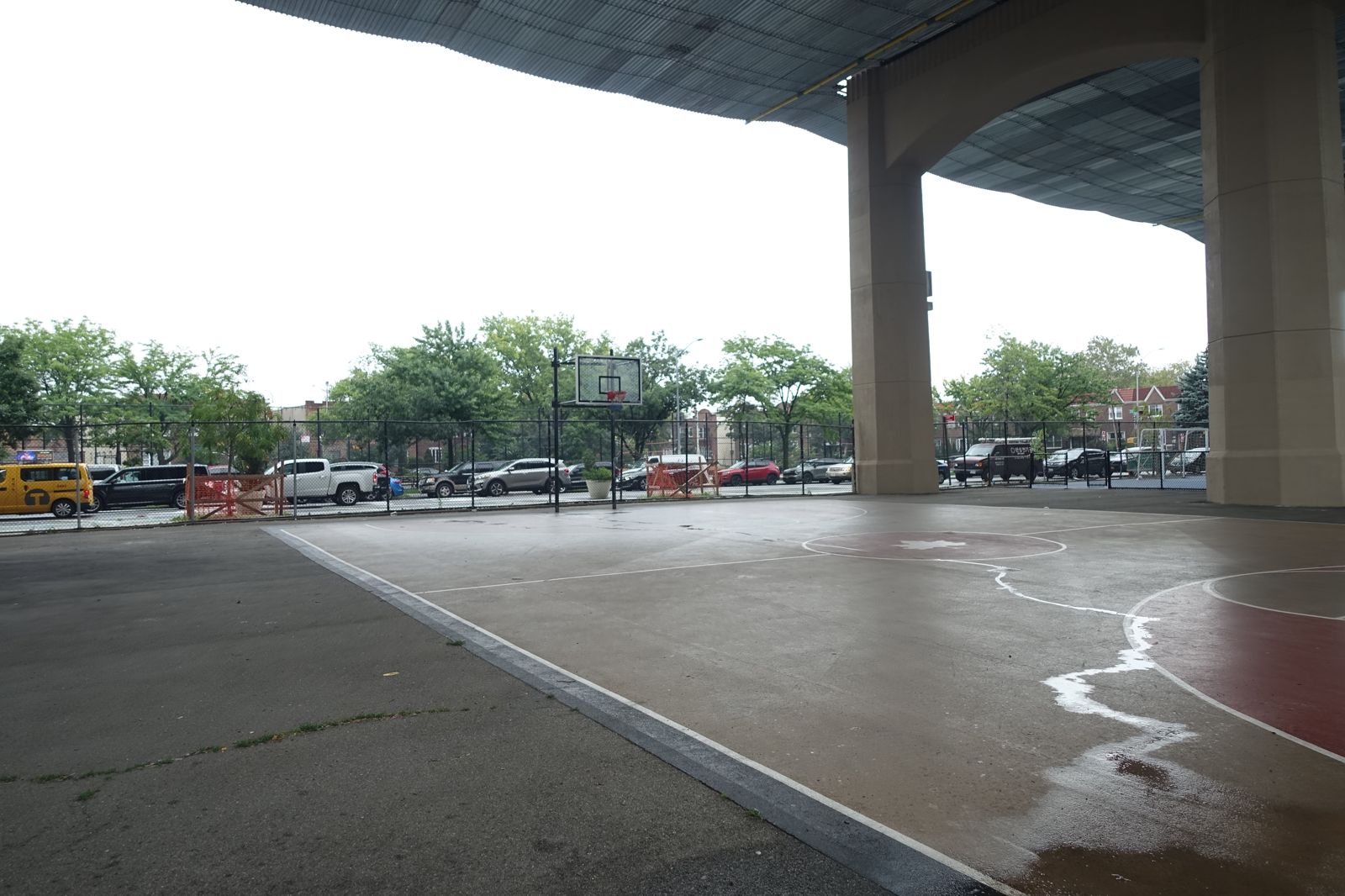
Outdoor painted basketball court under a bridge approach with faded lines and a worn center circle

A painted outdoor court with worn lines and a faded center circle, the maintenance cycle printed courts are meant to avoid. Photo: Tdorante10, “Triborough Bridge Playgrounds (2023-08-25) 007 - B Basketball Court,” Wikimedia Commons, CC BY-SA 4.0 (resized).

Line Layouts

Pick the Level Before the Artwork

The biggest difference between basketball courts is the three-point line and the lane. A printed line stays where it was printed, so the level has to be settled first.

LevelCourt sizeThree-point lineLane width
High school (NFHS)84 ft × 50 ft19 ft 9 in12 ft
College (NCAA men’s and women’s)94 ft × 50 ft22 ft 1¾ in12 ft
NBA94 ft × 50 ft23 ft 9 in; 22 ft in the corners16 ft
FIBA28 m × 15 m6.75 m4.9 m

The free-throw line is 15 feet from the face of the backboard under NBA rules, and the NBA rulebook draws its lines 2 inches wide. The NBA and NCAA also mark a 4-foot restricted-area arc under the basket. These figures come from the published rule diagrams listed in our sources; governing bodies do revise them, and older high school gyms often run shorter than 84 feet, so take the dimensions from the current rulebook and your own site plan, not from this table.

On a school or club court that hosts more than one level, the usual answer is to print both arcs in different colors rather than choose one. We set the primary arc in the strongest contrast color and the secondary arc a step quieter so players read the right line at speed.

Where It Fits

Four Basketball Projects That Suit a Printed Surface

Backyard and Driveway Half Courts

Most home courts are modular tile laid over a concrete pad. Printing lets a homeowner or court builder add a team logo, family name, custom key color or a shooting-spot layout without a separate paint job. Because the court is small, the full design sits in one file, and the print happens before the tiles ship.

School, Park and Community Courts

Public courts are where painted lines wear fastest. A printed design can carry the school or town identity, and a second set of lines for a younger age group or another sport, without adding a repaint to the maintenance budget.

Multi-Sport Gym and Rec Floors

Basketball usually shares a floor with volleyball, futsal or pickleball. Each sport’s lines can be printed in its own color in a single pass. If pickleball is the second sport, our pickleball court printing guide covers that overlay in detail.

Event, Tournament and Sponsor Courts

Temporary and event courts are where branding does the most work: sponsor marks, event names and broadcast-friendly color blocks. For the concourses, entries and signage around a venue rather than the court itself, see stadium and sports facility branding.

Logos & Sponsors

Branding the Playing Surface Without Breaking the Rules

On a private or community court, the design is yours: center-court logos, painted-look keys, sideline wordmarks and baseline sponsor bands all print in the same run as the lines. On a court that will host sanctioned games, the sanctioning body has a say. NCAA’s published court diagram, for example, marks designated commercial advertising areas and notes zones where commercial advertising is not permitted High school associations and leagues set their own rules. Get the current diagram for the level you will host before the artwork is locked.

A few layout habits keep a branded court playable:

  • Keep lines on top. Every boundary, lane and arc line should read clearly against whatever artwork sits under it. A logo that swallows part of the three-point line is a design error, not a style choice.
  • Watch dark-on-dark. A dark key next to a dark logo can hide the lane line. We proof contrast at the actual line width.
  • Match brand colors to the surface. A color that looks right on paper can shift on a textured court tile. Our guide to color matching and Pantone targets explains how we proof it.
  • Plan for sponsor turnover. If the sponsor changes every season, put the sponsor on removable or replaceable elements, or on a section of tile that can be swapped, and keep the permanent print for the court identity.
Start With the Floor Plan

Send the Court Size and Level

Court dimensions, indoor or outdoor, the level or levels that will play on it, any second sport, and your logo files. We’ll come back with what’s feasible on your surface and what the print and coating spec needs to cover.

Request a Quote →
Tested Performance

What the Lab Numbers Say, and What They Don’t

Basketball is hard on a surface: hard cuts, stops and jumps in court shoes, balls bouncing on the same spots thousands of times, and on outdoor courts, full sun and rain. Court surfaces get the same coated print finish and test package as every other Polyprint sports surface. The full results are on our testing and performance page.

  • UV weathering: no observable change after 3000 hours, EN ISO 16474-3, Cycle 1.
  • Coating hardness: 6H pencil hardness, EN 15184.
  • Impact: above 60 N on the EN 438-2 small-ball test and no damage from drops above 2.0 m on the large-ball method, the limits of the test equipment.
  • Wear: Class 31 under DIN EN 14354, Part D.

Ask Before You Spec

Slip resistance is not published yet. DIN EN 16165 inclined-plane testing is in progress. For an outdoor court that will be played wet, ask for current status on your substrate.

Lab hours are not years. A 3000-hour weathering result describes controlled conditions. How long a court looks new also depends on climate, cleaning and traffic; our durability and care guide covers what changes it.

The base still matters. Modular tile follows the slab under it. Drainage, cracks and level are the court builder’s job, before printing.

Fit Check

Print It, or Paint It?

Print It When

  • The court is a new modular install or a full resurface, so the print goes on before anything else.
  • The logo, colors and line sets are meant to stay for years.
  • More than one sport or more than one three-point arc shares the floor.
  • You want artwork that would take a striping crew days to stencil, such as gradients, photos or detailed crests.

Paint May Be Simpler When

  • The court is an existing acrylic-coated slab that isn’t due for resurfacing yet.
  • Sponsor branding changes every season and needs to be refreshed cheaply.
  • The design is plain lines on a single color with no logo.
  • The surface is poured concrete or asphalt you plan to keep coating on a regular cycle anyway.
What We Need

Before We Can Quote a Basketball Court

  • Court footprint and play area, full court or half court, and any run-off you want included in the design.
  • The surface: modular tile brand and model if you have one, vinyl, or a coated hard surface.
  • Indoor or outdoor, and the climate it sits in.
  • Which levels and sports need lines, and which is primary.
  • Logo and sponsor files in vector format, with brand color targets. Our file prep requirements list what works.
  • Who is installing, so we can coordinate tile layout and numbering with the court builder.
FAQ

UV Printing for Basketball Courts — Common Questions

Can a basketball court be UV printed instead of painted?

Yes, on the right surface. On modular polypropylene court tile, VersaCourt and vinyl sports surfaces, the court color, every line, center-court logo and any sponsor art can go down in one print run instead of a base coat, a striping pass and separate stenciled logos. Polyprint's coated print finish recorded no observable change after 3000 hours of EN ISO 16474-3 UV weathering and a 6H pencil hardness in our lab tests. A cracked asphalt or concrete slab still needs its own repair and coating; printing does not fix the base.

Which line layout should a printed basketball court use?

The one for the level that will actually play on it. High school (NFHS) courts are 84 by 50 feet with a 19 ft 9 in three-point arc and a 12 ft lane. NCAA courts are 94 by 50 feet with a 22 ft 1.75 in arc and a 12 ft lane. NBA courts are 94 by 50 feet with a 23 ft 9 in arc (22 ft in the corners) and a 16 ft lane. FIBA courts are 28 by 15 m with a 6.75 m arc. Confirm the current rulebook and your league's requirements before the print file is finalized, because a printed line is not repainted next season.

Can you print more than one set of lines on the same court?

Yes, and that is one of the main reasons to print. Two three-point arcs, a pickleball overlay or a volleyball court can each be printed in its own color in a single pass, so players can tell them apart without taped lines that peel and leave adhesive. Keep the primary sport's lines in the strongest contrast color and the secondary lines in a quieter one.

Can a center-court logo or sponsor be printed on the playing surface?

Yes. Logos, team names, mascots and sponsor marks are printed in the same run as the lines. If the court will host sanctioned games, check where that body allows advertising before you lay out the artwork; NCAA's court diagram, for example, marks specific commercial advertising areas and zones where advertising is not permitted. For a private or community court, the design is yours.

How slip resistant is a printed basketball surface?

We don't publish a slip rating yet. Formal DIN EN 16165 inclined-plane testing is in progress across Polyprint's product line. Ask for the current status on the specific substrate before you finalize a spec, especially for outdoor courts that get wet.

Sources: NBA Official Rule No. 1, “Court Dimensions – Equipment” (official.nba.com); NCAA 2025-26 Men’s and Women’s Basketball Court diagram (ncaa.org); NFHS and FIBA figures cross-checked against published court-dimension summaries (hoopspots.com, apollostemplates.com); Polyprint lab results on our testing page. Checked November 11, 2026.

One Print. Every Line. Your Logo.

Send the court size, the levels that will play on it and your artwork. We’ll tell you what prints well on your surface and quote it.