Full-color unit numbering, building signage, and wayfinding printed directly on aluminum — where that beats the industry's standard cut-vinyl-on-aluminum plaque, and where a plain vinyl number is still the smarter, cheaper call.
Request a Quote →Not always — it depends on what the sign needs to do. Cut vinyl on an aluminum backing is the proven industry standard for a simple sequential number, and there's no reason to replace something that already works. UV printing earns its place when a facility wants full color, a logo, or building-by-building color coding on the same aluminum substrate, without the layer limits that come with cutting and weeding vinyl for anything more complex than a number.
Unit door numbering gets the attention, but building and row identification, office and gate branding, and color-coded wayfinding across a multi-building site are ordered just as often — printed directly on the same aluminum most facilities already spec for exterior durability. A tenant who can't find their building from the gate is a support call; clear building-level wayfinding heads that off before it happens.
Facility branding for the office, gate, and street-facing sign rounds out most orders, closer in scope to warehouse and industrial site signage than to retail branding — durability and legibility matter more than decorative finish here.
Talk Through Your Project →
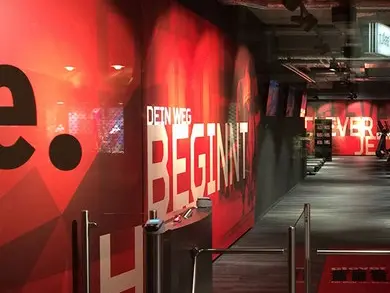
The self-storage industry has relied on aluminum composite plaques with cut and weeded vinyl numbering for decades, and for good reason — suppliers report 20+ year lifespans against digital ink that fades faster, and it's a mature, inexpensive process for a straightforward number. There's no reason to move a facility that already runs on that system to something new just because a different process exists.
Where direct UV printing changes the equation: vinyl cutting is efficient for a single flat color, but gets expensive fast once a facility wants a logo, a gradient, building-specific accent colors, or photographic wayfinding icons — each additional color or detail means another cut layer. Printing directly onto the same aluminum substrate handles full color in one pass at the same production step, on a material the industry already trusts for outdoor longevity.
Send us your unit count, building layout, and whether branding beyond a plain number is part of the plan, and we'll come back with what actually makes sense for the facility versus the standard vinyl approach.
Storage facility panels are finished under the same lab-tested performance benchmark used across every application.
EN ISO 16474-3 Atlas UV Test — relevant to outdoor unit doors and gate signage.
EN 15184 pencil hardness test — relevant to unit-door contact and cleaning.
The same material the self-storage industry already trusts for outdoor longevity.
Numbering format and color specs kept on file across every facility.
It is the industry standard, and for a single-color number, vinyl on aluminum is proven and inexpensive. UV printing earns its place for full-color branding, a logo, or building-specific color coding on the same aluminum substrate.
Lifespan depends on the coating. Polyprint's coating is tested to 3000+ hours of accelerated UV exposure with no surface change and 6H pencil hardness — confirm exposure conditions so the spec matches the site.
Building and row identification, office and gate branding, and color-coded wayfinding for multi-building sites are ordered as often as unit-door plaques. See our warehouse and industrial site signage guide for the adjacent category.
Yes — file-on-record color and format specs keep numbering and branding consistent from one facility to the next.
Depends on the goal. For plain sequential numbers, standard vinyl-on-aluminum is cheaper. For full-color branding or color-coded buildings, direct UV printing earns its cost. Request a quote here.
Send us your unit count and building layout. We'll come back with what's feasible and pricing.