Base lodge branding, trail-junction wayfinding, and rental shop panels finished in the same UV-cured coating used across every Polyprint surface — specified against a mountain winter's real failure mode, which is freeze-thaw at a seam, not a fading photograph.
Request a Quote →For fixed panel signage — wayfinding kiosks, base building branding, rental shop interiors — yes, provided the substrate is chosen for a freezing, wet climate rather than assumed from a warm-weather spec sheet. For handheld trail maps or anything mounted on lift equipment, no: those are different products entirely, and this page says so directly rather than quoting a job we shouldn't take.
Most resort orders split into two very different jobs under one contract. The first is interior lodge branding — cafeteria wall panels, bar tops, rental shop counters, ticket window graphics — which behaves like any commercial interior fit-out and shares more with our hotels and lodging guide than with anything winter-specific. The second is exterior signage: trail-junction kiosks, parking lot wayfinding, base building exterior panels, and directional signage between the lift line and the lodge. That second category is where the mountain climate actually changes the spec.
Retail and rental operations round out most projects — branded wall displays for a ski shop, seasonal promotion panels, and directional signage guiding foot traffic from parking to the lifts. None of that is exotic on its own; it's standard commercial signage and interior branding work. What makes it a resort project specifically is that a meaningful share of it sits outdoors, unheated, through an entire winter.
Talk Through Your Project →
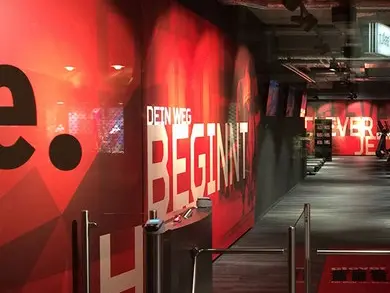
Most sign buyers ask about UV resistance first. At altitude, that's usually not what actually takes a panel out.
Freeze-thaw cycling is hard on outdoor graphics for a mechanical reason, not a chemical one: water finds its way into a small crack, a raw edge, or a porous face, then freezes and expands, forcing the opening wider. Repeat that cycle across a mountain winter — dozens of freeze-thaw swings between a sunny afternoon and a sub-freezing night — and a panel that wasn't built for standing moisture starts failing at the seams and edges well before the printed graphic itself fades. That's why a porous or improperly sealed substrate is a poor choice for exterior signage in a freezing climate, independent of how good the ink is.
The practical fix is substrate selection and edge treatment, not a heavier coating. Sealed aluminum, aluminum composite panel, and HDU sign foam with sealed edges give moisture nowhere to get in — see our UV printing on metal guide and HDU sign foam guide for how each is prepped and sealed. A panel we'd happily print for an indoor lobby is often the wrong pick for a trail-junction kiosk that sits in wind-driven snow for five months a year.
A wayfinding panel near a groomed run or a plowed lot also has to survive contact it was never designed for — a snowcat blade clipping a low sign, a plow berm burying a post-mounted panel for weeks, or a roof-mounted lodge sign carrying an actual snow load rather than just wind. None of that is a print-shop decision; it's a siting and structural call the resort's facilities team makes. What we can flag on a quote is panel material and mounting hardware rated for that kind of contact, the same way our metal panel guide flags galvanic corrosion at the fastener line for any exterior metal install.
Where salt and de-icing chemicals are part of winter maintenance — base area walkways, parking structures — the same dissimilar-metal corrosion risk that applies to any coastal or industrial install applies here too. Flag it up front and the fastener spec gets matched to it, not discovered after a season of ground-level splash.
The single most common failure on resort projects isn't a design problem — it's a location problem that never made it onto the quote.
Resort signage often gets ordered in one batch across dozens of locations with wildly different exposure — a rental shop wall panel, a lift-line queue sign, and a trail-junction kiosk half a mile up the mountain can all land on the same purchase order with the same panel spec attached, because nobody separated them by where they'll actually sit. That's how a perfectly good interior-grade panel ends up bolted to a post in wind-driven snow, or how a resort overpays for exterior-rated composite on a bar-top graphic that will never see weather. Sorting the list by exposure before ordering — fully interior, covered exterior, fully exposed — is a five-minute step that avoids both outcomes.
Retail and rental shop interiors deserve their own line item on that list, too. A ski or snowboard rental counter, a branded wall behind the boot-fitting area, or seasonal promotion panels near the lift ticket window are high-traffic but fully indoor — closer in spec to a ski shop's everyday commercial interior than to anything on this page's cold-weather section. Treating them as "resort signage" by default, rather than as the interior branding project they actually are, is how an indoor panel ends up over-specified and an outdoor one under-specified in the same order.
Resort panels are finished under the same lab-tested benchmark used across every application — the freeze-thaw resistance still comes from substrate and sealing, not from this coating alone.
EN ISO 16474-3 Atlas UV Test — relevant at altitude, where UV exposure is higher than at sea level.
EN 15184 pencil hardness test — relevant to ski/pole/edge contact near base-area signage.
DIN EN 16165 inclined plane test — relevant to wet lodge entryways and rental shop floors.
EN 438-2 ball impact testing — relevant to equipment contact near ground-level panels.
On the right substrate, yes. Freeze-thaw cycling destroys exterior graphics by forcing moisture into seams and porous faces, then expanding it as it freezes — a substrate and edge-sealing problem, not an ink problem. That's why resort signage gets specified on sealed aluminum, composite panel, or HDU sign foam rather than a porous board.
No. A handheld map needs waterproof synthetic paper built for a wet glove and repeated folding, not a rigid UV-printed panel. We fit the fixed signage — trail-junction kiosks, base area wayfinding, lodge panels — not the paper product.
No. Lift equipment is mechanical and regulated by the manufacturer's inspection program. Our work sits at the base and mid-mountain structures around the lift, not the cabins or towers themselves.
Exposure. Interior lodge branding behaves like any commercial interior project. Exterior trail-junction and parking signage sits in direct sun, wind-driven snow, and repeated freeze-thaw cycles for months, which changes the substrate and edge-sealing spec.
Yes — send a Pantone reference or an existing branded panel and the print gets color-matched against it, with each site's exposure and mounting conditions evaluated on their own. Request a quote here.
Send us your sign locations, exposure, and mounting conditions per site. We'll come back with what's feasible per area and pricing.