Home Sports Surfaces Testing About Request a Quote
Buying Guide

UV Printing for Signage
& Wayfinding.

Full-color graphics printed straight onto the aluminum, acrylic, or composite blank a sign shop already specs. Here's where it fits a wayfinding package — and where ADA rules still require a different process.

Request a Quote →
The Short Answer

Does UV Printing Work for Sign Panels?

Yes, for the graphic. UV-curable ink cures instantly under UV light as it's printed, bonding full-color artwork directly to aluminum, acrylic, or composite panel — no laminate film, no applied vinyl layer, no plates to make for a run of mixed sign types. What it doesn't do is produce the raised, ADA-required tactile characters and Braille that room-identification signage needs by code — that's a routed, photopolymer, or applied-cap process bonded to the panel separately. A wayfinding package almost always mixes both: printed directional and directory signs, and ADA room signs where the print handles the color and a second process handles the raised text.

Substrate by Environment

Interior vs. Exterior Sign Substrates

Exterior signage answers to weather first. A monument sign, building-ID panel, or parking directional lives outdoors for years, so aluminum and aluminum composite panel dominate that category — both take UV-stable ink well and won't warp, delaminate, or fade the way a lower-grade board can under years of direct sun. Our metal surface printing guide covers the primer and finish requirements that keep an aluminum sign panel performing outdoors specifically.

Interior wayfinding has more room to move. Lobby directories usually go on acrylic for a cleaner, more premium look, while interior directional and room-ID panels are often composite panel or painted MDF where budget matters more than showroom finish. The sign's environment decides the substrate before the graphic design does — a wayfinding schedule that's still guessing at substrate per sign type isn't ready to quote yet.

Aluminum & composite panel for exterior monument and directional signs
Acrylic for lobby directories and premium interior wayfinding
Composite panel or painted MDF for cost-sensitive interior signs
White ink underbase for backlit and translucent panel signage
Talk Through a Sign Package →
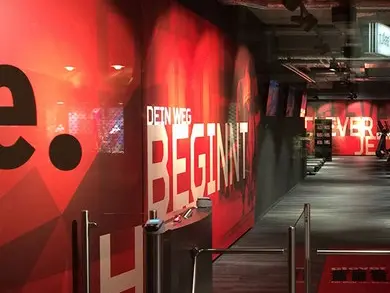
UV printed aluminum sign panel with full-color graphics
Where ADA Fits In

Printed Graphics vs. Raised, ADA-Compliant Characters

What UV Printing Handles

  • Full-color background graphics, pictograms, logos, and non-raised text
  • Directional arrows, floor and department identification, decorative panels
  • Any interior or exterior sign where the graphic doesn't need to be felt by touch

What It Doesn't Handle

  • Raised characters and Grade 2 Braille required on ADA room-identification signs
  • Any tactile element that has to be measurably raised off the panel face

How the Two Get Combined

  • Panel gets UV printed first for color, background, and pictograms
  • Raised characters and Braille are routed, photopolymer-cast, or applied as a separate cap layer
  • Both layers ship as one finished sign, produced through two distinct processes

Before You Quote an ADA Sign Program

  • Confirm which signs in the schedule are ADA room-ID signs requiring raised text
  • Ask who produces the raised layer and how it bonds to the printed panel
  • Don't assume a "custom printed sign" quote already includes ADA compliance
Tested Durability

Built to the Same Standard as Every Polyprint Surface

Printed sign panels are held to the same independently tested performance benchmarks that define all Polyprint applications.

☀️

UV Weathering

No Change at 3000h

EN ISO 16474-3 Atlas UV Test — zero surface change after 3000 hours of exposure.

✏️

Scratch Hardness

6H Pencil

EN 15184 pencil hardness test — rated 6H, the highest standard for coating hardness.

💥

Impact Resistance

>60N

EN 438-2 ball impact testing — maximum machine rating with no visible damage.

🔒

No Applied Layer

Ink Is the Finish

No laminate or overlay to lift or bubble at panel edges over years outdoors.

View Full Testing Data →
FAQ

UV Printing for Signage & Wayfinding — Common Questions

Can UV printing produce ADA-compliant tactile signage?

Not the part that makes it ADA-compliant. Room-ID signage needs raised characters and Grade 2 Braille a fingertip can read, and a flatbed printer lays down a flat, cured ink film — it can't raise a character to the required height. UV printing handles the full-color background and pictograms on that same panel; the raised text comes from a separate routed, photopolymer, or applied-cap process. Ask any sign shop how that layer is produced, not just how the graphic is printed.

What's the difference between interior and exterior sign substrate needs?

Exterior signs — monuments, building ID, parking directionals — need a substrate rated for years of direct sun and weather, which is why aluminum and composite panel dominate outdoor sign programs. Interior wayfinding has more latitude: acrylic for a premium lobby directory look, composite panel or painted MDF for cost-sensitive interior signs.

Can wayfinding or directory signage be backlit?

Yes, on a translucent substrate like acrylic, but it has to be planned for at the file stage. A backlit panel needs white ink and color coverage set up for transmitted light, not reflected light — flag it before the sign is quoted, not after a flat proof is approved.

How does UV-printed signage compare to a printed vinyl overlay on an aluminum blank?

A vinyl overlay is a separate printed film laminated onto a plain blank, which leaves an edge and a layer that can lift or bubble over years outdoors. Direct UV printing has no applied layer to fail at the edge. Vinyl still wins when a sign needs to be updated in place — see our UV printing vs. vinyl wrap comparison for where each wins.

What does a sign shop need to quote a multi-sign wayfinding package?

A sign schedule with every type and quantity, the substrate per type, mounting method, which signs are backlit, and which require ADA raised characters. Pricing and lead time depend on that mix being defined up front. Request a quote here.

Explore More Surfaces

Related Applications

Planning a Sign or Wayfinding Package?

Send us the sign schedule — types, quantities, substrates, and whether any signs need ADA raised characters. We'll come back with feasibility and a specification.

Website by Rank Easy Digital — websites, SEO & AI search visibility for your business. Get a free consult →