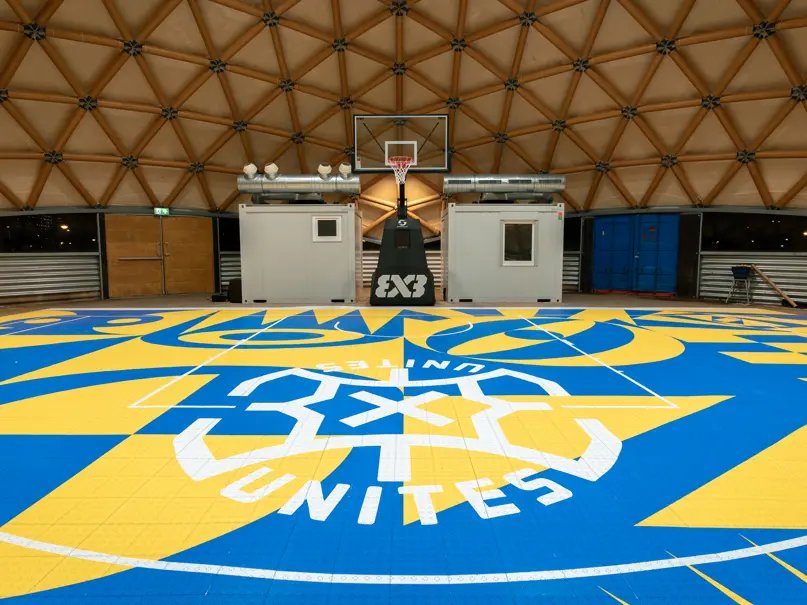
Safety zone marking, wayfinding, and branded floor graphics printed onto floor-rated tile and panel systems — built for daily traffic, not a substitute for a repainted layout or a code-required safety coating.
Request a Quote →UV printing earns its place on a warehouse or industrial floor when the layout is fixed and the graphic needs more detail than paint or tape can hold — color-coded safety zones, aisle boundaries, wayfinding icons, a branded reception or showroom floor. It's produced on a floor-rated substrate under controlled conditions, not sprayed onto an in-place slab, which is what gives it sharper detail and a longer service life than repainted markings. It is not the right call for a layout that shifts monthly, a zone with constant chemical spill exposure, or anywhere local safety code dictates the exact marking material — those stay jobs for tape, paint, or a certified coating system.
Most warehouse and facility floor graphics run through the same modular tile platform behind Polyprint's sports flooring work — PP, PE, or PVC tile printed and cured under controlled shop conditions, then installed as a floor system rather than sprayed in place. For a job that calls for a single continuous graphic set into an existing concrete floor, a printed rigid panel insert is the other route; see our UV printing on concrete guide for what changes when the substrate is the slab itself rather than a tile or panel system.
Floors are one of the more demanding surfaces Polyprint prints on — not because the ink adheres any differently, but because the finished piece takes continuous foot or wheel contact instead of hanging on a wall or sitting upright. That's the same challenge covered in our textured and uneven surfaces guide for anything beyond a flat tile, and the reason the traffic pattern — foot only, cart, or forklift — has to be part of the conversation before a substrate gets recommended.
See Performance Data →
A printed floor graphic replaces repainted markings well. It doesn't replace every floor process a facility needs.
The same independently tested benchmarks behind every Polyprint surface — but on a floor, traffic and impact resistance carry the most weight.
DIN EN 14354 Taber Abraser — the metric that matters most under continuous foot and cart traffic.
EN 438-2 ball impact testing — relevant for dropped tools, pallets, and equipment.
EN 15184 pencil hardness test — resists the scuffing a floor sees daily.
EN ISO 16474-3 Atlas UV Test — relevant for loading docks and daylight-exposed floor zones.
Not onto bare, in-place concrete carrying daily rolling loads — that's covered in our concrete printing guide. For facility floor graphics, the practical route is printing onto a floor-rated substrate, modular tile or a rigid panel insert, produced under controlled conditions and then installed.
Tape and paint are fast to apply and change, right for layouts that shift often. A UV-printed floor tile or panel is a fixed, full-color, photographic-detail graphic that holds up for years without repainting — but it's not repositioned next quarter the way tape is.
For light-to-moderate traffic and areas outside the direct wheel path, yes. For a primary forklift wheel lane seeing constant heavy loading, tell us the traffic pattern first — an epoxy coating system with the graphic built in is sometimes the better call there.
Yes — regular chemical spill exposure, wet-process zones needing extra anti-slip texture, and any marking governed by a specific safety code's required color or material. UV printing can usually match a required color scheme, but the compliance decision is yours to verify against local code.
Send the floor layout or a photo, the traffic type, whether there's any outdoor or dock exposure, and the design or color-coding scheme. Request a quote here.
Send us the layout, traffic type, and design. We'll tell you straight whether it's a printed tile job, a panel insert, or better served by paint or a coating system.