Home Sports Surfaces Testing About Request a Quote
Interior Surfaces

UV Printing on
Acoustic Panels.

Full-color graphics cured directly into a PET felt panel face — without sealing the fibers that actually absorb the sound.

Request a Quote →
The Short Answer

Does UV Printing Work on Acoustic Panels?

Yes, on the right acoustic core. PET felt panels — made from pressed polyester fiber, usually a blend of recycled and virgin PET — take a UV print directly on the face without needing a laminate or film layer over the top. The ink sits on and infuses into the surface fibers rather than flooding and sealing them shut, which is the detail that matters: an acoustic panel only works because its fiber structure is open enough to trap sound waves, and a print process that seals that structure solid would quietly undo the reason the panel was specified in the first place. A well-run UV print on PET felt doesn't do that. A panel wrapped in vinyl or heavy laminate film instead of printed usually does, which is part of why direct UV printing has become the preferred route for branded acoustic panels rather than an adhesive graphic applied after the fact.

Why the Core Material Decides the Process

Not Every Acoustic Panel Prints the Same Way

Commercial acoustic panels are built from three common cores, and they don't all take a graphic the same way. PET felt — polyester fiber pressed into a semi-rigid board, often blending post-consumer recycled PET with virgin fiber — has a relatively flat, uniform face, which is what makes it printable in the first place. Melamine foam panels have an open-cell, spongier surface that doesn't hold a crisp printed line well on its own. Glass wool panels are softer still and are almost never printed directly for that reason.

That's why the acoustic panel industry mostly splits into two finishing routes rather than one. PET felt gets printed directly, face-up, the same way a rigid composite panel would be. Foam and glass wool panels get fabric-wrapped instead — the graphic is printed on a stretchable acoustic fabric first, then that fabric is pulled taut over the foam or wool core and finished at the edges. Both routes end up full-color and durable. The difference is which one matches the acoustic spec someone already wrote, and PET felt is the one that lets us skip the fabric step entirely and print the panel itself.

The ink itself is a genuine consideration too, not an afterthought. UV-cured inks used on acoustic panel faces are formulated to be low-odor and to cure hard against abrasion and fading without building up a thick film — a thick, glossy ink layer across the whole face is exactly the kind of surface treatment that would work against the panel's sound-absorbing job. A properly run print keeps ink coverage and cure profile within a range that doesn't turn the felt into a sealed sheet.

PET felt (recycled/virgin polyester fiber board) — the substrate built for direct UV printing
Melamine foam and glass wool cores — usually fabric-wrapped and printed on the fabric instead
Ink cures onto surface fibers without fully sealing the open structure that absorbs sound
Bold logos, geometric patterns, and photographic murals are all common orders
Ask About Your Acoustic Spec →
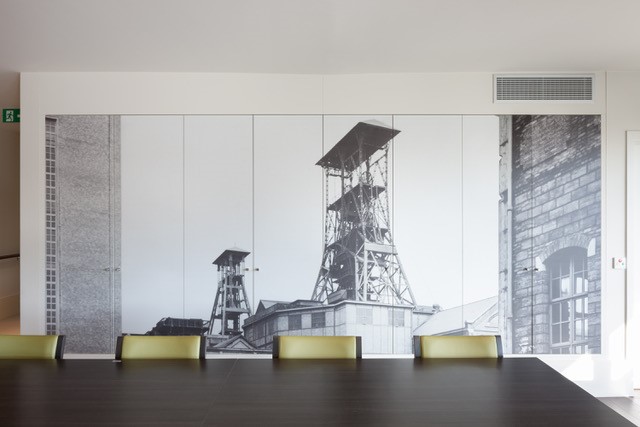
Printed acoustic panels on an office interior wall
Fit Check

Where UV Printing Fits on Acoustic Panels — and Where It Doesn't

A Strong Fit

  • Flat or lightly textured PET felt panels for office, coworking, and conference room walls
  • Bold logos, brand color blocks, and simple geometric patterns across a felt panel run
  • Multi-panel murals split across several felt boards mounted in a grid
  • Replacing plain gray or beige stock felt panels with branded ones at the same acoustic spec

Worth a Second Look

  • Deeply tufted, quilted, or 3D-profiled panels — fine detail and gradients don't hold up on that texture
  • Projects where the acoustic engineer specified foam or glass wool for NRC reasons — fabric-wrap is the better route there, not direct print

Not a Good Fit

  • Printing a heavy, fully opaque flood coat across an entire felt face edge to edge — it works against the panel's job
  • Panels that will be repositioned or swapped frequently for rotating campaigns — a printed felt panel is a fixed, permanent piece

What to Confirm Before It Goes to Print

  • The panel's core material — PET felt, melamine foam, or glass wool
  • Whether an NRC (noise reduction coefficient) target was specified by an acoustic consultant
  • Panel thickness and edge profile (square-cut vs. beveled)
  • Whether the design needs fine photographic detail or reads fine as bold shapes and color
In Practice

Why Acoustic Panel Printing Became a Design Line Item

Open-plan offices, coworking floors, and hospitality spaces added acoustic treatment for a functional reason — echo control — and then discovered they'd covered a meaningful amount of wall space in flat gray or beige felt. Printed PET felt closes that gap: the same panel that was already being specified for reverberation control now carries a logo, a wayfinding color code, or a full mural, at the same acoustic performance the space needed in the first place. That's a different conversation than our interior design and architecture guide, which covers rigid decorative panels with no acoustic function — acoustic felt is a functional material first and a design surface second, and the print has to respect that order.

Coworking operators and multi-tenant office landlords are a common source of these orders, often wanting the same printed panel design repeated across several floors or locations — see our coworking and shared office printing guide for how that consistency gets managed on other interior surfaces in the same buildings. Podcast studios and small conference rooms are the other frequent request, usually for a bold, simple brand mark rather than a photographic scene, since a small room means the panel is viewed up close where texture is more visible than it would be across an open floor.

A printed felt panel isn't a decal or a fabric wrap applied after the fact — see our UV printing vs. vinyl wrap comparison for how a bonded, cured print differs from an applied film in general. On felt specifically, that difference also means there's no adhesive layer sitting between the panel and a vinyl sheet that could eventually affect airflow through the fiber. Send us the panel spec sheet from your acoustic supplier along with the artwork, and we'll tell you plainly whether it's a direct-print job or a fabric-wrap job before anything goes to production.

Acoustic Panel Printing Basics

Four Factors That Decide the Result

What actually changes the outcome on a printed acoustic panel job.

🧶

Core Material

PET Felt Prints Direct

Polyester fiber board takes a UV print on its face; foam and glass wool are usually fabric-wrapped instead.

🔇

Sound Absorption

Preserved, Not Sealed

Ink cures onto surface fibers without flooding the open structure that does the acoustic work.

🖼️

Detail Level

Bold Beats Fine Texture

Flat felt holds photographic detail; tufted or profiled panels read better as simple shapes and color.

🏢

Common Settings

Offices, Studios, Restaurants

Anywhere echo control was already a functional requirement before branding entered the conversation.

View Full Testing Data →
FAQ

UV Printing on Acoustic Panels — Common Questions

Does printing on an acoustic panel reduce how well it absorbs sound?

Not when it's done on the right material. UV ink deposits color onto the surface fibers of a PET felt panel without saturating and sealing them shut the way a thick coat of paint or laminate film would. The panel's open fiber structure — the part that does the sound-absorbing work — stays intact.

What acoustic panel material takes a UV print best?

PET felt — polyester fiber, often a blend of recycled and virgin PET pressed into a semi-rigid board — is the material built for direct UV printing. Melamine foam and glass wool cores are usually finished as fabric-wrapped panels instead, printed on the stretched fabric before it's wrapped over the core.

Can a heavily textured or tufted acoustic panel be UV printed?

Not with fine detail. A tufted or deeply profiled panel breaks up gradients and small text the same way any uneven surface does — see our UV printing on textured and uneven surfaces guide. Bold graphics and geometric patterns hold up better than photographic images on that kind of face.

How does a UV-printed acoustic panel compare to a fabric-wrapped printed panel?

A UV-printed PET felt panel is a single rigid piece with the graphic cured directly into its face — no fabric layer, no wrap seam. A fabric-wrapped panel prints the graphic on stretchable fabric first, then pulls it over a foam or glass wool core. The choice mostly comes down to which core material the acoustic spec already calls for.

Where do printed acoustic panels get used most?

Open-plan offices, coworking spaces, conference rooms, call centers, podcast and recording studios, and restaurant dining rooms — anywhere echo control is needed but a plain gray or beige panel isn't the goal. Request a quote here.

Explore More Surfaces

Related Applications

Have an Acoustic Panel Project in Mind?

Send us the panel spec sheet from your acoustic supplier along with your artwork, and we'll tell you plainly whether it's a direct-print or fabric-wrap job before anything goes to production.

Website by Rank Easy Digital — websites, SEO & AI search visibility for your business. Get a free consult →