Direct UV printing on EVA foam — yoga mats, gym tiles, marine decking, and foam inserts — without transfer film or heat press. Adhesion and flex decide the spec, not color count.
Request a Quote →A UV flatbed prints straight onto the foam and cures the ink under UV light as it lands, so there's no transfer film, no heat press, and no dry-time wait. What actually decides whether the job holds up isn't the printer settings — it's whether the ink film is flexible enough for how the piece gets used and light enough not to fill in the surface texture the foam needs for grip. A flat foam panel insert and a yoga mat that gets rolled every day are two different specs even though they're the same base material. Tell us how the piece will be handled, not just what it's made of, and we'll match the ink to it.
EVA (ethylene-vinyl acetate) foam is a closed-cell material engineered for cushioning and grip, not for ink receptivity. Paper, coated canvas, and primed rigid panels are made to take a print; a yoga mat or a gym tile is made to take a footstep. That's the gap a UV printer has to close. The UV process itself is the same core mechanism we run on every surface — UV-curable ink jets onto the material and cures instantly under UV light rather than soaking in and drying — but on foam the cured film is sitting on top of a soft, often textured surface instead of bonding into a porous or primed one. Get the ink chemistry and laydown wrong and the print looks fine on day one and delaminates, crazes, or scuffs off within weeks. Get it right and it holds up the way shops running high volumes of printed mats report: solid adhesion, flexible film, no cracking, run after run.
Two variables matter more than any other on this substrate. First, ink film flexibility — a UV ink cured hard and brittle is fine on a rigid panel that never bends, but it's the wrong choice on anything that folds, rolls, or flexes in normal use. Print shops running yoga mats at volume have converged on flexible-rated UV ink formulations specifically because a stiff film cracks at the fold line long before the foam itself shows wear. Second, ink laydown — how much ink actually sits on the surface. Mat texture exists for traction, and a heavy, full-coverage flood of ink levels that texture out the same way a thick coat of paint fills in a rough wall. Shops that print mats professionally keep ink limits low and treat a full-bleed photographic design as a different, higher-risk job than a logo or a light pattern that leaves most of the grip texture exposed.
There's a production detail worth knowing if you're sourcing this at volume: multi-up printing — running several mats side by side across a single flatbed pass — can produce inconsistent cure across the bed, because pieces positioned farther from the UV lamp during the carriage's travel get less direct exposure than pieces closer to it. That shows up later as soft or under-cured spots on some units in a batch and not others, which is a print-floor calibration issue, not a material defect. It's also why foam should be loaded flat and relaxed before it goes under the head — foam that arrives rolled or creased won't sit flat, and an uneven surface either strikes the print head or leaves gaps in registration and cure. If the product is something people bring close to their face — a yoga mat used for an hour a day — ink odor is also a real consideration, not a cosmetic one; some UV ink chemistries off-gas more noticeably than others, and that's worth asking about before a large run ships.
Ask About Your Foam Product →
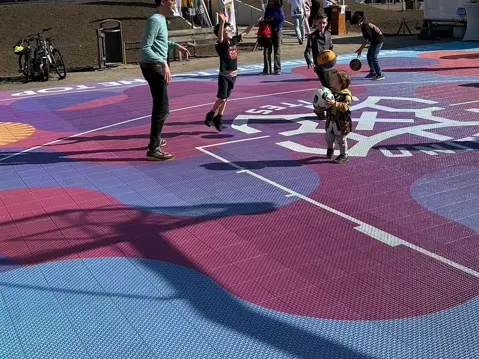
Same base material, different flex, grip, and exposure requirements depending on what it becomes.
The same printer runs every product on this page. What changes is the ink film and the laydown.
A foam insert glued into a case and shipped flat never sees a fold after printing. A yoga mat gets rolled tight every single day it's used. Those are different ink-film decisions even on identical foam stock — the flat piece can run a harder, more scuff-resistant film, and the rolled piece needs a film built to flex thousands of times without crazing at the crease.
A gym tile or yoga mat still has to do its job as a mat. If the design is a full-bleed photographic wrap, expect a conversation about ink limits and where a lighter pattern or a logo-plus-field-color layout protects traction better than saturated full coverage.
Marine decking sees UV, salt spray, and constant wet-foot traffic; a studio yoga mat sees sweat and indoor light. Durability targets and cure standards differ accordingly — general UV performance data for every Polyprint surface lives on durability and care, and we'll tell you where foam sits against that on the actual quote.
We will not run a heavy full-bleed design on a grip-critical mat without flagging the traction trade-off first, and we will not treat a rolled product and a flat-mounted panel as the same ink spec just because the foam is the same. Say how the piece is used and we'll build the file spec around that, not the other way around.
UV-printed foam runs against the same independently tested performance benchmarks that define every Polyprint application. Full data on the testing page.
EN ISO 16474-3 Atlas UV Test — zero surface change after 3000 hours of exposure.
EN 15184 pencil hardness test — rated 6H on rigid substrates, the highest standard for coating hardness.
EN 438-2 ball impact testing — maximum machine rating with no visible damage on rigid panels.
DIN EN 14354 Taber Abraser — achieved classification 31 in tested conditions.
From studio floors to boat decks, foam covers a wider range of B2B print jobs than it gets credit for.
If the product in question is rigid foam board or closed-cell sign foam rather than flexible EVA — Sintra, Gatorfoam, or HDU — the spec is different enough to live on its own pages: see UV printing on foam board and UV printing on HDU sign foam. Rubber and silicone parts that need a similarly flexible ink film are covered on UV printing on rubber and silicone.
Yes. A UV flatbed jets ink straight onto the foam surface and cures it under UV light as it lands — no transfer film, dye sublimation, or heat press involved. The harder part isn't the printing, it's the substrate: EVA is a closed-cell foam with a texture built for grip, not a coated stock built for ink, so adhesion and ink film flexibility drive the spec more than color count does.
It can, if the ink film is stiff. Foam that ships flat as a panel insert can run a harder, more scuff-resistant ink film. Foam that gets rolled, folded, or flexed in daily use — a yoga mat, a travel mat, a gasket — needs a flexible ink film rated for that repeated flex, or the coating crazes and lifts at the fold line well before the foam itself wears out.
It can if the ink is laid down heavy. The textured surface that gives a mat its traction is exactly what a flood of ink levels out. Shops that run mats in volume keep ink laydown as light as the design allows and treat a full-bleed, heavy-coverage graphic as a different job than a logo or a light pattern.
Yoga and exercise mats, interlocking gym floor tiles, cosplay and costume prop foam, marine non-skid boat decking, foam case and packaging inserts, and branded foam koozies all run on the same core process. The difference between them is flex requirement, indoor versus outdoor exposure, and how much of the surface needs to stay grippy versus how much can be a flat printed panel.
Finished size and thickness, quantity, whether the piece ships flat or gets rolled/folded in use, indoor or outdoor exposure, how much of the surface needs to stay textured for grip versus how much is open for full color, and artwork status. Request a quote here.
Send us the product, finished size, how it's used day to day, and artwork. We'll come back with the right ink film, laydown, and price.