Home Sports Surfaces Testing About Request a Quote
Sports Equipment

UV Printing on
Pickleball Paddles.

Full-color face graphics for paddle brands, private-label programs, clubs and corporate gifts. What prints well on carbon and fiberglass faces, and the USA Pickleball rules that decide where custom graphics are allowed.

Tell Us About Your Paddle Run →
The Short Answer

Can You UV Print a Pickleball Paddle Face?

Yes. Flatbed UV printing puts full-color artwork straight onto fiberglass, carbon fiber and painted composite paddle faces, with a white underbase for color on dark carbon and a clear coat over the top. The question that matters more than the ink is who the paddle is for. USA Pickleball’s rulebook says no aftermarket graphics are allowed on a commercially made paddle, beyond handwritten identification or an autograph. So graphics meant for sanctioned play have to be part of the manufacturer’s paddle, applied before or as part of the model that is tested and approved. Paddles for recreation, events, gifts and display can carry whatever design you like.

Why Paddles Get Printed

The Face Is the Brand

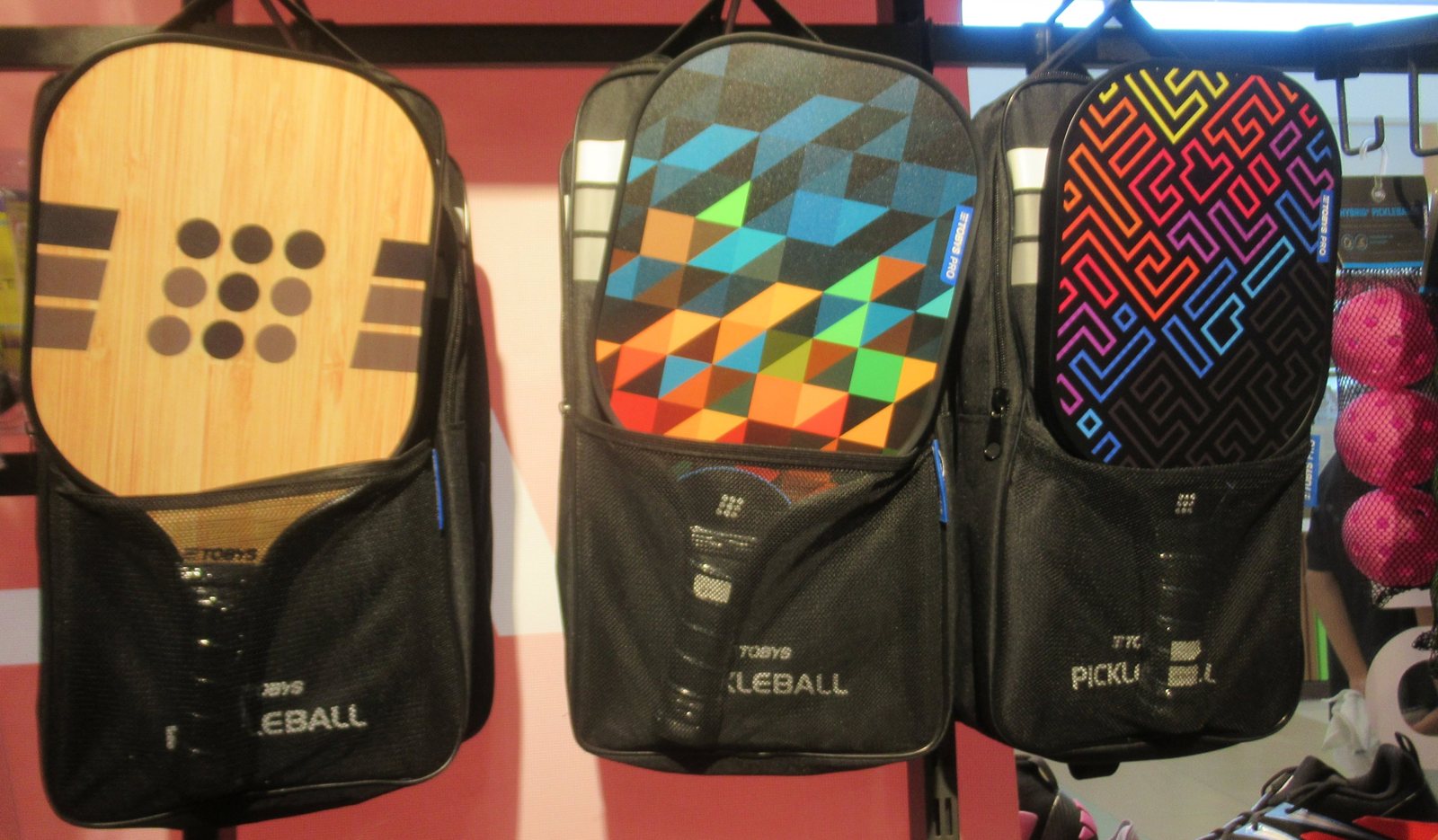
Walk down a retail paddle wall and nearly every face is a full-bleed graphic: geometric patterns, gradients, photo art, a bold wordmark down the center. The face is the largest flat area on the product and the part players see across the net, so it carries the brand.

Direct UV printing suits that work because it handles photographic artwork and fine detail on a rigid flat part without a film or decal layer, and short runs do not need screens or plates. It is a natural fit for paddle startups proving a design, private-label programs adding a club or resort identity, and promotional runs where every paddle carries a company logo. Our promotional products guide covers the gift side of that work in more detail.

Ask About Your Paddle →
Three pickleball paddles with printed wood-grain, geometric and maze-pattern faces hanging in zip cases at a sporting goods store

Printed paddle faces on a retail wall: a wood-grain graphic, a geometric color block and a neon maze pattern. Photo: Valenzuela400, “Pickleball three paddles1,” Wikimedia Commons, CC BY-SA 4.0 (resized).

The Rules

Sanctioned Play, Recreation, or Display?

Settle this before the artwork, because it decides who applies the graphic and what the finished face has to measure.

Paddle useWho prints the faceWhat the finished face must meet
Sanctioned tournament playThe paddle brand or its factory, as part of the model submitted for approvalUSA Pickleball paddle specifications, including the roughness, friction and reflection limits in the Equipment Standards Manual, plus the approved seal or text treatment
Club, league and recreational playA brand, private-label program or printer working from blank facesWhatever the club or league requires; many follow USA Pickleball rules informally, so ask
Corporate gifts, events, awards and displayAny qualified printerYour brand standards, durability expectations and a clear note that the paddle is not tournament-approved

The rulebook language is direct. Rule 3.D.6 lists the only alterations a player may make to a commercially produced paddle, among them edge guard tape, weighted tape, OEM replacement faces and grips, and name decals, and ends with: “No aftermarket graphics are allowed on a commercially made paddle.” Decals and tape on the face are also limited to within 1 inch above the top of the grip and 0.5 inch inside the outer edge or edge guard. Printing a full-face design onto an approved paddle someone has already bought is therefore an aftermarket graphic, and it can take that paddle out of sanctioned play.

For a paddle brand, the practical consequence is that face graphics belong in the manufacturing spec. If you are changing artwork on a model that is already on the approved list, ask USA Pickleball or your testing lab whether the change needs new testing before you print production quantities. We can print to your spec; we cannot certify a paddle.

Faces & Finish

What the Ink Has to Respect on a Paddle Face

Fiberglass and Painted Composite Faces

Smooth fiberglass and painted composite faces are the easiest to print. After cleaning off release agents and handling oils, they usually take ink well, and a light face color means less white underbase. Our fiberglass printing guide covers the prep in more depth.

Carbon Fiber Faces

Raw carbon is dark, so artwork needs an opaque white layer under the color to read correctly; without it, UV ink, which is semi-transparent, takes on the black of the weave. Cured resin surfaces can also be low in surface energy and may need an adhesion promoter. See UV printing on carbon fiber and our white ink and underprinting guide.

Texture and Grit

Many performance paddles have a textured or grit face for spin. USA Pickleball measures that texture: the Equipment Standards Manual caps average roughness at 30 µm Rz and 40 µm Rt per face, with no single reading above 33 µm Rz or 44 µm Rt, and sets a kinetic friction limit of 0.1875. Ink and clear coat change the surface. Printing over grit can fill it and reduce spin; a raised or textured print effect can add roughness. Either way, the finished face is what gets measured.

Gloss

The same manual says a paddle face and edge guard must not measure above 80 gloss units at 60 degrees, because a reflective face can affect the opponent’s vision. A high-gloss flood coat or heavy spot gloss effect is the obvious risk. For a tournament paddle, specify a matte or satin top coat and have the finished face measured.

Start With the Spec

Send the Face Material and the Use

Tell us the face material and texture, whether the paddles are for sanctioned play, club play or gifts, the quantity, and your artwork. We’ll come back with what’s feasible, what the finish should be and how we’d proof it.

Request a Quote →
Who It’s For

Four Paddle Programs That Suit UV Printing

Emerging Paddle Brands

Small brands often want several colorways before committing to a factory run. Printed sample faces let you show retailers and test players real designs. If the model is headed for approval testing, print the samples on the same face build and finish you will submit.

Clubs, Resorts and Facilities

Loaner and rental paddles with the club crest, pro shop retail with the facility’s own design, and paddles that match the court graphics. If you are branding the courts too, our pickleball court printing guide covers the surface side.

Corporate Gifts and Event Swag

A logo paddle set is a common gift for a company tournament or client outing. These paddles are for fun, so the design can run full bleed, but it should still survive ball contact and a season in a car trunk.

Awards and Display Paddles

Trophy paddles, signed-paddle displays and oversized wall pieces. With no ball contact, gloss and texture limits do not apply, and photo-quality detail is the priority.

Durability

What We Can Promise, and What We Won’t

A paddle face takes thousands of ball impacts, edge scrapes on the court surface, and sun and heat in a car or bag. Clear coat over the print is what protects it. Our published lab results, including no observable change after 3000 hours of EN ISO 16474-3 UV weathering and a 6H pencil hardness under EN 15184, were measured on Polyprint’s coated sports-surface finish. They are on our testing and performance page.

Those numbers were not measured on a paddle face, and a paddle is a different part with a different coating stack. For a paddle program, we proof on your actual face material and recommend play-testing a sample before production.

Where Paddle Graphics Wear First

  • The sweet spot. Repeated ball contact in the center of the face.
  • The lower edge. Scrapes when players dig balls off the ground, especially on paddles without edge guards.
  • The throat. Handling and sweat where the face meets the handle.

Designs that keep the most important detail, such as a logo, away from the lowest inch of the face and the center sweet spot tend to look newer longer.

What We Need

Before We Can Quote a Paddle Run

  • Face material and finish: fiberglass, carbon, hybrid or painted, smooth or textured, and whether the faces arrive as blanks or finished paddles.
  • The intended use: sanctioned play, club or recreational play, gifts, or display.
  • Quantity and whether every paddle is the same design or each one is personalized. Our minimum order quantities page explains how run size affects the quote.
  • Print area: full face, one side or both, and any no-print zones for brand marks, approval seals or edge guards.
  • Finish: matte, satin or gloss, and whether you need a measured gloss value.
  • Artwork in vector or high-resolution format with color targets. See our file prep requirements and our sample and proofing process.
FAQ

UV Printing on Pickleball Paddles — Common Questions

Can you UV print on a pickleball paddle?

Yes. Flatbed UV printing applies full-color artwork directly to fiberglass, carbon fiber and painted composite paddle faces, with a white underbase on dark carbon and a clear coat on top. Whether the printed paddle can be used in sanctioned play depends on who applies the graphic and whether the finished face meets USA Pickleball specifications.

Are custom graphics allowed on a USA Pickleball approved paddle?

Not as an aftermarket addition. USA Pickleball's rulebook says no aftermarket graphics are allowed on a commercially made paddle; players may add things like name decals within set limits and handwritten identification or an autograph. Graphics for tournament paddles need to be part of the manufacturer's paddle. If you are changing artwork on an already approved model, ask USA Pickleball or your testing lab whether new testing is needed.

Does printing change a paddle's spin or texture?

It can. Ink and clear coat sit on the face, so printing over a grit or textured face can fill some of that texture, and a raised print effect can add roughness. USA Pickleball's Equipment Standards Manual limits face roughness to an average of 30 micrometers Rz and 40 micrometers Rt and sets a kinetic friction limit, so tournament faces should be measured as finished.

How glossy can a printed pickleball paddle be?

For sanctioned play, the Equipment Standards Manual says the face and edge guard must not measure above 80 gloss units at a 60-degree angle. A matte or satin top coat is the safer choice for tournament paddles. Display and gift paddles that will not be used in sanctioned play are not bound by that limit.

Can you print one-off personalized paddles?

Yes. Digital UV printing does not need screens or plates, so names, numbers or different designs on each paddle can run in the same job. Pricing still depends on quantity, setup and how the paddles are fixtured on the printer, so send the run size with your request.
Sources: USA Pickleball, 2026 Official Rulebook, Rule 3.D Paddle Specifications, including 3.D.5, 3.D.6 and 3.D.7 (usapickleball.org); USA Pickleball Equipment Standards Manual, January 2025, section 2.E (usapickleball.org). Polyprint lab results are for our coated sports-surface finish; see the testing page. Checked November 12, 2026. Rules change; confirm the current edition before you finalize a tournament paddle spec.

Your Artwork. Every Face. Built to Spec.

Send the face material, the use and the quantity. We’ll tell you what prints well and quote it.