Photographic-quality graphics bonded to ceramic and tile with UV-curable inks and a protective coating — UV stable, scratch resistant, and engineered for architecture, retail, and design environments.
Request a Quote →UV printing on tiles jets UV-curable ink directly onto the tile face and hardens it instantly under UV light, then seals it under a protective coating — no kiln firing required, which is what makes short runs and one-off murals practical. Glaze condition is the variable that decides how well it holds: a glossy vitrified glaze is smooth and low-energy, so it needs a primer or plasma pre-treatment before ink will key in, while unglazed bisque tile grips better mechanically but can drink ink unevenly if it isn't sealed first. For continuously wet floors or heavy foot traffic, in-glaze kiln-fired printing still outlasts a UV-printed surface — worth knowing before you spec the wrong process for a pool surround.
UV printing on tiles applies ultraviolet-curable inks directly to the ceramic surface. As each ink layer is laid down, UV light instantly cures and hardens it — so the graphic bonds to the tile rather than sitting on top of it. A protective top coat seals the result for scratch and UV resistance, even across multi-tile murals.
Surface prep depends entirely on glaze. A high-gloss vitrified glaze is chemically smooth, so ink has nothing to key into without a primer or plasma/corona pre-treatment first — skip that step and a fingernail can lift the print at the edge. Matte and unglazed bisque tile has more mechanical tooth and generally holds UV ink better on contact, but it's also more porous, so it needs a sealer coat first or it will absorb ink unevenly and print blotchy. Either way, this is a surface finish, not a fired-in one: for pool decks, shower floors, and other continuously wet, high-traffic surfaces, in-glaze kiln-fired ceramic printing is the more durable — if slower and less flexible — choice.
The UV printing on tiles method excels at delivering full-color photographic detail and seamless artwork across multiple tile layouts. Because the ink cures instantly without a kiln cycle, UV printing on tiles is ideal for custom, short-run, and one-off projects where traditional ceramic printing would be cost-prohibitive. The protective coating ensures the printed surface resists scratching, UV fading, and minor chemical exposure in interior and moderate-exterior environments.
See Performance Data →
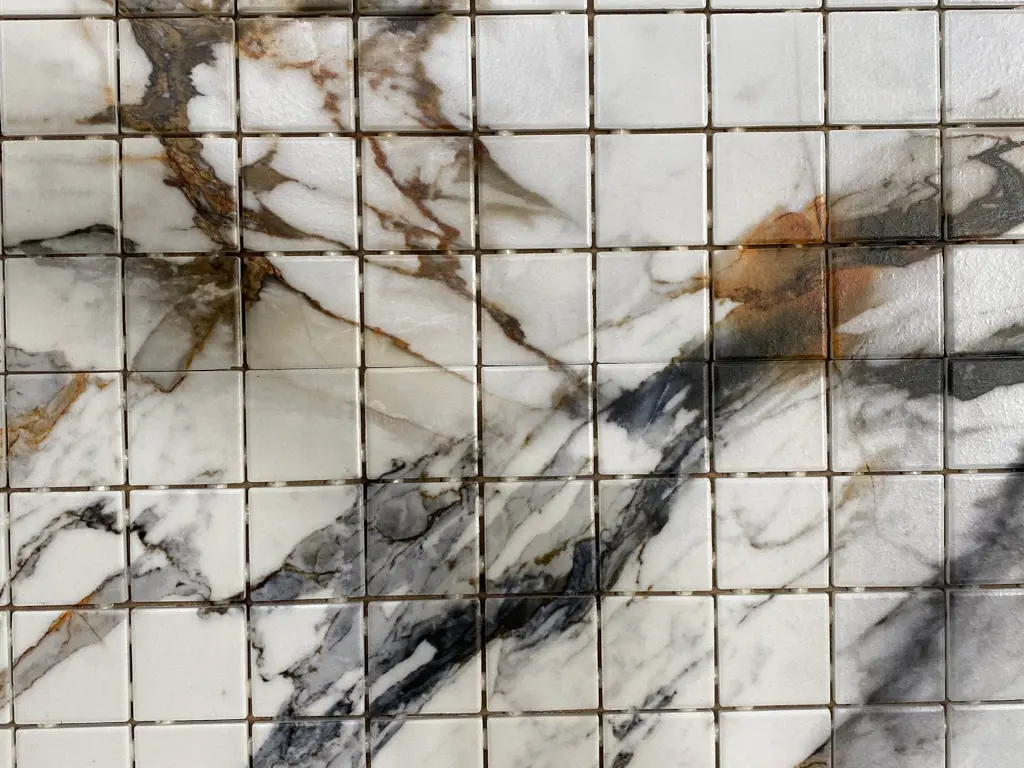
UV printing on tiles wins on speed, full color, and short-run economics. It isn't always the most durable choice for every wet or high-traffic floor.
UV printing on tiles bridges branding, art, and architecture. These are the environments where decision-makers most often specify it.
A tile mural isn't a seamless image the way a printed panel or composite substrate is — the grid is fixed before the art ever gets laid out.
A large-format mural printed across composite or ACM panels only breaks at engineered seams, positioned wherever the layout designer chooses. A tile mural breaks at every grout line, in a grid fixed by the tile size and joint width the installer is using — and that grid doesn't move to accommodate the artwork. A face, a headline, or any focal point that lands across a joint reads as visibly interrupted in a way a panel seam usually doesn't, so the image has to be planned to the actual tile grid before final art is approved, not fitted to it afterward.
Rectified tile — cut to a precise, consistent edge — allows a narrower grout joint than standard pressed tile, which keeps the image reading more continuously. Wider or darker grout makes the grid more visually present regardless of how well the artwork is planned around it, so grout color and width are part of the design decision, not just an installation detail decided later.
For a mural that needs to read as genuinely seamless rather than tiled, a composite panel substrate sidesteps the grout-line question entirely — see our large-format tiling and murals guide for how that panel-seam approach compares.
Printed ceramic is held to the same independently tested performance benchmarks that define all Polyprint applications.
EN ISO 16474-3 Atlas UV Test — zero surface change after 3000 hours of exposure.
EN 15184 pencil hardness test — rated 6H, the highest standard for coating hardness.
EN 438-2 ball impact testing — maximum machine rating with no visible damage.
DIN EN 14354 Taber Abraser — achieved classification 31 in tested conditions.
UV printing on tiles jets UV-curable ink directly onto the tile face and hardens it instantly under UV light, then seals it with a protective coating. There's no kiln firing step — the graphic bonds to the surface at room temperature, which is what makes short runs and one-off panels practical.
Yes, significantly. Glossy, fully vitrified glaze is smooth and low in surface energy, so it needs a primer or plasma/corona pre-treatment for ink to key in — skip that and the print can scuff off under a fingernail. Matte or unglazed bisque tile has more texture and generally takes ink with better mechanical grip, but it's more porous and can absorb ink unevenly if it isn't sealed first.
Not quite, and it's worth being upfront about that. In-glaze printing fires the image into the glaze at kiln temperature, fusing it permanently — effectively immune to scratching, fade, and chemical attack, which is why it's standard for wet-area floors and pool surrounds. UV printing sits on the surface under a protective coating instead: faster, full color, better short-run economics, but for continuously wet or heavy-traffic floors, in-glaze is usually the better spec.
Yes. UV printing on tiles supports full-color, photographic-quality graphics, brand patterns, logos, murals across multiple tiles, and gradients, including white ink for opacity and color accuracy on the ceramic surface.
Flat ceramic, porcelain, and tile formats used in walls, splashbacks, feature panels, and signage can be printed with UV. Surface finish, glaze, and intended environment should be confirmed for each project.
Share your tile sizes, quantities, artwork, and intended environment (wall, splashback, floor, interior or exterior). Polyprint will return feasibility, specifications, and pricing. Request a quote here.
Yes — a tile mural breaks at every grout joint in a fixed grid, unlike a seamless panel mural. Faces, text, and focal points need to be planned to land within a tile rather than across a joint. Rectified tile allows a narrower grout line for a more continuous-looking image than standard pressed tile.
Send us your tile sizes, artwork, and environment. We'll come back with what's possible, the right specification, and pricing.