Home Sports Surfaces Testing About Request a Quote
Process Guide

Large-Format UV Printing
Across Multiple Panels.

No press bed is as big as a building facade. Here's how one continuous image gets split into panels, registered, and reassembled on site — and where the seams still show.

Request a Quote →
The Short Answer

How Do You Print an Image Bigger Than the Press?

You split it. Every flatbed UV press has a fixed bed size, so a mural, facade graphic, or lobby wall larger than that footprint gets divided into individual panels at the file stage, each printed with a small bleed allowance and registration marks, then physically reassembled in sequence during installation. The printer doesn't do anything special to make this happen — the planning happens in the RIP software and the fabrication drawings, and the seam quality that results depends far more on file prep, substrate choice, and the install crew than on the press itself.

How It Works

Splitting the File Into Panels

RIP software divides the master image into a grid matched to the panel dimensions the job will actually use, which are set by the substrate, the press bed size, and how the panels will be handled and installed — not by convenient round numbers. Each panel is printed with a small bleed or overlap allowance, so a slight misalignment during install gets absorbed by trimmed excess instead of showing up as a gap. Registration marks, printed just outside the visible image area, give the install crew a physical reference for lining panels up edge to edge rather than eyeballing it.

Every panel is also numbered and keyed to a layout diagram before it leaves the shop — panel 4 of 12, oriented a specific way, installed in a specific position. On a job with dozens of panels, this is what actually prevents an install-day mixup more than anything printed on the panel face itself. Panels are batched and printed as close together in the schedule as possible, using the same color profile and ink lot where practical, because color drift between separate print runs is one of the few things that shows up clearly once panels are hanging side by side.

Panel grid sized to press bed and substrate handling limits
Bleed/overlap allowance absorbs minor install misalignment
Registration marks give install crews a physical alignment reference
Panels numbered and keyed to a layout diagram before leaving the shop
Full panel set printed together where possible to protect color consistency
Discuss a Mural Project →
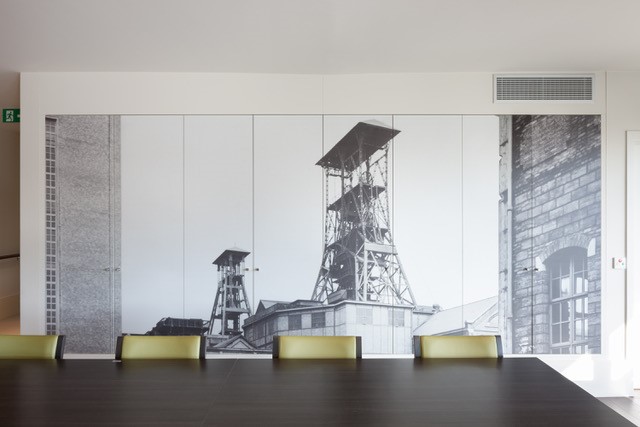
Large UV printed graphic tiled across multiple wall panels
Seam Behavior by Substrate

Which Materials Actually Hide a Panel Seam?

The joint detail, not the print quality, decides whether a seam disappears or reads as a line across the image.

Substrate How Seams Are Handled Visibility
Ceramic & tile Grout line at each panel boundary Expected and visible — designed into the layout
Composite panel / ACM Butt joint, often with a reveal or trim strip Hairline without trim; concealed with a reveal detail
Fiber cement rainscreen Overlap under a batten or open joint by design Usually visible — rainscreen joints are functional, not hidden
Glass panels Overlap concealed with metal capping Visible without capping; well concealed with it
Foam board / exhibit backdrop Taped, magneted, or velcroed seam Depends entirely on install tension — loose panels gap visibly
What to Plan For

Four Things That Decide Whether a Tiled Mural Reads as One Image

None of these are print-quality issues — they're planning issues that show up after the panels are on the wall.

📐

Bed Size Limit

~1.5–2m Per Panel

Physical press dimensions set the panel grid — the artwork gets sized around the machine.

✂️

Bleed & Overlap

Trim Margin Built In

A small overlap absorbs minor install misalignment instead of leaving a visible gap.

🔢

Panel Keying

Numbered & Diagrammed

Every panel is keyed to a layout before it leaves the shop — the main defense against install-day mixups.

🌡️

Thermal Movement

Joint Gaps by Design

Outdoor facade panels need expansion room at seams — a tight butt joint outdoors is a defect, not a feature.

Request a Quote →
Related Reading

Planning a Facade or Feature Wall?

Large tiled murals almost always come back to two questions: which substrate, and how will color hold across the whole run.

Composite Panel vs. Fiber Cement

The two most common facade substrates for a large tiled mural handle seams differently — composite panel can take a clean butt joint with a reveal, while fiber cement rainscreen typically shows its joints by design. Our composite panel guide and fiber cement guide cover the fire-rating and weight trade-offs that usually decide between them before the seam question even comes up.

Holding Color Across a Panel Set

Panel-to-panel color consistency is really the same problem covered in our color matching & Pantone guide, applied across a whole run instead of a single piece — the file, ink lot, and print scheduling all matter more than any adjustment made after the fact.

FAQ

Large-Format Tiling & Murals — Common Questions

How big can a single UV-printed panel be?

That's set by the physical bed size of the press, not the artwork — flatbed presses commonly top out somewhere around 1.5 to 2 meters in one dimension. Anything larger than that footprint has to be split into multiple panels regardless of substrate.

Can you make the seams between panels invisible?

Not universally. Grout lines and rainscreen reveal joints are designed to be seen. A butt-jointed composite panel or glass installation without trim over the joint usually shows a hairline gap under raking light. A genuinely seamless look needs the right substrate and joint detail chosen from the start — that's a fabrication decision, not a printing one.

Does color match consistently across panels printed on different days?

It should, but it isn't automatic — ink batches, printhead condition, and ambient temperature can introduce small drift between runs. We print full panel sets close together in the schedule off the same reference file and profile rather than treating each panel as its own job. Reprints or expansions months later carry the highest risk of a visible mismatch.

What information do you need to plan a multi-panel mural?

Finished wall or surface dimensions, the substrate, where structural joints, corners, or obstructions fall within that area, and whether the install crew needs numbered panels with a layout diagram. A mismeasured wall is the most common reason a tiled mural doesn't line up on site.

Can a mural wrap around a corner or across different substrates?

Wrapping a corner is routine — the file splits at the corner line like any other panel boundary. Spanning two different substrates in one image is harder, since each material can take color slightly differently, so it needs its own color-matching pass. Request a quote here to talk through your layout.

Explore More Surfaces

Related Applications

Planning a Mural or Facade Graphic?

Send us the finished dimensions, substrate, and any corners or obstructions in the space. We'll come back with a panel layout, seam plan, and pricing.