Home Sports Surfaces Testing About Request a Quote
Buying Guide

UV Printing for
Aerospace & Aviation.

Ground support equipment, tooling ID, and hangar or MRO facility signage built to hold finish under fuel exposure and constant equipment traffic — and a clear line on why it isn't a substitute for FAA-regulated aircraft part marking.

Request a Quote →
The Short Answer

Does UV Printing Have a Place on an Airfield?

Yes, on the ground side. UV-printed panels work well for ground support equipment branding, tooling identification, hangar wall and floor signage, and MRO facility wayfinding. What it doesn't replace is FAA-regulated aircraft data plates and part marking — that's a certified process with its own material specs, and a flat UV print on a standard substrate doesn't carry that certification. Everywhere outside the aircraft itself, it's a durability and branding question, not a compliance one.

Where It Applies

GSE, Tooling, and the Facility Around the Aircraft

Ground support equipment is the most common order — tugs, belt loaders, ground power units, and maintenance carts that need consistent branding across a fleet without repainting or wrapping each unit individually. Tooling identification is close behind: shadow boards, tool crib panels, and cabinet labeling that stay legible through years of handling and don't need reprinting every time a tool set gets reorganized. For equipment that carries a serial number or asset-tracking code alongside the branding, that's the same durable identification work covered in our nameplates and asset tags guide — the panel just gets sized and specified for the equipment it's mounted on.

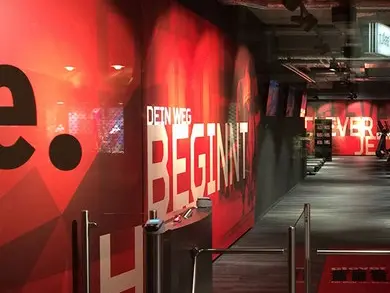
Hangar interiors add a facility-signage layer on top of that: wall graphics, floor markings for equipment staging lanes, bay numbering, and break room or office branding for MRO tenants and FBOs. Terminal-adjacent maintenance areas and crew facilities follow the same wayfinding logic used across any large commercial building — see our signage and wayfinding guide for how multi-zone consistency gets produced in one run rather than piecemeal. Metal cabinet fronts, GSE panel covers, and aluminum equipment housings are printed the same way as any other aluminum panel — our UV printing on metal guide covers the surface prep that applies whether the panel ends up on a hangar wall or a loading dock.

Ground support equipment branding — tugs, carts, GPUs
Tooling shadow boards and tool crib identification
Hangar wall, floor, and bay-numbering signage
MRO office, break room, and tenant branding
Fleet-wide color and branding consistency
Talk Through Your Project →
UV printed aluminum panel finish suited to aviation ground equipment
Fit Check

Where This Fits an Aviation Project — and Where It Doesn't

A Strong Fit

  • Ground support equipment branding that needs to match across a growing fleet
  • Hangar and MRO facility signage produced in one batch instead of piecemeal sign-shop orders
  • Tooling and asset identification panels that need to survive years of handling

Worth a Second Look

  • Composite or carbon fiber ground equipment housings — surface prep and primer depend on the resin system, confirm before ordering
  • Ramp-side signage exposed to jet blast and de-icing fluid — mounting and edge sealing need extra attention

Not a Good Fit

  • FAA-regulated aircraft data plates or flight-critical part marking — that requires a certified process on a specified material, not a standard UV-printed panel
  • Any marking an OEM or airworthiness directive requires to be traceable to a specific certified vendor process

What to Confirm Before It Goes to Print

  • Whether the item is a certified part or ground-side equipment and branding
  • Fluid and chemical exposure at the mounting location — fuel, hydraulic fluid, de-icing agents
  • Whether other stations or bases need matching color and branding
Why the Line Exists

Why Aircraft Part Marking Is a Different Category

Aircraft data plates and part identification are held to a different standard than facility or equipment branding, and for good reason. Flight-critical marking typically has to survive fuel and hydraulic fluid contact, salt spray, extreme thermal cycling between altitude and ground, and abrasion over the operational life of the part — validated through specific test protocols before a marking process gets approved for use. The common industry approach for that category is photosensitive anodized aluminum, where the image is sealed under the anodic layer itself rather than printed on top of it, or laser marking to a defined military or OEM specification.

That's a different manufacturing process than UV inkjet printing on a standard substrate, and it's not what Polyprint offers. The distinction matters because the two categories get confused easily: a GSE tug in the same hangar as a certified aircraft can absolutely carry UV-printed branding, but the aircraft's own data plates need a vendor and process qualified for that specific application. If a project spans both — ground equipment plus facility signage plus questions about part marking — tell us which is which up front and we'll scope the pieces that fit what we actually do.

Send us your equipment list or facility floor plan and we'll come back with what's printable directly and where a certified nameplate vendor needs to handle the rest.

Common Mistakes

Where Aviation Ground Projects Go Wrong Before They Even Reach Print

The most common scoping error is treating a mixed project as one line item. A base manager sends over a list that includes GSE tug decals, a hangar directory panel, and a request to "match the data plates on the aircraft" — three different categories with three different answers. Sorting which items are branding and which are regulated part marking before quoting saves a round of rework later, and it's worth doing that sort internally before the request even reaches a vendor.

A second recurring issue is ordering composite or carbon fiber ground equipment covers printed the same way as an aluminum panel. Resin systems vary enough that adhesion promoters and prep steps aren't interchangeable between substrates — a panel that looks fine on delivery can start lifting at the edges within months if the prep didn't match the actual material. Confirming the substrate before the order goes to print, not after a batch is already cut, avoids that outcome entirely.

Fleet color drift is the third one — ordering GSE branding in small batches over time without a color-matched file on record. Each small order gets color-approved on its own, and by the time a fleet has ten or fifteen units, no two came off the same reference file. Locking a spec at the start, even for a project that will roll out over a year, keeps every later batch matching the first one instead of drifting unit by unit.

Last, ramp-side and de-icing-zone panels sometimes get specified with the same coating as an interior hangar wall graphic because nobody flagged the fluid exposure difference. De-icing fluid, jet blast, and standing water at ground level call for a different edge-seal and mounting approach than a wall panel that never sees liquid contact — flag that exposure up front and the spec gets set correctly the first time.

Tested Standard

Same Coating Standard as Every Polyprint Surface

Ground equipment and facility panels are finished under the same lab-tested performance benchmark used across every application.

✏️

Scratch Hardness

6H Pencil

EN 15184 pencil hardness test — relevant to tool crib and cabinet handling.

☀️

UV Weathering

No Change at 3000h

EN ISO 16474-3 Atlas UV Test — relevant to bay-door sun exposure and ramp-side panels.

💥

Impact Resistance

>60N / >2.0m

EN 438-2 ball impact tests — relevant to equipment contact zones.

🛫

High-Traffic Standard

Daily Contact Rated

Coating spec set to match hangar and ramp traffic per zone, not one blanket spec.

View Full Testing Data →
FAQ

UV Printing for Aerospace & Aviation — Common Questions

Can UV printing be used to mark aircraft parts?

Not for flight-critical or FAA-regulated part marking. That work typically requires Metalphoto photosensitive anodized aluminum or laser marking to MIL-STD-130, tested to aerospace-specific specs. UV printing fits the ground side of the operation — GSE branding, tooling ID, facility signage — not certified part marking.

What can UV printing actually cover at an airport or MRO facility?

Ground support equipment branding, hangar wall and floor signage, tooling shadow boards, office and break room branding, and wayfinding through maintenance areas. See our nameplates and asset tags guide for how equipment ID gets specified.

Does a printed panel hold up in a hangar environment?

Hangars mix bright lighting, occasional direct sun through bay doors, fluid exposure near maintenance bays, and constant equipment traffic. See our durability and care guide for what drives panel lifespan under that kind of exposure.

Can composite or carbon fiber ground equipment be printed?

Yes, once surface prep and primer match the resin system. See our UV printing on carbon fiber guide for what that prep involves.

Can branding stay consistent across multiple hangars or a fleet of GSE?

Yes — file-on-record color matching keeps fleet and facility branding consistent across stations. Request a quote here.

Explore More Surfaces

Related Applications

Have a Ground Ops or Facility Project to Print?

Send us your equipment list or floor plan and which items are certified parts versus ground-side branding. We'll come back with what's feasible per item and pricing.

Website by Rank Easy Digital — websites, SEO & AI search visibility for your business. Get a free consult →