Wayfinding, sponsor panels, and facility signage built for a venue that changes shows every week — not a one-off mural that gets outdated the day the next event loads in.
Request a Quote →Some signage in a convention center or event venue is permanent — wayfinding totems, hall IDs, restroom and code signage — and should be printed on durable rigid panel that survives years of dock traffic and cleaning. Some of it changes every time a new show loads in — sponsor walls, donor recognition panels, event-branded column wraps — and needs to live in a reusable frame or panel system so the venue isn't reprinting a full mural for every booking. The mistake we see most is a venue treating both categories the same way: either over-building temporary graphics as permanent installs, or under-building permanent wayfinding as if it'll be swapped out next month. Tell us which category each sign falls into and we'll spec accordingly.
A trade show exhibitor buys graphics that travel with their company from show to show — that's a different job, covered on our trade show displays and booth graphics guide. A venue or convention center buys signage that stays behind: it belongs to the building, not to whichever company is renting the hall that week. That distinction drives almost every spec decision on this page. Facility wayfinding — directional totems, hall numbers, restroom identification, code-required life-safety signage — gets installed once and needs to survive years of dock traffic, cart collisions, and daily cleaning. It's a durability spec, closer to the rigid-panel work we do for airports and transit facilities than to anything built to be struck down and shipped home after three days.
Sponsor and event-specific graphics are the opposite problem. Convention centers sell premium wall, floor, and panel real estate in high-traffic zones to event organizers and sponsors as a revenue line — the same physical wall might carry a tech conference's branding one week and a medical association's the next. Printing a new full mural for every booking is slow and expensive at that turnover rate. The standard fix is a reusable hardware layer: slide-in panel frames, magnetic graphic systems, or interchangeable rail-mounted inserts sized to whatever the venue already runs, with new UV-printed panels produced per event and dropped into existing frames. We'll ask what frame system is already installed before we spec panel size and material, because matching an existing standard saves the venue from re-hardwaring every sign location.
Turnaround matters more here than on almost any other vertical we quote. Venues run on dock schedules and show contractor timelines that don't bend — a sponsor panel that isn't installed before doors open isn't worth printing. That means lead time, install windows, and who's doing the install (venue staff, our team, or the show's general contractor) need to be nailed down on the quote, not figured out after the job is printed. A local or regional relationship that understands a specific venue's loading dock rules and load-in windows genuinely cuts hours off a turnaround that a stranger to the building would lose to logistics alone.
Ask About Your Venue →
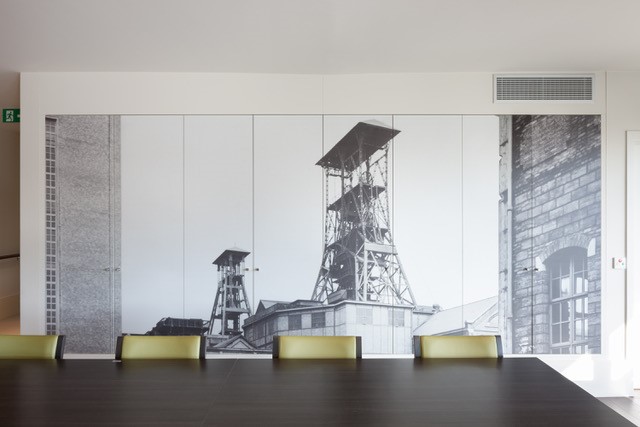
Both live in the same building. They don't share a spec.
Not the graphic. The building, the traffic, and how often the sign changes.
Aluminum composite panel and rigid PVC cover most permanent wayfinding; acrylic and metal often carry premium sponsor or donor recognition where the finish matters as much as the message. Panel size and mounting hardware get matched to whatever frame system the venue already has installed wherever one exists — building a new hardware standard from scratch adds cost the venue usually doesn't need to carry.
Floor graphics and low-wall panels in main concourses take cart traffic, spilled drinks, and daily cleaning in a way a hallway sign ten feet up never sees. Those get specced against wear and slip performance, not just print quality — the same durability standards we hold every Polyprint surface to.
Lead time gets planned against the venue's dock schedule and show load-in window, and we confirm up front whether install is handled by venue staff, our crew, or the show's general contractor. A sponsor panel that misses doors-open isn't worth printing early.
We will not print a full permanent mural where a reusable frame and a swappable insert would save the venue money on the third event, and we will not spec code-required ADA and life-safety signage as a design afterthought. If your need is exhibitor booth graphics rather than facility signage, that's a different page and a different spec — see trade show displays.
Facility signage in a high-traffic venue runs against the same independently tested benchmarks as every Polyprint application. Full data on the testing page.
EN ISO 16474-3 Atlas UV Test — zero surface change after 3000 hours of exposure.
EN 15184 pencil hardness test — rated 6H, the highest standard for coating hardness.
EN 438-2 ball impact testing — maximum machine rating with no visible damage.
DIN EN 14354 Taber Abraser — achieved classification 31 in tested conditions, relevant to floor and low-wall panel traffic.
From load-in to doors-open, signage in these buildings has to work at every phase.
Booth graphics belong to an exhibitor — they're built, shipped, and reused across whatever shows that company attends. Venue signage belongs to the facility — wayfinding, restroom and hall identification, floor graphics, and sponsor walls that stay behind after the show tears down and get reused or refreshed for the next event. Different owner, different lifecycle, different spec.
Yes, if it's built that way from the start. A venue that turns over events weekly needs modular hardware — slide-in panel frames, interchangeable inserts, magnetic graphic systems — printed on rigid stock sized to a standard frame, not a one-off wall mural. We'll ask what frame system, if any, the venue already runs before we spec the panel.
Wayfinding totems and directional panels, hall and meeting room ID signs, restroom and code-required signage, sponsor and donor recognition walls, floor graphics for aisle direction and sponsor real estate, and column wraps or banner panels in pre-function space. Most of it is rigid panel or floor-rated material, not the fabric backdrops an exhibitor brings in.
Venues and event organizers sell premium wall, floor, and panel placements in high-traffic zones to sponsors as a revenue line, separate from the venue's own permanent wayfinding. That means the same physical location may carry a different sponsor's graphic from one event to the next, which is the strongest argument for a swappable frame system over a permanently printed surface in those specific spots.
A facility map or list of sign locations, which pieces are permanent versus swappable between events, substrate preference if you already have a standard (aluminum panel, PVC, acrylic), any ADA or local code requirements for restroom and life-safety signage, install timeline against your dock and show schedule, and artwork or a brand guide if you have one. Request a quote here.
Send us your sign locations, which pieces are permanent versus swappable, and your install timeline. We'll come back with substrate, hardware, and price.