Home Sports Surfaces Testing About Request a Quote
Buying Guide

UV Printing for
Airports & Transit Facilities.

Durable, vandal-resistant wayfinding panels, gate directories, and terminal wall graphics — printed to survive round-the-clock foot traffic, cart contact, and daily cleaning without fading or scuffing through.

Request a Quote →
The Short Answer

Where Does UV Printing Fit an Airport's Signage Program?

It fits the static signage layer — wayfinding panels, gate and terminal directories, concourse wall graphics, and retail or concession signage — printed onto aluminum, aluminum composite panel, or acrylic, the same rigid substrates already standard across most airport signage programs. It doesn't produce raised tactile lettering and Braille on its own, which is a separate process required for ADA-compliant room and gate identification signs, and it doesn't replace flight information display screens, which are electronic. Knowing which category a given sign falls into before it goes to bid saves a round of the wrong quote.

Where It Shows Up

The Signage Airports and Transit Hubs Actually Order

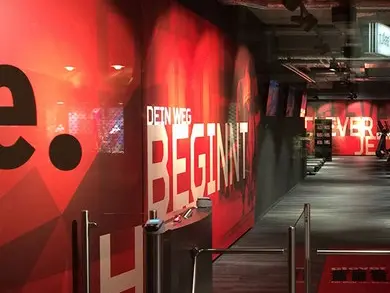
Wayfinding panels and terminal directories are the core order — arrows, maps, gate ranges, and amenity listings printed directly onto aluminum or metal panel instead of a laminated overlay that yellows and lifts at the corners under years of fluorescent light and cleaning-crew wipe-downs. Concourse wall graphics and column wraps come next, often at architectural scale for terminal rebrands or a new concourse opening — the same category of large-format panel work covered in our large-format tiling and murals guide for projects that exceed a single panel's size.

Gate-area concession and retail tenants order signage on the same panel materials, following the same finish spec as a mall storefront but built for a much higher daily traffic count. Parking structure signage for the attached garage runs on a related but distinct spec — see our UV printing for parking garages guide for how level identification and deck signage differ from terminal interior work.

Baggage claim and ground transportation areas add another signage layer — carousel numbers, rideshare and taxi queue directories, and rental car company wayfinding, all of which see even heavier cart and luggage-cart contact than the concourse above. These panels tend to sit lower on the wall, at a height where luggage corners and cart bumpers make contact daily, so the coating spec has to hold up to blunt impact as well as scuffing, not just foot traffic and cleaning chemicals.

Wayfinding panels, arrows, and terminal directories
Gate ranges, concourse wall graphics, and column wraps
Concession and retail tenant storefront signage
Modular insert panels for gate and tenant changes
For signage integrators, airport authorities, transit agencies
Talk Through Your Project →
UV printed aluminum wayfinding panel for an airport terminal
Fit Check

Where This Fits an Airport Project — and Where It Doesn't

A Strong Fit

  • Static wayfinding, directory, and informational panels on aluminum, ACM, or acrylic
  • Concourse wall graphics, column wraps, and terminal rebrand-scale installations
  • Modular insert panels built into a frame system for gate or tenant changes
  • Gate-area retail and concession signage matched to a terminal's design standard

Worth a Second Look

  • Landside exterior panels exposed to freeze-thaw cycling — confirm the substrate spec for that climate
  • Anti-glare requirements near jet bridges and high-glare glazing

Not a Good Fit

  • ADA tactile and Grade 2 Braille identification signs — a raised-character process, not flat UV print
  • Flight information display screens and other electronic signage
  • Airside taxiway and runway pavement markings — an FAA-regulated pavement-marking process

What to Confirm Before It Goes to Print

  • Whether the sign needs a paired tactile/Braille element alongside the printed panel
  • Indoor concourse versus landside or airside exterior placement
  • How often gate assignments or tenants change and whether inserts are needed
  • Mounting system and frame dimensions already in use across the terminal
Market Context

A Constant-Change Environment That Rewards Modular Panels

Airport signage programs are built around the assumption that gate assignments shift, concession tenants turn over, and terminals go through phased renovation on a rolling basis — a static sign that can't be updated without a full replacement becomes a recurring cost. That's why most terminal signage specs favor a common frame with a swappable printed insert, and it's the same design logic behind Polyprint's coated panel finish: color-coded, high-contrast graphics that hold up under 24/7 traffic and cleaning-crew chemicals without a laminate edge to lift or bubble over time.

Materials commonly specified for airport and transit wayfinding — acrylic for indoor non-glare panels, aluminum for weather-resistant exterior and entrance signage, and photopolymer for tactile elements — map directly onto the substrate range Polyprint already prints on for architectural and commercial signage, with the tactile element handled as a separate paired component where ADA compliance requires it.

Send us the panel spec, the frame system already in place, and whether the install is landside, airside, or interior concourse, and we'll come back with what's feasible and pricing.

Project Coordination

Working Inside an Active Terminal Schedule

Airport signage rarely gets installed in an empty building. Most panel orders come through a signage integrator or general contractor working inside a phased terminal renovation, a badge-and-escort security process for anyone on airside or secure-side work, and an overnight or off-peak install window so a concourse isn't shut down during business hours. Building lead time in for badging and escort scheduling — not just print production — is one of the most common gaps between an airport project's planned timeline and its actual one, so we ask about site-access requirements early rather than after a panel is already in production.

Frame and mounting compatibility matters more here than on a typical commercial signage job, because most terminals standardize on a specific frame system across the whole facility so maintenance staff can service any sign with the same hardware. A new panel needs to match that existing frame's dimensions and mounting method rather than introducing a one-off system that maintenance then has to track separately — send us photos or spec sheets of the current frame and we'll confirm panel sizing against it before production starts.

Multi-terminal or multi-airport signage programs add a consistency requirement on top of the durability spec: the same color, font, and panel finish needs to read the same in Terminal A as it does in Terminal C, and the same as it will two years from now when the next phase of panels gets ordered. Keeping the approved print file, Pantone reference, and substrate spec on record — the same practice covered in our reorder process guide — is what keeps a phased rollout from drifting in color or layout between phases.

Tested Standard

Same Coating Standard as Every Polyprint Surface

Terminal and transit signage gets finished under the same protective coating benchmark used on any high-traffic commercial application.

✏️

Scratch Hardness

6H Pencil

EN 15184 pencil hardness test — rated for cart contact, hand traffic, and daily wipe-downs.

☀️

UV Weathering

No Change at 3000h

EN ISO 16474-3 Atlas UV Test — relevant for landside and exterior transit shelter panels.

🧽

Chemical Exposure

Coating-Dependent

Clearcoat spec determines resistance to institutional cleaning chemicals — confirm protocol before quoting.

🔁

Modular Inserts

Frame-Ready

Panels sized to standard signage frames for single-piece swaps on gate or tenant changes.

View Full Testing Data →
FAQ

UV Printing for Airports & Transit Facilities — Common Questions

What airport and transit surfaces can actually be UV printed?

Static wayfinding panels, gate and terminal directories, concourse wall graphics, column wraps, and retail signage print well on aluminum, ACM, or acrylic. UV printing doesn't produce raised tactile lettering and Braille, and it doesn't replace electronic flight information displays.

Can a UV-printed panel meet ADA signage requirements?

Not alone — tactile identification signs need raised characters and Grade 2 Braille at a specified height and contrast, a separate process. UV printing fits the surrounding directional and informational graphics, paired with a separately produced tactile element where required.

How durable does terminal signage need to be for 24/7 operations?

It needs the same coating hardness and UV stability as any high-traffic commercial surface. Polyprint's coating is tested to 6H pencil hardness and 3000+ hours of accelerated UV exposure with no surface change.

Can signage be updated when gate assignments or tenants change?

Yes — modular panel systems with a common frame and swappable printed insert are the standard approach, so an update means reprinting one panel rather than replacing the whole structure.

Who typically orders airport and transit signage from a UV printing vendor?

Signage integrators and contractors on terminal build-outs, airport authority facilities teams, transit agency signage departments, and gate-area retail or concession tenants. Request a quote here.

Explore More Surfaces

Related Applications

Have an Airport or Transit Signage Program to Print?

Send us the panel spec, the frame system, and where it's installed. We'll come back with what's feasible and pricing.

Website by Rank Easy Digital — websites, SEO & AI search visibility for your business. Get a free consult →