Color-coded level identification, directional panels, and column wraps — printed to hold color and hardness through exhaust film, road salt, and years of weather cycling on open decks.
Request a Quote →It fits the panel signage layer — level identification, color-coded zone markers, directional and entry/exit lane signs, and column wraps — printed onto aluminum, aluminum composite panel, or powder-coated aluminum, the materials parking signage specs already call for. It doesn't cover pavement-applied striping or directional arrows painted on the deck surface itself, a traffic-paint trade rather than panel printing, and it doesn't replace digital parking guidance sensor systems. A garage with a mix of new panel signage and existing pavement markings is the normal split, not a gap in either vendor's scope.
Level identification panels are the most common order — a large-format number and a matched zone color printed directly onto aluminum or composite panel instead of a vinyl decal that fades unevenly under exhaust film and UV exposure on upper decks. Directional and entry/exit lane panels follow the same spec, and column wraps extend the same graphic treatment around structural columns for wayfinding that reads at a driver's eye level and speed.
Garages attached to airports, stadiums, hospitals, or mixed-use retail developments order the largest signage packages, often matched to the attached facility's branding — our UV printing for airports and transit facilities guide covers how terminal wayfinding and attached-garage signage typically get specified together under one design standard. City- and county-owned garages attached to a courthouse or municipal campus follow the same panel spec but usually run through a public purchase order instead of a private one — our UV printing for government and municipal facilities guide covers how that procurement path typically works.
Stairwell and elevator lobby graphics round out most orders — level and building-name identification at the point where a driver transitions from the garage into the attached facility, which is also usually the highest-visibility panel in the entire structure since every visitor passes it twice. Garages adding EV charging bays are an increasingly common variation on the same signage program — see our UV printing for EV charging stations and solar installations guide for the station ID and ADA-accessible signage that gets layered on top of standard level identification. These panels tend to justify a higher design budget per square foot than a typical deck-level sign, since it's functioning as much as a brand touchpoint as a directional one.
Talk Through Your Project →
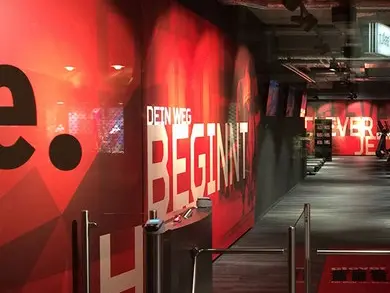
Parking structure signage specs commonly call for powder-coated aluminum, aluminum composite panel, or high-density urethane paired with UV-resistant graphics — materials chosen specifically because a garage combines constant vehicle exhaust exposure, road salt tracked in on tires, and, on open decks, direct sun and freeze-thaw cycling that most interior signage never sees. Panel signage rated to that spec is generally expected to hold up 5 to 10-plus years outdoors, which is the same durability class Polyprint's coating is built and tested to.
Color-coding by level or zone — a specific color per floor, large-format numbers, and consistent graphic identifiers — is standard practice in parking wayfinding because drivers process color and shape faster than text alone at low speed. Matching that system to an exact Pantone reference is a straightforward part of a UV printing order once the color code is confirmed.
Send us the level and zone plan, column dimensions, and whether the deck is enclosed or open-air, and we'll come back with what's feasible and pricing.
New-build garages usually order signage as one package tied to the construction schedule — level ID and column wraps go in during finish-out, after structural work and before the garage opens to traffic, which means panel dimensions and mounting points need to be locked in against the architect's drawings well before the panels themselves are needed on site. A renovation project runs the opposite way: signage typically gets replaced level by level or zone by zone so the garage can stay partially operational, which means color and font consistency across phases matters as much as the individual panel spec, since a driver moving from a freshly renovated level to an unrenovated one shouldn't be confused about which system they're reading.
Mounting hardware in a parking structure has to account for vibration from vehicle traffic and, on exposed decks, wind load that a typical indoor sign never sees — standard practice is a mechanical fastener system into the structural column or wall rather than an adhesive-only mount, which also makes future panel swaps easier if a level gets renumbered or a zone gets recolored. We confirm mounting method against the structure before production so a panel doesn't arrive without the right hardware already speced.
Garages that serve as the first and last impression of a larger property — an airport, a stadium, a hospital, a downtown mixed-use development — often get signage budget and design attention disproportionate to their square footage, because it's the space every visitor passes through twice. Matching that garage signage to the attached facility's brand standard from day one avoids the mismatched, bolted-on look that comes from treating the garage as an afterthought.
Parking structure panels get finished under the same protective coating benchmark used on any exterior or high-exposure commercial application.
EN ISO 16474-3 Atlas UV Test — relevant for open-deck and upper-level panel exposure.
EN 15184 pencil hardness test — rated for vehicle contact and cleaning-crew wipe-downs.
EN 438-2 ball impact test — relevant for column wraps in vehicle turning zones.
Level and zone colors matched to an exact reference before production.
Level identification panels, color-coded zone markers, directional and entry/exit lane signage, and column wraps print well on aluminum, ACM, or powder-coated aluminum. Pavement-applied striping and digital guidance sensors fall outside UV panel printing.
Polyprint's coating is tested to 3000+ hours of accelerated UV exposure with no surface change and 6H pencil hardness — the same benchmark aluminum and composite panels are expected to hold in specs rated 5-10+ years outdoors.
Yes — matching a specific zone color to Pantone is a standard part of the order once the color code is confirmed. See our color matching and Pantone guide.
Column wraps are sized to the structural column on site, and level ID panels typically follow standard signage frame sizes. Send exact column and frame dimensions with the order.
Parking operators, signage integrators on new-build or renovation garages, municipal and university parking authorities, and developers of attached retail, office, or hospitality projects. Request a quote here.
Send us the level and zone plan, column dimensions, and deck exposure. We'll come back with what's feasible and pricing.