Hallway wayfinding, locker end-panels, cafeteria graphics, and gym entrance branding built to survive a full school year of backpacks and elbows — not every wall in the building needs a permanent print, and we'll tell you which ones don't.
Request a Quote →Yes, on hard, non-porous surfaces — metal, acrylic, HPL panel, and solid surface all take a direct UV print and the same scratch-resistant topcoat used across every Polyprint application. The question that actually matters isn't durability, though; it's whether the graphic is meant to be permanent. A hallway wayfinding system or a building's core identity belongs on a printed panel. A mascot that gets refreshed every few years or a spirit-week banner does not, and printing those permanently just means paying to reprint them on someone else's timeline.
Hallway wayfinding between wings and floors is the most common first order, but locker bank end-panels and cafeteria wall graphics see just as much daily contact — and just as much wear. Gym entrance branding, donor recognition walls, and lab or shop-class equipment nameplates round out most district orders. Equipment and asset labeling in a school shop, science lab, or maintenance area follows the same spec as any industrial ID tag — see our nameplates and asset tags guide for what that print needs to survive.
Cafeteria work is closer to restaurant branding than office branding — tabletops and wall panels near serving lines get wiped down constantly and take spills as a given, which is the same durability conversation covered in our restaurants and hospitality guide.
Talk Through Your Project →
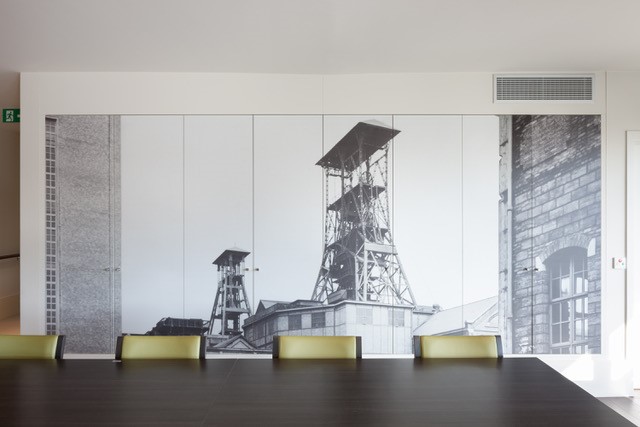
A district facilities team ordering printed graphics is really making two separate decisions at once, even if the purchase order treats it as one: what goes on a permanent panel, and what belongs on something replaceable. Wayfinding, building identity, and locker or cafeteria branding are genuinely permanent — they don't change unless the building gets renovated. Mascots get refreshed, spirit themes rotate by season, and donor walls grow every year. Printing all of it the same way means paying full panel cost to update something that was only ever meant to last a semester.
The practical fix is splitting the order: permanent identity and wayfinding go on a fixed printed panel with the full protective topcoat, and anything on a shorter cycle goes on a removable insert, a printed banner, or a panel with blank fields built in from the start. Tell us which category each piece of your project falls into and we'll spec accordingly, rather than defaulting everything to one printed panel and one price.
Send us your floor plan and which graphics are meant to be permanent, and we'll come back with what's feasible per space and pricing.
School hallway and cafeteria panels are finished under the same lab-tested performance benchmark used across every application.
EN 15184 pencil hardness test — the standard relevant to backpack and locker traffic.
EN 438-2 ball impact testing — maximum machine rating with no visible damage.
DIN EN 14354 Taber Abraser — relevant to hallway floor-adjacent panels and high-traffic walls.
EN ISO 16474-3 Atlas UV Test — relevant to gym entrances and exterior building identity.
Hallway wayfinding, locker bank end-panels, cafeteria wall and tabletop graphics, gym entrance and donor walls, and lab equipment nameplates are the recurring orders. Hard, non-porous substrates take the print and the hallway traffic; soft or textured surfaces like acoustic fabric panels aren't a fit for direct UV printing.
On the right substrate, yes — the same 6H pencil-hardness coating used across every Polyprint application. It won't survive something sharper than a pencil point being carved into it deliberately; no coating does.
Anything tied to a cycle shorter than the panel's service life — a mascot rebrand, a rotating spirit banner, or a donor wall that adds names every year. A removable insert or a panel with blank name fields solves those better than reprinting the whole piece each time.
Usually not permanently. Portable classrooms and leased buildings often restrict wall alterations, so a mounted-not-adhered panel system keeps the graphic movable if a portable gets relocated.
Yes — the same color-matching and file-on-record process used for any multi-location client keeps a district's wayfinding and identity graphics matching from campus to campus. Request a quote here.
Send us your floor plan and which graphics are meant to be permanent. We'll come back with what's feasible per space and pricing.