Home Sports Surfaces Testing About Request a Quote
Buying Guide

UV Printing for
Restaurants & Hospitality.

Full-color graphics printed directly onto tabletops, bar tops, host stands, and wall panels — surfaces that get bussed, wiped down, and stared at every service. Here's where that holds up, and where it doesn't belong.

Request a Quote →
The Short Answer

Does UV Printing Actually Hold Up in a Restaurant?

Yes, on surfaces built to be handled — but not on every surface a guest or a food touches. UV printing bonds full-color ink to the tabletop, bar top, or panel itself and finishes it with the same 6H-hardness protective coating used across every Polyprint application, so it survives daily wipe-downs and bus tub traffic far better than a printed decal or a placemat insert. Where it needs a different spec is anywhere food or drink makes direct contact, or anywhere it sits against sustained heat — those are different jobs with different ink and material requirements, not a reason to avoid printing everywhere else.

Where It Shows Up

The Surfaces Restaurant and Hospitality Groups Actually Order

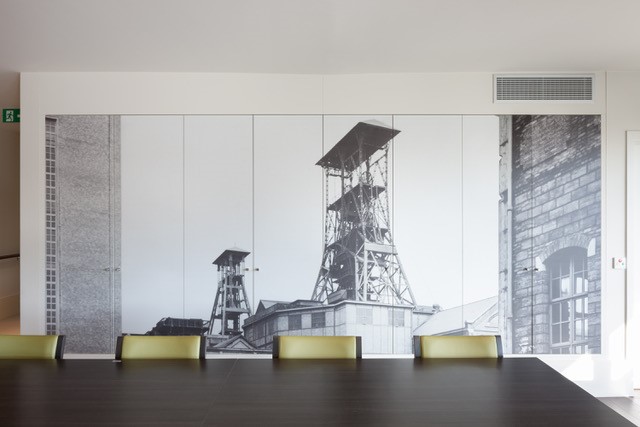
Tabletops and bar tops are the most common request — a logo, pattern, or branded finish printed straight onto solid surface, HPL, or sealed wood rather than added as a removable insert. Host stands and reception panels follow close behind, usually the first branded surface a guest sees walking in. Feature walls in the dining room or private event space use the same rigid-panel approach covered in our interior design and architecture guide, just scaled to a hospitality footprint instead of a full building lobby.

Beyond the front of house, printed wayfinding for restrooms and private rooms, drink rail and waiting-area graphics, and small-batch branded serving boards or trays round out most orders. Taprooms and breweries follow this same bar-top and wall-panel approach with a few beverage-specific additions — see our UV printing for breweries and craft beverage branding guide for tap handle blanks and growler branding. Wineries and distilleries order the same tasting room mix, with barrel room humidity adding its own substrate question — see our UV printing for wineries and distilleries guide. None of it changes how the print goes on — it changes what substrate gets specified and whether direct food contact is part of the job. School cafeteria service lines see the same wipe-down frequency and spill exposure as a restaurant dining room — see our UV printing for schools and educational facilities guide for how that spec carries over to a K-12 or campus cafeteria.

Tabletops and bar tops — solid surface, HPL, or sealed wood
Host stand and reception panels
Dining room and private event feature walls
Restroom and private-room wayfinding
Serving boards, trays, and drink rail graphics
Talk Through Your Project →
UV printed panel finish suited to hospitality interiors
Fit Check

Where This Fits a Restaurant or Hospitality Project — and Where It Doesn't

A Strong Fit

  • Tabletops, bar tops, and host stands — high-touch, frequently wiped, but not direct food contact
  • Front-of-house feature walls and branded panels that need to survive years of foot traffic without fading
  • Multi-location groups that want one consistent, durable brand finish instead of vinyl decals that peel

Worth a Second Look

  • Anywhere food or drink sits in direct contact with the printed surface — needs a food-contact-compliant ink spec up front
  • Fast-changing seasonal menus or promotions on a permanent panel — a swappable insert may fit the update cadence better

Not a Good Fit

  • Surfaces against sustained heat — expo pass shelves, plancha edges, anywhere near 200°F+ for hours a day
  • A cutting or prep surface where the blade or food sits directly on the printed face

What to Confirm Before It Goes to Print

  • Whether the printed area is direct or indirect food contact
  • What cleaning products the front-of-house team actually uses, not just what's specified
  • Proximity to heat sources
  • How often the graphic needs to change — one-time install versus seasonal refresh
Daily Reality

What Actually Wears a Restaurant Surface Down

Sunlight isn't the enemy indoors the way it is on an outdoor facade or lobby panel — the enemy is what's under the sink. Bleach-based sanitizers, degreasers, and abrasive scrub pads used out of habit erode a clearcoat far faster than years of ambient light, which is the same lesson our durability and care guide covers for every printed surface, not just hospitality ones. Getting the front-of-house team the right cleaning product list at handoff matters as much as the coating spec itself.

Substrate choice follows from how the piece is used, not just how it looks. A solid surface bar top resists staining and takes a repair sand-out better than laminate if it ever gets gouged; a sealed wood tabletop reads warmer for a design brief that wants it, at the cost of being less forgiving of standing water left overnight. Neither choice is wrong — it's a brief-and-budget question, not a printing limitation.

Send the substrate you're considering, where the piece sits relative to food contact and heat, and the cleaning protocol your team actually follows, and we'll come back with what's feasible and what coating spec it needs.

Tested Standard

Same Coating Standard as Every Polyprint Surface

Hospitality surfaces get finished under the same protective coating benchmark used on sports courts and architectural panels.

✏️

Scratch Hardness

6H Pencil

EN 15184 pencil hardness test — rated 6H, relevant to daily bussing, glassware, and bar traffic.

☀️

UV Weathering

No Change at 3000h

EN ISO 16474-3 Atlas UV Test — matters for patio dining and daylight-heavy dining rooms.

🧽

Chemical Exposure

Coating-Dependent

Clearcoat spec, not the ink, determines resistance to sanitizers and degreasers — confirm cleaning protocol before quoting.

🍽️

Food Contact

Indirect by Default

Standard ink suits surfaces near but not touched by food; direct contact needs a specified food-contact ink system.

View Full Testing Data →
FAQ

UV Printing for Restaurants & Hospitality — Common Questions

Can a restaurant tabletop be UV printed and still hold up to daily bussing and wipe-downs?

Yes, on the right substrate with the right topcoat. A UV print on solid surface, HPL, or sealed wood with a clearcoat finish is rated 6H on the pencil hardness scale — well above normal bus tub abuse. The real risk is the wrong cleaning chemical eating the coating over months. See our durability and care guide for which cleaners actually shorten a printed surface's life.

Is a UV-printed bar top or table food safe?

Depends whether food or drink actually touches the printed area. Standard UV ink isn't certified as a food-contact substance, but most printed restaurant surfaces are indirect contact, which standard ink handles fine. Direct contact — a cutting surface, a bowl's interior — needs a food-contact-compliant ink specified up front. Our food safety and food-contact compliance guide covers exactly where that line sits.

Can this go near the kitchen pass or a hot plate?

Not directly against sustained heat. UV-cured ink and clearcoat suit ambient dining-room and bar conditions, not a 200°F+ pass shelf for hours a day — heat cycling degrades a coating faster than cleaning chemicals do. Pass-adjacent surfaces usually call for stainless or heat-rated laminate instead.

What's the difference between a UV-printed tabletop and a printed graphic under an epoxy pour?

A UV print cures ink directly onto the panel in one pass — substrate and graphic are one piece. An epoxy-over-print tabletop is two steps: place the graphic, then pour and cure a resin topcoat, which adds thickness and a second point of failure if the resin yellows or delaminates at the edge. UV printing is typically faster with fewer failure points; epoxy gives a thicker, glass-like look some bar programs specifically want.

How do multi-location groups handle reprints for seasonal menus or rebrands?

By keeping print files and substrate specs on record so a reorder doesn't start from scratch, and by choosing a swappable insert panel over a full custom tabletop if the graphic changes seasonally — a decision worth making before the first location, not the fifth. See our reorder process guide. Request a quote here.

Explore More Surfaces

Related Applications

Have a Restaurant or Hospitality Project to Print?

Send us the substrate, where it sits relative to food contact and heat, and your cleaning protocol. We'll come back with what's feasible and pricing.

Website by Rank Easy Digital — websites, SEO & AI search visibility for your business. Get a free consult →