Full-color logo balls for golf clubs, corporate outings, charity tournaments, pro shops and private-label programs. What prints well on a dimpled cover, how much of the ball you can use, and the USGA rules on custom markings.
Tell Us About Your Golf Ball Order →Yes. A UV inkjet printer can put a full-color logo, gradient or photo onto the cover of a golf ball held in a jig, and the ink cures the moment the UV lamp passes over it. The limits come from the shape, not the ink: a golf ball is a small dimpled sphere, so the sharp print area is a patch on one side of the ball, not a wrap. On a conforming ball, that patch also has to stay clear of the manufacturer’s pole and seam markings, which is where the USGA says custom logos belong anyway. Plan the art around a compact logo, confirm adhesion on the exact ball model, and UV printing handles the rest, including names on every ball and full-color club crests that would need several plates by pad printing.
Logo balls are everywhere in golf. Clubs sell them in the pro shop with the course crest, companies hand them out at outings and trade shows, charity events put the sponsor on every sleeve, and players collect balls from courses they have played. A golf ball is small, inexpensive compared with most gifts, and actually gets used, which is why it has been a staple of golf promotion for decades.
What has changed is the art. A one-color wordmark is easy by any method. A crest with six colors, a photo of the clubhouse, a gradient sunset or a different name on each ball in a foursome is where digital UV printing earns its place, because it does not need a plate for every color or a new setup for every name.
Ask About Your Logo Balls →
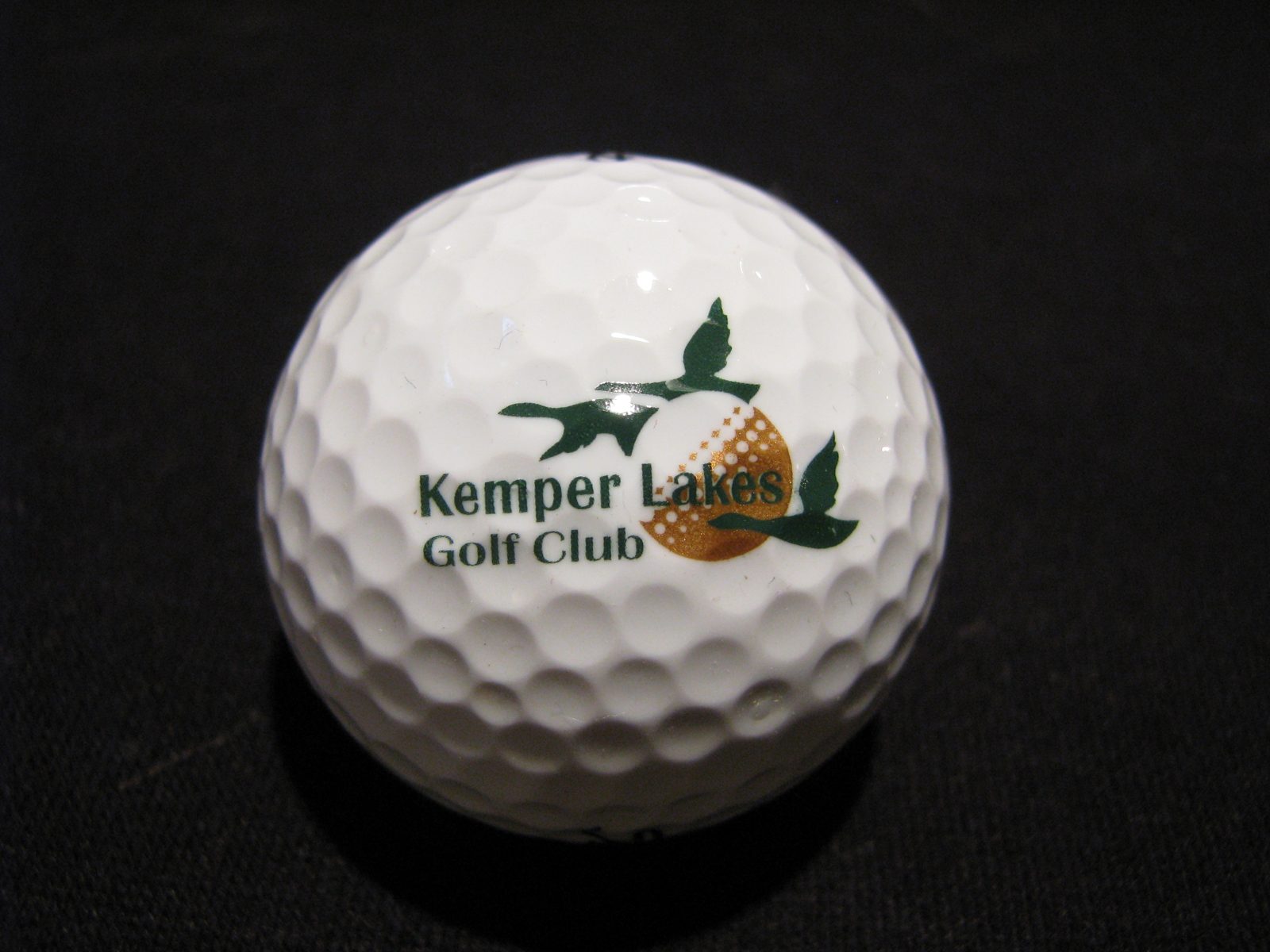
A club logo ball: two-color crest and wordmark printed on the open side of the ball, clear of the maker’s markings. Photo: Dan Perry, “Kemper Lakes Golf Club, Kildeer, Illinois,” Wikimedia Commons, CC BY 2.0 (resized). Shown as an example of a logo ball, not our work.
Most logo balls are printed on balls that are already on the USGA and R&A List of Conforming Golf Balls. The question is whether your logo changes how that ball is identified.
Golf balls are identified by their markings. The USGA’s list describes each ball type by its pole markings (the major markings, usually the brand and model name), its seam markings (the minor markings around the equator) and its cover color. The list notes that player numbers are not part of the markings, so one ball type can carry numbers in different colors and still be one listed ball.
On custom logos, the USGA’s golf ball conformance submission guidelines are specific. They say custom logos, symbols and personalized markings such as a player name or initials are permitted anywhere on the ball, provided they do not encroach on the pole or seam markings and could not be mistaken for an identification marking. The guidelines add that custom markings using golf-related phrases or terminology are discouraged, and that small lines associated with a player name or initials are permitted.
Why it matters: many high-level competitions, including USGA championships, use the List of Conforming Golf Balls as a local rule (Model Local Rule G-3), and players and officials are told to make sure the markings on a ball correspond to a listed ball. A club logo on the open side of the ball is the long-standing norm. An alignment line with words, a logo that sits on top of the model name, or a number that looks like a ball identification marking is where questions start. For tournament balls, we keep artwork in the open zone and send you a proof showing where it sits relative to the factory markings.
For outings, gifts, pro shop retail and collectors, the rule mostly matters as good practice. For a private-label ball that you plan to submit for conformance, the markings are part of the submission, so work out your logo, alignment aid and colors with the ball manufacturer and the USGA guidance before printing in volume.
The Rules of Golf set a minimum ball diameter of 1.680 inches (42.67 mm), so even the whole ball is small, and only the side facing the print heads is close enough for sharp detail. As the surface curves away, the distance from the head grows and edges soften. That is why logo balls carry a compact mark on one side. Jigs hold the balls in fixed positions so every ball prints in the same spot, and a second position can add a name or number on another side.
Ink lands on the land areas between dimples and in the dimples themselves. Bold shapes, solid fills and type at a sensible size hold up well. Hairline rules and very small text can look broken across dimple edges. We check fine detail on a sample before a run, and our textured and uneven surfaces guide explains the general limits.
Golf balls leave the factory with a painted or clear-coated cover over materials such as ionomer or urethane, and those coatings differ by brand and model. Adhesion depends on that top layer. We clean the balls, use an adhesion promoter where testing calls for it, and print a sample on the exact model before quoting a run. Our page on adhesion promoters and primers covers how that works.
Most logo balls are white, and UV inks print directly on white covers. On yellow, orange, pink or matte colored balls, an opaque white layer under the artwork keeps colors true; without it, semi-transparent ink takes on the cover color. Our white ink and underprinting guide shows the difference.
Tell us which ball you want to use (or whether you need us to source blanks), the quantity, your artwork and whether the balls are for an outing, retail, gifts or tournament play. We will confirm print area and adhesion on that ball and come back with a proof and a quote.
Request a Quote →Pad printing has long been a standard way to put logos on golf balls. UV inkjet printing is the better fit for different kinds of orders.
| Factor | Pad printing | UV inkjet printing |
|---|---|---|
| Logo or artwork | One- or two-color logo; best in very large repeat runs of the same design | Full color, gradients, photos and fine detail in one pass |
| Setup | An etched plate (cliché) and pad for each color | Digital file; no plates or screens |
| Personalization | Each name or design change needs new setup | Names, numbers or different art on every ball in the same run |
| White on colored balls | A separate white color pass | White ink printed under or with color in the same job |
| Print area | Small logo patch on the open side of the ball | Small logo patch on the open side of the ball; size depends on the jig |
| Best fit | Large, simple, single-design orders | Short runs, multicolor art, event and gift balls, personalized sets |
Neither method changes the shape problem: both print a patch on a curved surface. The deciding factors are color count, quantity and whether every ball is the same. For a detailed comparison across products, see UV printing vs pad printing.
Full-color course crests, anniversary logos, member-guest and club championship balls, and seasonal designs in short runs instead of one big order. Logo balls pair naturally with course signage and tee markers; our golf courses and country clubs page covers the rest of the property.
Company logos for a sponsored outing, a sleeve per guest with each name printed, or a co-branded ball for a client event. Personalization runs in the same job as the logo.
Event logos with the date, sponsor marks for hole sponsors, and commemorative balls for volunteers and donors. Short runs make it practical to print exactly what the field needs.
Brands building their own ball line and promotional distributors who need a print partner for full-color orders. We also offer white-label printing for resellers, and our promotional products guide covers other items for the same event.
A golf ball in play is hit by clubs at high speed, skids across greens, bounces off cart paths and trees, and picks up sand and water. Any printed logo on a ball that is used hard will eventually show wear, the same way factory markings do. How fast depends on the ball’s cover and coating, the ink and any clear coat, where the logo sits and how the ball is played.
We do not publish a wear rating for printed golf balls, because results vary too much by ball model and use. What we do is print samples on your chosen ball so you can hit them before committing to a large order. For gift and display balls that will never be struck, wear is rarely a concern.
Yes. UV inkjet printing can put full-color logos, photos and gradients on a golf ball held in a jig, and the ink cures instantly under UV light. Because the ball is a dimpled sphere, the sharp print area is a patch on one side of the ball rather than a wrap, and the exact size depends on the fixture and the printer. We confirm print area with a sample before quoting.
USGA golf ball conformance guidelines say custom logos, symbols and personalized markings such as a player name or initials are permitted anywhere on the ball, as long as they do not encroach on the pole or seam markings and could not be mistaken for an identification marking. Printing a club or company logo on the open side of a conforming ball is the normal way logo balls are made. Golf-related phrases in custom markings are discouraged by the USGA.
Pad printing transfers ink from an etched plate with a silicone pad and has long been used for one- and two-color logo balls; every color needs its own plate and pass. UV inkjet printing needs no plates, so full-color art, gradients, photos and individual names can run in the same job. Pad printing can be efficient for very large single-color runs, while UV printing usually suits short runs, multicolor art and personalization.
It depends on the ball's cover and factory coating, the ink and any clear coat, and how the ball is used. A logo on a ball that sits on a desk will last far longer than one that is hit with wedges and scuffed on cart paths. We do not publish a wear rating for golf balls; we print samples on your chosen ball model and recommend you test them on the course before a large order.
We can print on most standard white or colored balls, but covers and factory coatings differ between models, so adhesion has to be checked on the exact ball you plan to use. If you are supplying the balls, send a few extra for testing. If a ball brand's own trademarks are on the ball, your artwork should stay clear of them.
Digital UV printing has little setup compared with plate-based methods, so short runs and personalized balls are practical. Pricing still depends on quantity, fixturing, number of print positions and whether you supply the balls. Our minimum order quantities page explains how run size affects cost.
Sources: USGA, Golf Ball Conformance Submission Guidelines, “Alignment Markings and Customization” (2025 edition); USGA, Conforming Club and Ball Lists (List of Conforming Golf Balls and Model Local Rule G-3); Rules of Golf Equipment Rules, Part 4 (ball size). Checked November 13, 2026.