Wayfinding, transit, parking, park and campus signs get tagged. The question is whether the tag comes off with a wipe and a remover, or takes the print with it. This is how anti-graffiti films, clear coats and smart print builds keep UV-printed graphics cleanable.
Request a Quote →A bare UV print has no defense against spray paint or permanent marker: the solvent that dissolves the tag will usually attack the ink too. Anti-graffiti protection works by putting a layer between the vandal and the print that paint can’t bond to well and that survives graffiti removers. There are three ways to do it. An anti-graffiti overlaminate film, a hard clear polyester applied over a flat print, is the most common choice for signs. A liquid anti-graffiti coating, either sacrificial or permanent, suits surfaces a film can’t follow, such as masonry and textured panels. And a reverse print behind a clear face puts the substrate itself in the line of fire. Which one is right depends on the substrate, the ink, how often the sign will be cleaned, and who will clean it. The details below are drawn from manufacturer data sheets and the National Park Service’s guidance on graffiti, and we flag where a choice has to be proven with a test print rather than assumed.
Spray paint and paint markers are designed to stick to almost anything, and cured UV ink is no exception. Once a tag has dried, the crew trying to remove it has two tools: solvent and abrasion. Strong solvents soften or lift UV ink, and scrubbing pads or a tight pressure-washer jet erode it. Either way, the result is often a ghost of the tag sitting in a scuffed or faded patch of the original graphic. On a regulatory or wayfinding sign, that can mean replacing the panel.
Protection changes the math. Avery Dennison describes its anti-graffiti overlaminates as films that protect markings and decorations against permanent damage from graffiti paints, and says most commercially available graffiti removal fluids will take graffiti off its SL 4530 and 7110 FasFiti films without damaging them. The film takes the solvent and the scrubbing. The print underneath never sees either.
That doesn’t make a sign vandal-proof. Deep scratches, etching and stickers are separate problems, and every film and coating has a service life. What it does is turn most tags into a maintenance task instead of a reprint.
Ask About Protecting Your Signs →
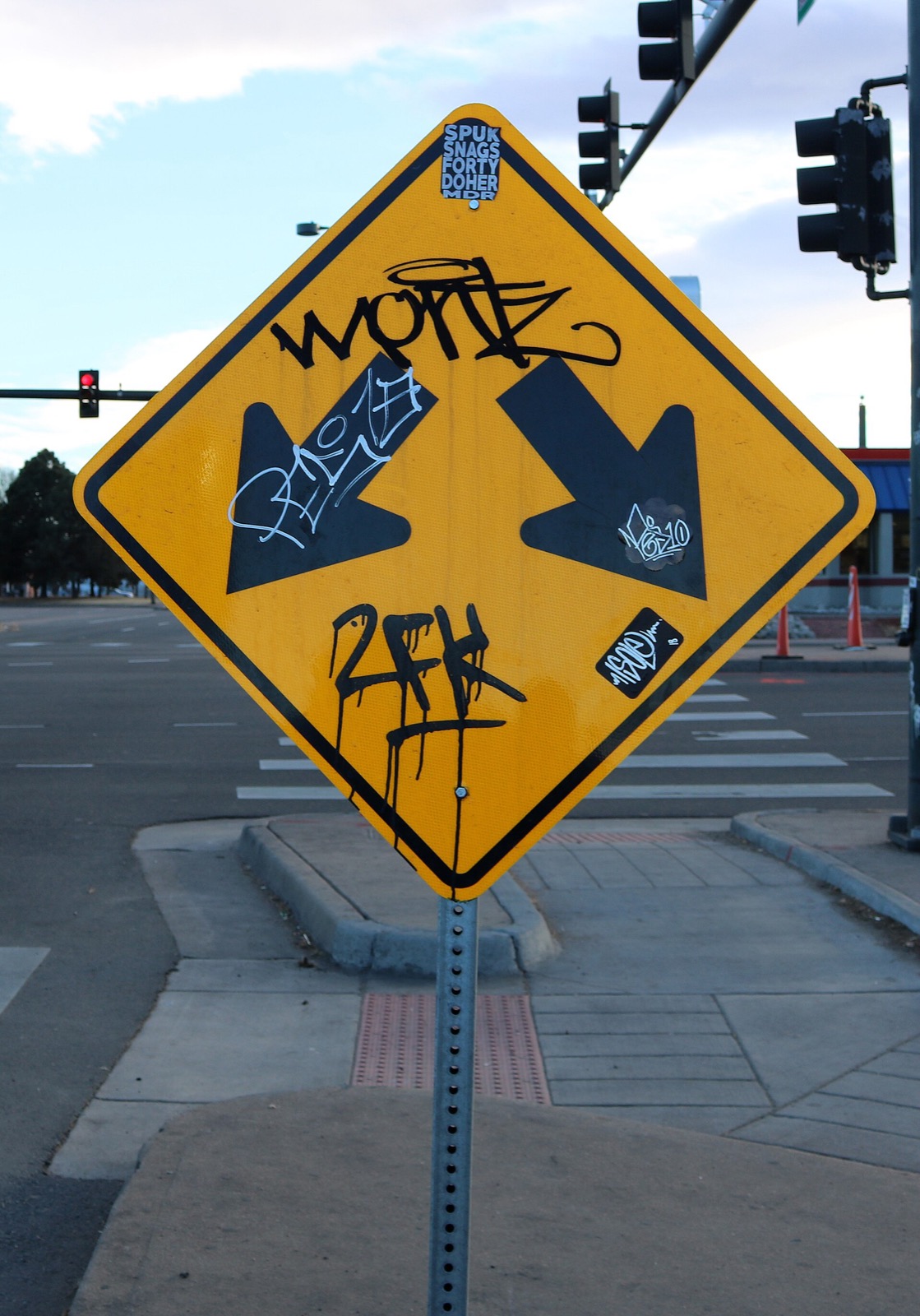
A tagged road sign in Denver, Colorado: the kind of damage anti-graffiti films and coatings are meant to make removable. Not a Polyprint project. Photo: Denverjeffrey, Wikimedia Commons, CC BY 4.0 (resized).
For flat, rigid signs and panels, a clear anti-graffiti overlaminate is the default. These are hard, thin polyester films with a permanent acrylic adhesive, applied over the finished print with a cold laminator. Here is what the published data sheets for four widely used Avery Dennison films say. Durability figures are the maker’s vertical-exposure ratings for the film; how long your graphic lasts also depends on the ink and substrate under it.
| Film | Face film | Stated outdoor durability | Notes from the data sheet |
|---|---|---|---|
| DOL 6060 Anti-Graffiti | 1 mil (25 µm) gloss clear polyester, permanent acrylic adhesive | Up to 3 years | For screen and digital graphics; flat and simple curves; service temperature -40°F to 180°F (NA data sheet) |
| DOL 4300 | 23 µm high-gloss UV-stable polyester, permanent acrylic | Up to 5 years | Lists real estate, architectural signage, buses, light rail and windows among applications |
| SL 4530 Anti Graffiti | 23 µm high-gloss polyester, permanent acrylic | 5 years | PVC-free; EN 13501-1 fire class B-s1, d0; inks must be fully dry and free of silicone additives |
| 7110 FasFiti | 23 µm high-gloss UV-stable polyester, permanent acrylic | Up to 5 years | Recommended for public transport vehicles; also cited for protection against stone chips |
Is the ink flexible enough? UV inks come in hard and flexible formulations. As we cover in our UV print durability guide, Mimaki advises against laminating its hard UV ink because lamination pressure can crack it. Anti-graffiti film is a lamination job, so the ink set has to be one that tolerates it.
Will the adhesive bond to the ink? Avery’s SL 4530 data sheet says inks should be thoroughly dry and free of silicone additives that could reduce adhesion. Some UV ink sets contain slip or flow additives for exactly the opposite reason: to make the cured surface slick. Data sheets also differ in which print processes they list as compatible, and the 7110 FasFiti conversion table doesn’t mark UV-curable inkjet among them. That doesn’t mean it can’t work. It means the combination has to be proven with a laminated test print and a peel check, not assumed.
Does the substrate outgas? Avery’s FasFiti data sheet warns that polyester films are not compatible with acrylic, polycarbonate and other substrates that tend to outgas, because the gas can’t pass through the polyester and the film bubbles or blisters. If your sign is UV printed directly on acrylic or polycarbonate and needs graffiti protection, that is a reason to look at a coating or a second-surface build instead, or to ask the film maker for a version rated for those plastics.
Tell us the substrate, size, quantity, where the signs will stand and who cleans them. We’ll recommend a protection build and run a test print before production.
Films need a flat or gently curved surface. Murals on block or brick, textured panels and three-dimensional pieces need a coating instead, and coatings come in two families.
The National Park Service’s Preservation Brief 38, Removing Graffiti from Historic Masonry, lays out the distinction clearly. Sacrificial coatings come off when the graffiti is removed and must then be reapplied. Permanent transparent barrier coatings are more resistant to the water or solvents used for removal and stay on the surface. The brief also describes two-part systems: a water-based acrylic sealer first, then a sacrificial wax layer that dissolves and leaves with the graffiti. Even the base coat in that system wears off after many cleanings and has to be renewed.
For a UV-printed mural on masonry, that translates into a practical choice:
The same compatibility rule applies as with films: the coating has to bond to the cured ink without softening it. Mimaki’s guidance, cited in our durability guide, warns that a solvent spray overcoat can soften cured flexible UV ink so that it comes off the substrate. Ask the coating maker whether a product is approved over UV-cured ink, and test it on a printed sample of the same substrate before coating a finished wall. Our brick and masonry printing guide covers the print side of those jobs.
On historic masonry, Preservation Brief 38 is cautious about barrier coatings in general because they can change the appearance of the masonry and trap moisture. If the wall is historic, involve whoever has jurisdiction before coating it.
Sometimes the cheapest protection is a print build that keeps ink off the outer face entirely.
Second-surface printing on glass. Printing in reverse on the back of a glass panel, then mounting it with the printed side facing the wall, puts a hard, solvent-resistant face toward the public. Paint can be scraped or dissolved off glass with little risk to the print behind it. Our glass printing guide covers the build.
Reverse-printed acrylic, with care. The same idea works on acrylic, but acrylic is far less tolerant of solvents than glass, and aggressive graffiti removers can craze or cloud it. If acrylic is the face, specify the remover the maintenance crew will use and test it on an offcut first.
Replaceable faces. For signs in places that get hit constantly, a frame with a removable printed insert can be cheaper over a few years than any coating. Reprinting one insert from saved artwork is a quick job with UV printing because there are no screens or plates to remake.
Matte versus gloss. All four films in the table above are high-gloss. Gloss is easier to clean, but it reflects light, which can hurt legibility on wayfinding and is a consideration for ADA signage, where non-glare finishes are part of the standard. Ask about matte anti-graffiti options when glare matters.
If you manage a fleet of signs, write the cleaning method into the spec you send the printer. Protection that isn’t matched to the crew’s remover and equipment doesn’t protect much.
Graffiti protection earns its cost where signs are public, low-traffic at night and expensive to replace. That typically means outdoor wayfinding systems, parking garages, transit shelters and stations, park and trail signage, playgrounds, school and campus exteriors, utility enclosures and dumpster screens, and the back sides of monument signs. Indoors, restrooms, stairwells and elevator lobbies in public buildings get hit with markers more than spray paint, and the same films apply.
Where a sign is in a protected, staffed lobby, it usually doesn’t need anti-graffiti film. A standard protective laminate or clear coat for abrasion and UV is enough, and it costs less.
Yes. The usual method is a clear anti-graffiti overlaminate film over the print, such as Avery Dennison’s DOL 4300, SL 4530 or 7110 FasFiti, which are designed so graffiti can be removed with commercial removers without damaging the film. Liquid sacrificial or permanent coatings and second-surface prints behind glass are the other options.
Per the National Park Service’s Preservation Brief 38, a sacrificial coating comes off with the graffiti and has to be reapplied after each cleaning, while a permanent barrier coating resists the removal solvents and stays on the surface. Two-part systems combine a sealer base coat with a sacrificial top layer.
Avery Dennison rates DOL 6060 at up to 3 years and DOL 4300, SL 4530 and 7110 FasFiti at up to 5 years of vertical outdoor exposure. Those are film ratings; the life of the finished sign also depends on the ink, substrate, sun exposure and how often it is cleaned.
Be careful. Avery’s FasFiti data sheet warns that polyester films are not compatible with acrylic, polycarbonate and other substrates that outgas, because bubbling or blistering can occur. For acrylic, a reverse print with a tested remover, a coating approved for the plastic, or a film the maker rates for acrylic are safer routes.
Yes, it adds material and a lamination or coating step. We don’t publish a per-sign price because it depends on the substrate, size, quantity and protection build. Send the details above and we will quote the actual job, and tell you if a standard laminate is enough.
Sources: Avery Dennison product data sheets for DOL 6060 Anti-Graffiti (NA, rev. 6), DOL 4300, SL 4530 Anti Graffiti (09/2024) and 7110 FasFiti Gloss (rev. 5); National Park Service, Preservation Brief 38, “Removing Graffiti from Historic Masonry”; Mimaki guidance as summarized in our UV print durability guide. Checked October 30, 2026. Product names are trademarks of their owners; Polyprint is not affiliated with Avery Dennison.
Send the substrate, sizes, quantity, location and cleaning method. We will recommend a protection build, proof it on your material, and quote the job.