UV ink bonds well to brick, CMU block, and cast masonry — but the piece has to come to the press. Here's what's actually printable, and what to order instead when the ask is a wall that's already standing.
Request a Quote →Yes, individual brick, block, and paver units take a direct UV print the same way stone or concrete does — dense enough to hold ink, textured enough to need a bit more care in setup. What changes the job isn't the material's printability, it's that a flatbed press can only print what fits on its bed. That means printed brick and masonry is almost always units printed before installation, not a logo applied to a wall that's already built.
A flatbed UV press prints one piece at a time under a fixed-height gantry — the material sits still on the bed while the printhead moves over it. That works fine for a brick, a CMU block, or a masonry paver delivered to the shop. It doesn't work for a wall that's already mortared into place, no matter how flat or accessible it is, because the wall can't sit on a press bed. Most requests for "printed brick" turn out to mean one of two real jobs: pre-printed units installed during a build or renovation, or a printed panel mounted onto or beside existing masonry.
If the goal is a branded feature wall and the masonry is already built, a composite or aluminum panel is usually the faster, cleaner route — see our UV printing on composite panels guide. If the goal is building-scale coverage that has to look continuous, that's a tiling job regardless of substrate; our large-format tiling and murals guide covers how a single design gets split across panels sized to what the press can actually handle.
Ask About Your Project →
Masonry behaves differently from a factory-milled panel — three things to plan for before a run, not after.
Efflorescence is mineral salt — usually calcium carbonate — that migrates to a masonry surface as moisture moves through the material and crystallizes when the water evaporates. It's the white, chalky bloom you see on older brick and block. If that migration keeps happening under a cured ink film, the salt crystallizing beneath the print can blister or delaminate it from underneath, sometimes months after installation, not on day one. New units need to fully cure and dry before printing; porous or previously wet units generally need a masonry sealer or moisture-block primer first.
Brick and unsealed CMU are more porous than stone, concrete, or fiber cement, which means ink can soak in unevenly across a single face if the surface isn't sealed consistently first. A sealer coat doesn't just block moisture — it also gives the ink a uniform surface to bond to, which is what keeps color consistent unit to unit across a batch.
Brick face varies unit to unit — sand texture, minor warping, the occasional chipped corner — and a flatbed printhead holds a fixed clearance above the bed. Deep low spots can print thin or miss ink entirely, the same limitation covered in general in our textured and uneven surfaces guide. Brick sits toward the higher-variance end of what we'll test on a sample before committing to a production run, rather than assume it'll behave like a smoother stone or tile.
What actually determines whether printed brick or masonry is the right call for a project.
Individual brick, block, or paver units printed before install — never a wall already built.
New units need to fully dry; porous units generally need a sealer before ink goes on.
Face variation and printhead clearance interact — a sample run catches problems early.
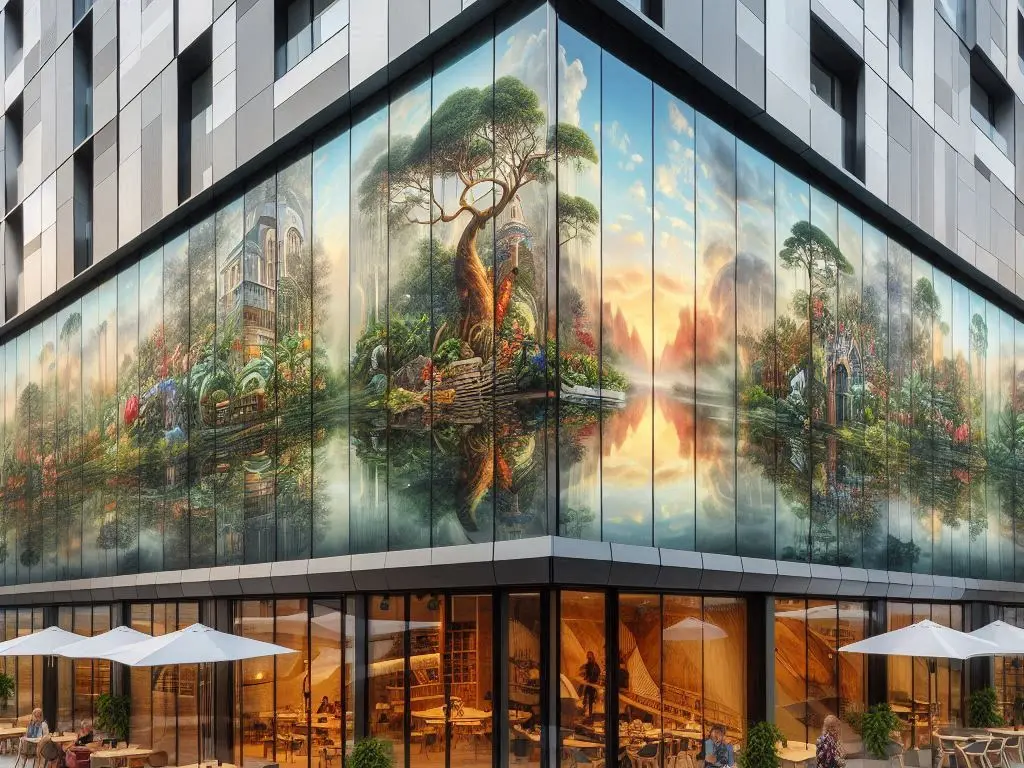
Full facades and feature walls usually mean a tiled panel system, not printed brick alone.
Yes, onto individual brick units, CMU block, or cast masonry pavers brought to us before installation — not onto a wall that's already built. The units get printed first, the same way you'd order any other pre-finished masonry product, then installed as part of the build.
It can if the masonry isn't sealed and dried down first. Efflorescence is mineral salt that migrates to the surface as moisture moves through it — if that keeps happening under a cured ink film, the crystallizing salt can blister the print from underneath. New units need to cure and dry fully, and porous units generally need a moisture-block primer or sealer before printing.
No — a flatbed UV press can't print a wall that's already standing. The workable alternative is a printed composite or aluminum panel mounted onto or beside the wall, or replacing select courses with pre-printed units during a renovation.
It's a bigger factor than on a factory-flat substrate. Face variation and chips can print thin in low spots because the printhead holds a fixed clearance above the bed. We test a sample from the actual batch before committing to a full run rather than assume uniform results.
Branded accent walls for restaurant and retail build-outs, developer feature walls, custom hardscape pavers, and small decorative runs — a specialty design order, not a structural building material. Request a quote here and send sample units or photos of the actual masonry.
Send us photos or sample units of the actual brick or block, whether it's new or existing stock, and where it'll be installed. We'll confirm whether direct-printed units or a panel alternative fits the project.