Menu boards, entrance signage, and bay wall graphics built for constant water, detergent spray, and sun — printed on aluminum composite panel, not the wash tunnel or equipment itself.
Request a Quote →On the building and the signage around it — not the tunnel equipment. Menu and pricing boards, entrance arch and monument signage, lane and directional signage, and interior bay wall graphics all take a direct UV print on aluminum composite panel with the same scratch-resistant, weatherable coating used across every Polyprint application. Printing on the wash arches, brushes, or tunnel mechanicals themselves isn't something a flatbed UV printer is built for — that's sourced equipment, not signage substrate. Knowing which category a piece falls into before quoting keeps the two from getting mixed into one order.
Menu and pricing boards at the pay station or entry lane are the highest-visibility, most frequently updated signage on the property — every customer reads them before deciding what wash package to buy. Entrance arch and monument signage do the branding work from the street, while lane-control and directional signage keep traffic moving through self-pay stations, vacuum areas, and the tunnel queue without confusion.
Inside the building, bay wall graphics, membership and loyalty program signage, and waiting-area branding see less weather exposure but just as much daily foot traffic. The durability logic is the same one covered in our auto dealership guide — permanent branding on a fixed panel, with anything tied to pricing or a promotional cycle built to swap out separately. Gas stations and convenience stores next door run an even harder version of the same exposure problem — see our UV printing for gas stations and convenience stores guide for how canopy fascia and pump toppers hold up against fuel vapor and exhaust film on top of the sun and water a car wash already deals with. Mobile operators without a fixed building — food trucks parked in the same retail lots — face a version of this on a much smaller, transportable footprint; see our UV printing for food trucks and mobile vendors guide for why the flat menu board prints directly while the curved truck body doesn't.
Talk Through Your Car Wash Project →
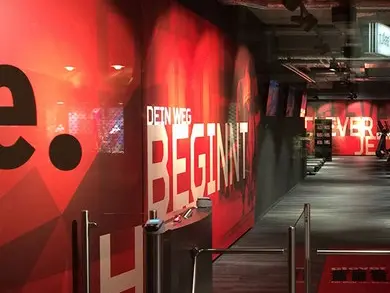
A car wash is one of the harder outdoor signage environments to get right — not because of any one extreme condition, but because it stacks several at once. Entry lane and monument signage sit in direct sun all day, detergent and spot-free rinse overspray drifts well past the tunnel entrance, and the whole site runs at higher ambient humidity than a typical retail lot simply because water is the product. None of that is unusual on its own; the combination is what wears out the wrong substrate faster than buyers expect.
Aluminum composite panel (ACM) is the standard recommendation for exterior car wash signage for the same reason it's used across most commercial outdoor signage — it resists the corrosion that raw or mild steel is prone to in a consistently wet environment, holds a flat rigid shape that a UV-printed graphic needs, and takes a protective clearcoat well. Panel signage finished with a UV-resistant coating and lamination is commonly rated for somewhere in the five-to-seven-year range of outdoor service life before fading becomes a real concern — a reasonable planning number for a site that's outdoors and exposed to spray every day it's open.
Our own UV coating is tested to show no observable surface change after 3000 hours of accelerated UV weathering — the relevant spec for the printed graphic itself on exterior menu boards and monument signs. That number is about the print finish, not the panel's chemical resistance to detergent overspray, which is why panel grade and edge sealing are worth specifying as carefully as the artwork before anything goes to press.
Standard indoor-grade panel used outdoors. The most common failure isn't the print — it's specifying a panel or coating meant for interior retail use on a site that sees daily water and chemical exposure. Confirming aluminum composite panel with a weatherable coating before production, not after installation, is the fix.
Permanent print on a pricing board. Wash package pricing and seasonal promotions change often enough that printing them as if they were permanent branding means paying to reprint the whole fixture every time a price moves. A frame or insert system for the pricing portion solves this the same way it does at an auto dealership or retail storefront.
Underestimating overspray range. Detergent mist and rinse overspray travel further from the tunnel entrance than most site plans account for, especially on windy days. Signage positioned just outside what looks like the "wet zone" on a floor plan can still take regular chemical contact — worth flagging honestly when siting a new panel rather than discovering it after the finish starts to dull.
Send us your site plan and we'll flag which panels sit in heavier exposure zones before pricing the job.
The car wash industry has consolidated fast over the past several years, with regional and national chains acquiring independent sites and rolling them under a single brand — which means a big share of the signage work in this category isn't a single new build, it's a rebrand across a portfolio of existing locations that all need to hit the same color, layout, and pricing-board standard on a rollout schedule. That's a different logistics problem than one storefront: file-on-record color matching, batching production by region, and coordinating install dates around each site's operating hours so a wash doesn't have to close a lane mid-install.
New builds run the opposite direction but hit the same coordination point — a developer or operator finalizing a site plan needs monument sign, menu board, and interior branding specs locked well before the building opens, since exterior signage typically has to clear a local permitting and zoning review that can take longer than the print production itself. Getting artwork and substrate specs finalized early, even before the building shell is complete, keeps the signage from becoming the last thing holding up a grand opening date.
Either way, the underlying production doesn't change — an aluminum composite panel and a documented color file are what let a tenth location seven states away look identical to the flagship, which is the whole point of standing up a repeatable signage spec instead of quoting each new site from scratch. Tell us how many sites you're planning across and we'll set up a process that scales with the rollout rather than starting over each time.
Car wash signage is finished under the same lab-tested performance benchmark used across every application.
EN ISO 16474-3 Atlas UV Test — the relevant spec for exterior menu boards and monument signs.
EN 15184 pencil hardness test — relevant to signage cleaned or wiped down regularly.
EN 438-2 ball impact testing — relevant to signage in a high-traffic vehicle environment.
Standard recommendation for exterior signage exposed to water and chemical spray.
Menu and pricing boards, entrance arch and monument signage, lane and directional signage, bay wall graphics, and membership signage — all mounted to a fixed structure, not the wash equipment itself.
Aluminum composite panel (ACM) is the standard recommendation — it resists corrosion, holds a flat rigid shape, and pairs well with a protective clearcoat. Panels finished this way are commonly rated for five to seven years of outdoor service life.
No — that's outside what a flatbed UV printer is built for. Wash arches, brushes, and tunnel mechanicals are sourced equipment, not printable signage substrate. Our work is the building, monument sign, and interior branding around it.
Permanent branding goes down as a fixed UV print; pricing and wash-package tiers live on a swappable insert or frame within the same panel system, since prices change too often to reprint the whole fixture each time.
Yes — the same color-matching and file-on-record process used for any multi-location client keeps monument signs, menu boards, and bay graphics matching across sites. Request a quote here.
Send us your site plan, brand guideline, and current signage photos. We'll confirm substrate, exposure zones, and pricing before it goes to press.