Showroom glass, service bay walls, and finance office panels built for daily foot traffic and OEM brand standards — not the format for a model-year price sign that changes every quarter.
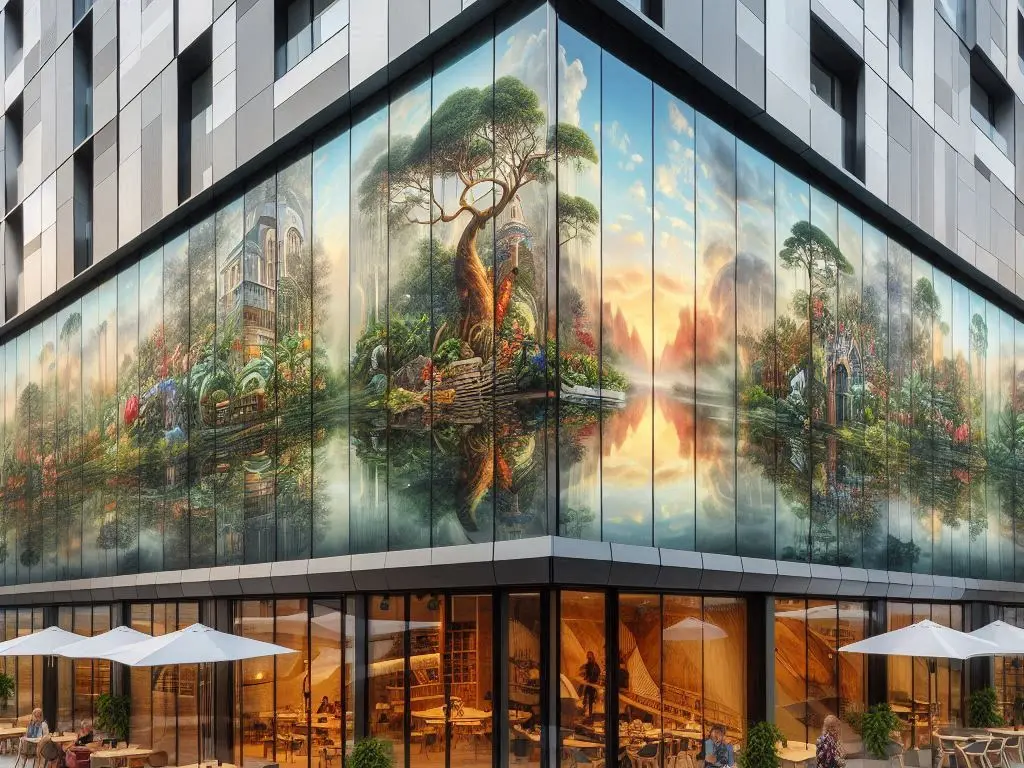
Request a Quote →On the building, not the inventory. Showroom glass, storefront windows, service bay walls, and finance office panels all take a direct UV print with the same scratch-resistant coating used across every Polyprint application — built for the daily foot traffic a busy sales floor and service drive see. It's a separate job from printing on vehicle parts, trim, or accessories, which carries its own structural and safety-certification constraints. Knowing which category a piece falls into before quoting keeps the two from getting mixed into one order.
Showroom glass and storefront windows are the highest-visibility order — see our UV printing on glass guide for how first-surface versus second-surface printing applies to a storefront that gets cleaned daily. Service bay wall panels and finance office branding see just as much daily contact as the sales floor, just less of the design budget.
Point-of-sale fixtures, vehicle feature callouts, and financing promotion displays on the sales floor follow the same durability logic covered in our retail displays and POP guide — permanent branding on a fixed panel, rotating offers on a swappable insert.
Talk Through Your Dealership →
Franchised dealerships don't set their own showroom branding rules — the manufacturer does, down to specific colors, proportions, and placement, and dealer groups are expected to hold to that standard across every rooftop carrying the brand. That's a stricter requirement than most retail branding work, and it's exactly what a documented color-matching process is built to hold: a showroom graphic ordered in year one should still match the OEM reference when a second location opens two years later, not drift because the file got recreated from a photo instead of the original spec.
The other recurring mismatch is treating a promotional sign like permanent branding. Showroom identity and wayfinding are fixed; a model-year price sign or a manufacturer incentive banner is not, and printing it as if it were permanent means paying to replace it every time pricing changes. A frame or insert system for anything on a pricing cycle keeps the fixture reusable while the message underneath it changes as often as it needs to.
Send us your OEM brand guideline and floor plan, and we'll come back with what's feasible per surface and pricing.
Boat dealerships run through the same showroom-glass-and-finance-office logic, with one added variable: an outdoor lot and dock display area exposed to coastal salt air. Our UV printing for marinas and boat dealers guide covers the marine-grade substrate question that adds to a dealership project once it's on the water.
Dealerships aren't the only automotive-adjacent business working through this same fixed-branding-versus-swappable-pricing question. Car washes attached to or near a dealership's service drive — a common pairing on larger auto retail corridors — run the same split: monument signs, entrance branding, and interior bay wall graphics as permanent UV-printed panels, with wash-package pricing and seasonal promotions kept on a swappable insert rather than a fixed print. See our UV printing for car washes guide for how that plays out, including why aluminum composite panel is the standard substrate call for that level of daily water and detergent exposure.
Quick-lube and tire service centers near a dealership's service department face the same outdoor signage conditions as the dealership lot itself — direct sun, daily traffic, and the same OEM-adjacent brand consistency question for multi-location chains. The substrate and mounting guidance covered above for a dealership's exterior signage applies just as directly to a standalone service center down the street.
Gas stations and convenience stores on the same auto retail corridor face a version of this pattern too, with a harder exposure environment — canopy fascia and pump toppers see overhead sun with no shade cycle plus fuel vapor and exhaust film that a dealership showroom never sees. See our UV printing for gas stations and convenience stores guide for how that changes the substrate and coating spec.
Showroom and service area panels are finished under the same lab-tested performance benchmark used across every application.
EN 15184 pencil hardness test — relevant to service bay and daily-traffic contact.
EN 438-2 ball impact testing — maximum machine rating with no visible damage.
DIN EN 14354 Taber Abraser — achieved classification 31 in tested conditions.
EN ISO 16474-3 Atlas UV Test — the relevant spec for storefront glass and exterior signage.
Showroom glass and storefront windows, service bay wall panels, finance office branding, and sales floor point-of-sale fixtures. It's all interior or storefront branding printed onto glass, metal, or panel material — separate from printing on vehicles or parts.
No. Dealership branding is interior and storefront printing on glass, panel, and metal. Vehicle trim and accessory printing is a separate application with its own structural and safety-certification constraints — see our UV printing on automotive parts guide.
Yes — franchised dealerships operate under OEM-mandated color, proportion, and placement standards, and a documented color-matching process keeps a showroom graphic on-spec across a multi-rooftop group. Send us the brand guideline and we'll match to it.
No — pricing and seasonal promotions change too often for a permanent panel. A printed frame or insert system holds the same production quality while letting the message change without reprinting the fixture.
Yes — the same color-matching and file-on-record process used for any multi-location client keeps showroom, service, and finance office graphics matching from the flagship store to a new rooftop.
Largely, yes — the same fixed-branding-versus-swappable-pricing split and aluminum composite substrate call applies. See our UV printing for car washes guide. Request a quote here.
Send us your OEM brand guideline and floor plan. We'll come back with what's feasible per surface and pricing.