Home Sports Surfaces Testing About Request a Quote
Application

UV Printing for Donor Walls & Donor Recognition Displays

Full-color donor walls, capital-campaign displays and recognition panels for hospitals, schools, churches, museums and nonprofits. Printed directly on acrylic, metal, glass and solid surfaces, and built so new names can be added without rebuilding the wall.

Request a Quote →
The Short Answer

UV Printing Puts Color, Logos and Names on the Same Panel

Most donor walls used to come down to two choices: engraved or cast lettering that looks permanent but is slow and costly to update, or vinyl lettering that is quick but can peel and look temporary up close. Direct UV printing sits between them. The ink is jetted onto the actual panel, whether that is acrylic, brushed aluminum, glass, composite or a solid surface, and cured instantly by UV light. That lets one panel carry a full-color campaign image, your logo in its exact brand colors, and hundreds of donor names in sharp small type. White ink and clear layers allow printing behind clear acrylic or glass, adding raised or gloss accents, and matching individual nameplates added years later. It is not the right answer for every wall. Some institutions want the weight of cast bronze or the look of deep engraving, and we will say so. But for walls that need color, imagery or regular updates, UV printing is usually the most flexible way to build them.

How It Works

A Donor Wall Is a System, Not a Single Sign

A typical donor wall has three layers. There is a background or feature panel with the campaign name, a story or image, and the organization’s branding. There are donor names, usually grouped by giving level. And there is a mounting system that holds it all on the wall, such as standoffs, rails, magnetic backers, or panels fixed directly to the wall. UV printing can produce the first two layers on most of the materials donor walls use.

On clear acrylic or glass, the most durable approach is second-surface printing. The image is printed in reverse on the back face, followed by a white or color backing layer, so the viewer reads it through the clear material. The ink sits behind the panel and can’t be scratched from the front. On metal, solid surface or opaque acrylic, the print goes on the face, and a clear layer can be added for gloss contrast or a raised feel on names and logos.

Because the same files and color settings can be reused, a nameplate printed for next year’s donors can be produced to match this year’s wall. That is often the biggest practical difference from hand-finished methods.

Full-color imagery, logos and donor names on one panel
Second-surface printing behind clear acrylic or glass
White ink underprint for color on metal, dark or clear materials
Clear and raised layers for gloss or texture accents
Repeatable files for matching add-on nameplates
Ask About Your Donor Wall →
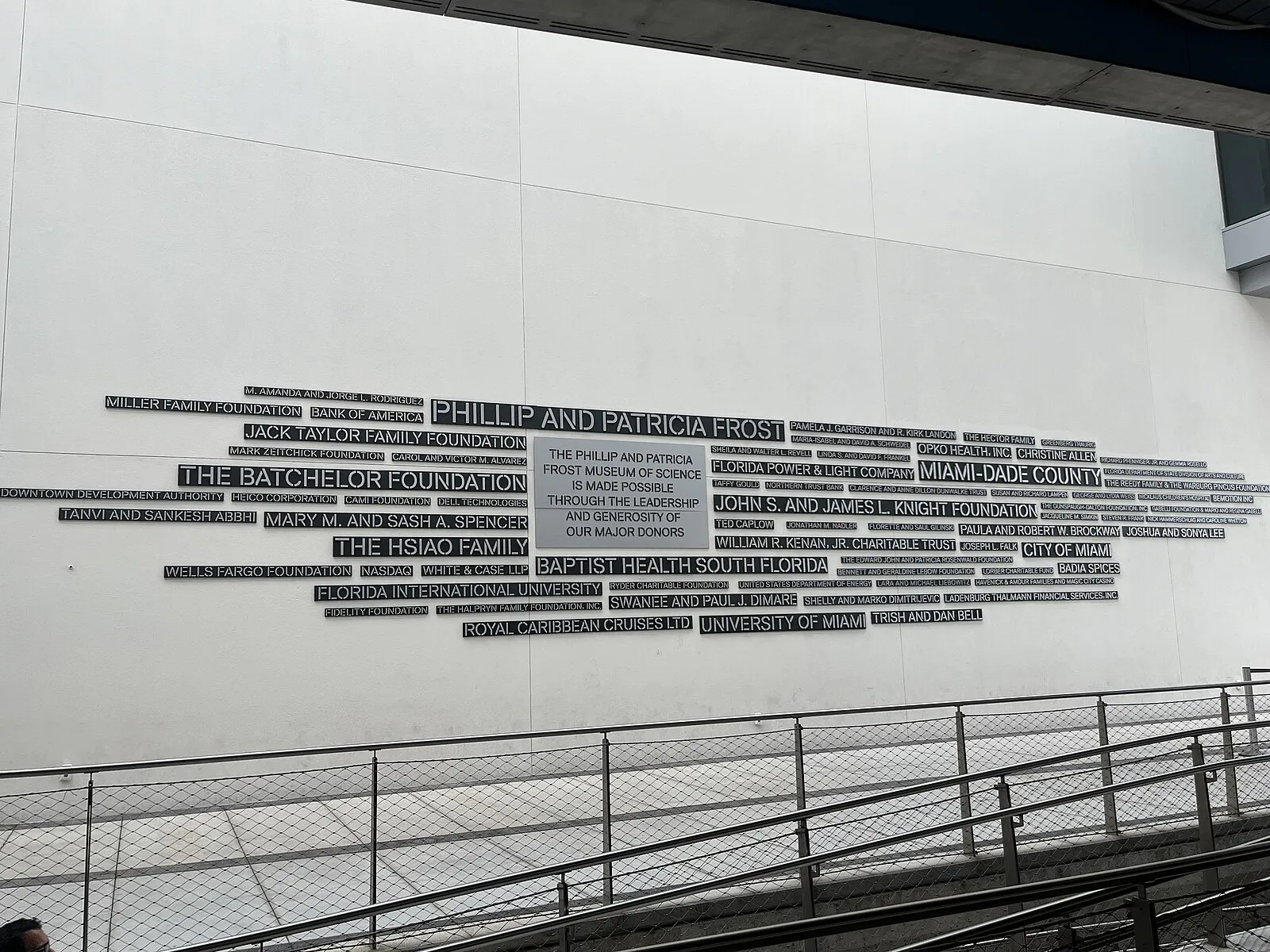
Major donor recognition wall with dark name panels in a museum entrance

Example of a modular donor wall at the Phillip and Patricia Frost Museum of Science, Miami. Not a Polyprint project. Photo: Wikimedia Commons, CC0.

Material Comparison

Choosing a Donor Wall Material

The material sets the look and the lifespan. UV printing works on all of these, but in different ways.

Material How UV printing is used Good for Watch out for
Clear cast acrylic Second-surface print with a white or color backer, often mounted on standoffs Layered, modern walls; color and photos; backlit or edge-lit pieces Use cast rather than extruded sheet for clarity and edge quality; fingerprints show on gloss faces
Brushed aluminum or aluminum composite Face print with selective white so the brushed metal shows through unprinted areas Clean institutional look in hospitals and campuses; nameplates on rails or magnets Metal needs the right pretreatment for adhesion; plan how cut edges are finished
Tempered glass Second-surface print on the back face High-end lobbies and galleries Heavy, so it needs proper structural mounting; glass must be tempered before printing, not after
Solid surface, stone or wood Face print, sometimes combined with engraving Warm or traditional settings: churches, libraries, memorial walls Natural grain and texture show through the print; sample on the real material
Cast bronze or deep engraving (no print) Not a UV job Legacy and memorial walls where permanence is the point Slower and costlier to add names; limited color

When Acrylic or Glass Makes Sense

If the wall carries a campaign photo, a timeline, or a lot of color, clear acrylic or glass printed from behind gives a deep, finished look and protects the ink. Our UV printing on acrylic page covers sheet choices and edge finishing, and UV printing on glass covers adhesion and tempered-glass handling.

When Metal Makes Sense

Brushed aluminum nameplates read as permanent and professional, wipe clean, and are light enough to slide into rails or attach with magnets. Leaving the metal unprinted in places and printing names in a dark ink or white gives a look close to etched metal at a fraction of the effort. See UV printing on aluminum for finishes and pretreatment.

Planning a Capital Campaign Wall?

Send the wall size, a photo of the space, your rough donor counts by level, and how often names will change. We will suggest materials and a layout that can grow with the campaign.

Built to Grow

Designing a Donor Wall You Can Update

The most common regret with a donor wall is building one that can’t take new names. Campaigns run for years, donors move up a level, and families ask for a name to be changed. Plan for that on day one.

Separate the permanent from the changeable

Print the campaign story, imagery and branding on a large feature panel that won’t change. Put donor names on individual plates or strips that attach to it or sit beside it. Then an update means printing a few new plates, not replacing the whole wall.

Pick a mounting system that matches how often names change

Donor wall fabricators commonly use rail systems, where plates slide in and out, magnetic backers, and standoff-mounted plates. A wall updated every quarter wants rails or magnets. A wall closed out after a finished campaign can be fixed permanently. We print the plates and panels and can work with the mounting system your installer or sign partner prefers.

Leave room, and decide what the empty space looks like

Reserve space in every giving level for future names. Some organizations fill it with blank plates in the same finish, others with a printed pattern or a line inviting future gifts. Either way, decide before the first install so the wall doesn’t look unfinished.

Keep the master files and color settings

An add-on plate should match the original. That means keeping the layout template, fonts, ink settings and material from the first run, and reordering on the same substrate. Our color consistency guide explains how repeat runs are matched, and the reorder process page covers what we keep on file.

Getting the Names Right

The Content Work Behind a Donor Wall

Giving levels and hierarchy. Decide how levels will be shown: bigger type, a different material, a separate panel, or position on the wall. Keep the number of levels manageable. Six levels in six type sizes on one panel gets hard to read.

Name formatting rules. Agree on how couples, families, foundations, companies and memorial gifts appear (“in memory of” or “in honor of”), and how anonymous gifts are shown. Write these down so next year’s plates follow the same style.

Proofing. A misspelled donor name is the most expensive typo in signage. Have the development office approve the final name list from the actual print proof, not from a spreadsheet, and have someone outside the project read it once more. Supply names as text, never retyped from a PDF.

Readability. Names are read from a few feet away, often under lobby lighting that throws glare. Matte finishes cut reflections. Contrast between ink and material matters more than font choice. A sample plate held on the actual wall under the actual lights is worth requesting.

Accessibility. A donor wall is usually treated as informational display rather than a sign identifying a permanent room. A naming sign at the entrance to a room, such as “The Smith Family Conference Room,” can fall under room-identification sign rules, with raised characters and braille. Check those with your architect or code consultant. Our ADA signage page explains what UV printing can and can’t do for tactile signs.

Tested Durability

The Polyprint Benchmarks, and What They Mean for a Donor Wall

These are the independently tested results behind Polyprint surfaces, measured on rigid test panels in lab conditions. Results on a specific donor wall depend on the material and whether the print is on the face or behind clear acrylic or glass. Full data is on the testing page.

☀️

UV Weathering

No Change at 3000h

EN ISO 16474-3 Atlas UV Test — zero surface change after 3000 hours of exposure.

✏️

Scratch Resistance

6H Pencil

EN 15184 pencil hardness test — rated 6H on rigid substrates, the highest standard for coating hardness.

💥

Impact Resistance

>60N

EN 438-2 ball impact testing — maximum machine rating with no visible damage on rigid panels.

🔬

Wear Resistance

Class 31

DIN EN 14354 Taber Abraser — achieved classification 31 in tested conditions.

View Full Testing Data →
Where It Gets Used

Donor Recognition Projects by Sector

Each setting asks for something a little different from the wall.

Hospitals and healthcare foundations. Lobby walls for building campaigns, plus named rooms and wings. Surfaces that wipe clean with hospital disinfectants matter here, so test the printed sample with the facility’s products. See UV printing for medical and healthcare facilities.

Universities and schools. Capital campaign walls, athletics booster walls, scholarship recognition and class gift displays. Often updated every year, so modular plates are the norm.

Churches and houses of worship. Building-fund and memorial walls, often in warmer materials. Our churches and houses of worship page covers the wider set of projects.

Museums, arts centers and libraries. Members and founders walls that need to sit comfortably next to the collection. Image-led acrylic or glass panels are common.

Parks, fields and community facilities. Outdoor or semi-outdoor recognition at playgrounds, sports complexes and park pavilions, where weather and UV exposure decide the material. Outdoor walls need a material and ink spec chosen for exterior use, not just an indoor panel moved outside.

Quoting

What We Need to Quote a Donor Wall

Send the wall dimensions and a photo, whether it is indoors or outdoors, the materials you are considering, approximate donor counts at each giving level, how often names will be added, and your artwork status. If you already have a designer or a sign company handling installation, tell us. We can print panels and plates for another fabricator to mount, as described on our white-label printing page.

Pricing depends on material, panel count and size, ink layers, and whether the print is on the face or behind clear acrylic or glass, so we don’t publish a per-square-foot price. We quote the actual wall. For art files, our file prep requirements page covers resolution, color mode and white-ink layers.

FAQ

Donor Wall Printing — Common Questions

Can you UV print a donor wall?

Yes. UV printing jets ink directly onto acrylic, aluminum, glass, composite panels and solid surfaces and cures it instantly, so one panel can carry full-color campaign imagery, logos and donor names. On clear acrylic or glass the print is usually applied to the back face with a white backer, which protects it from scratches.

What is the best material for a donor wall?

It depends on the look and how often names change. Clear cast acrylic printed from behind suits colorful, layered walls. Brushed aluminum nameplates suit clean institutional spaces and update easily on rails or magnets. Tempered glass suits high-end lobbies but is heavy. Cast bronze or deep engraving suits permanent memorial walls but is slower and costlier to update.

How do you add new donor names later?

Design the wall with a permanent feature panel and separate name plates on a rail, magnetic or standoff system, reserve space in each giving level, and keep the original files, fonts, ink settings and material on record. New plates are then printed to match and added without rebuilding the wall.

Do donor walls need to meet ADA signage rules?

A donor wall is usually treated as an informational display rather than a sign identifying a permanent room. A naming sign at a room entrance can fall under room-identification sign rules with raised characters and braille. Confirm requirements with your architect or code consultant.

How much does a UV-printed donor wall cost?

It depends on material, panel count and size, ink layers, and whether printing is on the face or behind clear acrylic or glass. We don’t publish a per-square-foot price. Send the wall size, a photo, materials, donor counts and update frequency and we will quote the actual project.

Will you print panels for our sign company or designer to install?

Yes. We can print panels and nameplates for another sign company, designer or installer to mount, working to their layout and mounting system.

Explore More Surfaces

Related Applications

Have a Donor Wall Project?

Send the wall size, photos, indoor or outdoor location, materials you are considering, donor counts by level and how often names will change. We will come back with a material and layout recommendation and a quote, or tell you plainly if engraving or cast metal fits better.