Home Sports Surfaces Testing About Request a Quote
Buying Guide

UV Printing for
Medical & Healthcare Facilities.

Durable, full-color graphics for hospital and clinic wayfinding, waiting areas, and interior panels — surfaces that get wiped down with hospital-grade disinfectant far more often than a typical commercial interior.

Request a Quote →
The Short Answer

Does UV Printing Hold Up in a Clinical Environment?

For wayfinding, reception, and interior branding surfaces, yes — as long as the coating is specified for the cleaning regimen the facility actually runs. Hospital workflows lean on frequent isopropyl alcohol and other aggressive disinfectant wipe-downs, which is a tougher daily chemical load than most retail or office interiors ever see, and a standard clearcoat picked without that in mind can wear faster than expected. Where the conversation changes is anything playing a direct clinical role — a device housing, a surface inside a sterile field — which needs its own biocompatibility review and isn't a general interior-printing decision.

Where It Shows Up

The Surfaces Health Systems Actually Order

Corridor and department wayfinding is the most common request — directional graphics, department icons, and floor-level signage printed onto rigid panel with the same approach covered in our signage and wayfinding guide, adapted to a healthcare campus instead of a retail or office building. Waiting rooms and reception areas follow close behind, usually a feature wall or accent panel meant to soften a clinical space without adding anything hard to clean.

Exam room accent panels, donor recognition walls, and campaign or capital-project signage round out most orders. None of it changes the print process — it changes what coating gets specified and how far the surface sits from an actual clinical workflow. Veterinary practices run an even heavier disinfectant rotation than most human healthcare buildings — see our UV printing for veterinary clinics and animal care facilities guide for how that changes the spec.

Corridor and department wayfinding signage
Waiting room and reception feature walls
Exam room and clinic accent panels
Donor recognition and capital-campaign walls
Multi-building wayfinding consistency for health systems
Talk Through Your Project →
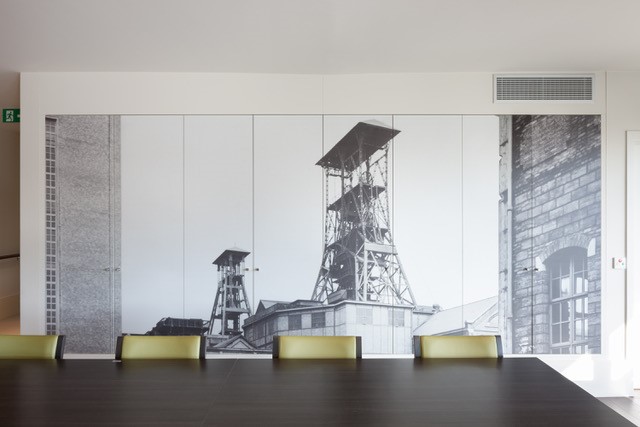
UV printed interior panel suited to healthcare environments
Fit Check

Where This Fits a Healthcare Project — and Where It Doesn't

A Strong Fit

  • Wayfinding, reception, and interior branding that gets touched and cleaned but isn't part of a sterile workflow
  • Multi-building health systems that need consistent wayfinding color and layout across sites
  • Facilities replacing peeling vinyl wayfinding graphics with a coated, permanent panel

Worth a Second Look

  • High-touch surfaces where an antimicrobial coating add-on is being considered alongside standard cleaning protocol
  • Spaces with an unusually aggressive or specialized disinfectant regimen — confirm the exact chemical before quoting

Not a Good Fit by Default

  • Surfaces inside a sterile field or in direct sustained contact with a wound or medication
  • Device housings or components requiring formal biocompatibility certification

What to Confirm Before It Goes to Print

  • The exact disinfectant or cleaning chemical the facility uses, not just its general policy
  • Whether the surface has any direct clinical contact role
  • Whether an antimicrobial coating add-on is wanted
  • Whether the design needs to match wayfinding already installed elsewhere in the system
Daily Reality

What Actually Wears a Healthcare Surface Down

The chemical load is the real durability question in a clinical building, not foot traffic or daylight exposure the way it might be for an office lobby or retail interior. Frequent isopropyl alcohol wipe-downs and hospital-grade disinfectants are harder on a clearcoat than routine commercial cleaning, which is why confirming the specific product a housekeeping team uses matters more here than in most other verticals — a coating rated for general use can wear noticeably faster under a daily IPA regimen it wasn't specified for.

Antimicrobial additives are available for facilities that want an added layer on top of their existing sanitation program, but they're a supplement to cleaning protocol, not a substitute for it — a printed surface, treated or not, still needs to be part of the facility's regular disinfection routine to do its job. The line between general interior branding and anything with a direct clinical role is worth drawing early: a reception wall and an exam room accent panel are one conversation, while anything touching a sterile field or a device housing is a different one entirely, closer to what our food safety and food-contact compliance guide addresses for direct-contact ink systems in another industry. Senior living and memory care communities run a similar cleaning cadence with an added wayfinding-contrast requirement layered on top — see our UV printing for senior living and memory care communities guide for how that combination gets specified.

Send us the substrate, the space, and the cleaning protocol the facility actually runs, and we'll come back with what's feasible and the right coating spec.

Tested Standard

Same Coating Standard as Every Polyprint Surface

Healthcare interior panels are finished under the same lab-tested performance benchmark used across every application.

✏️

Scratch Hardness

6H Pencil

EN 15184 pencil hardness test — relevant to gurney and cart traffic in corridors.

🧴

Chemical Exposure

Coating-Dependent

Clearcoat spec, not the ink, determines resistance to IPA and hospital-grade disinfectants — confirm cleaning protocol before quoting.

🦠

Antimicrobial Option

Available on Request

Additive coating layer for high-touch surfaces — a supplement to, not a replacement for, sanitation protocol.

☀️

UV Weathering

No Change at 3000h

EN ISO 16474-3 Atlas UV Test — matters for daylight-heavy atriums and waiting areas.

View Full Testing Data →
FAQ

UV Printing for Medical & Healthcare Facilities — Common Questions

Can a UV-printed panel survive constant hospital-grade disinfectant wipe-downs?

Yes, with the right topcoat specified up front. Healthcare environments rely on frequent isopropyl alcohol and other aggressive disinfectant wipe-downs, harder on a coating than typical retail or office cleaning. Tell us the actual cleaning protocol a space uses so we can confirm the coating spec before production, not after installation.

Is standard UV ink safe for surfaces patients or staff touch directly?

For wayfinding, wall panels, and reception surfaces that get touched and wiped but aren't part of a sterile workflow, standard UV ink and coating is the right spec. Anywhere the surface plays a direct clinical role needs its own biocompatibility and cleaning-chemical review, scoped separately before quoting.

Are antimicrobial coatings available, and are they necessary?

Antimicrobial additives can be built into a coating on request, and more facilities specify them for high-touch surfaces as an added layer. It's a supplement to a facility's existing cleaning and sanitation protocol, not a replacement for it.

What healthcare surfaces get printed most often?

Corridor and department wayfinding, waiting room and reception feature walls, exam room accent panels, and donor recognition walls are the most common requests — surfaces meant to be seen and touched casually, not part of a clinical or sterile workflow.

How do multi-site health systems keep wayfinding consistent across buildings?

By keeping approved print files, color values, and substrate specs on record so a new or renovated building matches what's already installed system-wide. See our color matching and Pantone guide. Request a quote here.

Explore More Surfaces

Related Applications

Have a Healthcare Facility Project to Print?

Send us the substrate, the space, and your cleaning protocol. We'll come back with what's feasible and the right coating spec.

Website by Rank Easy Digital — websites, SEO & AI search visibility for your business. Get a free consult →