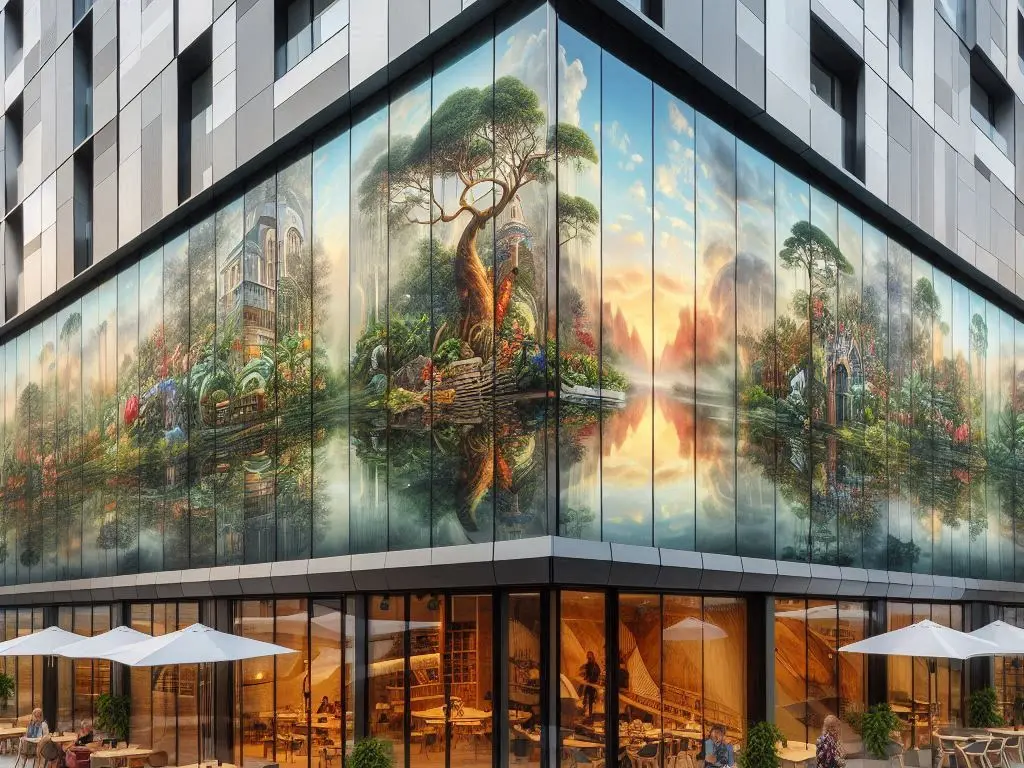
Long-life, weather-resistant UV-printed ACM and dibond panels for exterior signage, architectural cladding, wayfinding, and permanent display installations.
Request an ACM Panel QuoteAluminium composite material (ACM) — the category that includes dibond, alucobond, reynobond, and equivalent products — offers the combination of properties that permanent exterior print applications demand: dimensional stability, weather resistance, a smooth UV-printable face, and manageable weight for large-format installation.
UV printing directly onto the aluminium face produces sharp, photographic-quality results that, with appropriate coating, hold their colour for 10+ years in exterior environments. For building identification, wayfinding systems, architectural graphic cladding, and any signage application where longevity justifies the premium over foam board or paper-based substrates, ACM is the specification of choice.
UV-printed ACM with protective coating maintains colour stability for 7–15+ years outdoors. Aluminium doesn't absorb moisture, warp, or delaminate — unlike wood, foam, or paper substrates. See our durability & care guide for what actually shortens that lifespan and how to clean panels correctly.
The composite construction provides exceptional flatness at scale — critical for large-format precision work where panel bow or print registration errors are unacceptable.
Smooth aluminium face produces photographic-quality UV output — consistent, sharp, and accurate to brand colour specification across multiple panels in large installations.
CNC cuttable, routable, V-grooveable for folded returns, and drillable. Panel fabrication into box signs, cladding cassettes, or custom shapes is done after print for dimensional accuracy.
| Specification | Standard Options | Notes |
|---|---|---|
| Thickness | 2mm, 3mm, 4mm | 3mm is the most common for signage; 4mm for larger panels and structural applications |
| Face material | Pre-painted aluminium (various colours) or mill finish | Pre-painted white is standard for UV printing background; other colours available |
| Core material | Polyethylene (PE) or fire-resistant mineral (FR) | FR core required by building regulations for use above ground floor on facades |
| Standard panel sizes | Up to 1500mm × 4050mm | Custom sizes and gang-printing of multiple panels per sheet available |
| Protective coating | Gloss, satin, or matte UV-stable clear coat | Required for exterior applications; optional for interior use |
| Fabrication | CNC cut, V-groove, drill, fold | Typically done after printing to ensure dimensional accuracy of finished panel |
Fire-resistance note: Building regulation requirements for facade cladding materials vary by jurisdiction and building type. If ACM panels are to be used as building cladding, confirm fire-resistance requirements for your specific application — FR core panels may be mandated. Polyprint can advise on specification.
ACM earns its premium on exterior longevity, but it isn't the default answer for every project. Three situations where we'll usually point you elsewhere:
ACM V-grooves and bends cleanly on a single axis for folded returns and box signs, but it doesn't form compound curves. Wrapped columns or domed surfaces need a different substrate or fabrication method entirely.
Many jurisdictions require FR (fire-resistant mineral core) panels rather than standard PE-core ACM above ground floor. That changes cost and lead time — confirm the building's fire classification before specifying standard core. If fire rating is driving the spec rather than weight or panel size, UV printing on fiber cement is worth comparing directly — it clears most fire codes without an FR-core upcharge, at the cost of a heavier panel and its own alkalinity and cure-time prep requirements.
For a trade show panel or indoor sign that will never see weather, foam board is lighter, cheaper, and just as durable for that use case. ACM's premium is only worth paying when exterior exposure or long service life is actually required.
ACM is an aluminum-skinned sandwich panel, not a fiber-reinforced composite, so it's a different substrate family than carbon fiber. If the project is a carbon composite part rather than an ACM panel, see UV printing on carbon fiber — the surface being printed is cured resin, not aluminum, and the prep requirements follow accordingly.
Share your panel dimensions, quantity, intended application, and environment. We'll confirm substrate and coating specification, and provide pricing and lead time for your project.
Get a Quote →ACM is a sandwich panel with two thin aluminium skins bonded to a polyethylene or mineral core. Trade names include dibond, alucobond, reynobond, and others. The aluminium face provides a smooth, weather-resistant surface ideal for UV printing. Standard thicknesses are 2–4mm. It is the primary substrate for permanent exterior signage worldwide.
With UV-stable inks and protective coating, UV-printed ACM maintains colour fidelity for 7–15+ years under typical weathering conditions. The aluminium face doesn't warp, absorb moisture, or delaminate — making it significantly more durable than foam, wood, or paper substrates in exterior environments.
Three cases come up regularly: curved or compound-curve installations (ACM bends on one axis but doesn't form compound curves), above-ground facade cladding in jurisdictions that require FR core rather than standard PE core, and short-run indoor graphics where foam board is lighter, cheaper, and equally durable since the panel won't see weather.
Yes. UV-printed ACM can be CNC cut, routed, V-grooved for folded returns, and drilled after printing. Fabrication is done after print to ensure the printed area aligns precisely with the finished panel dimensions. Polyprint can supply flat printed panels for your fabrication or coordinate fabrication as part of the project scope.
A UV-stable protective clear coat applied over the UV-printed surface extends colour life and scratch resistance for exterior applications. Gloss, satin, or matte finish options are available. Polyprint specifies coating type and thickness to match each project's environmental exposure and expected service life.
Building regulation requirements vary by jurisdiction and building type. Above ground floor on facades, FR (fire-resistant mineral core) ACM is often mandated. Polyprint can advise on specification requirements for your application — share the building use, height, and location, and we'll confirm the appropriate core material.
Related guides