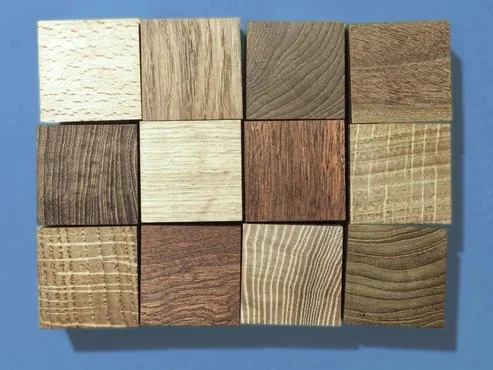
Direct UV flatbed printing on wood — from smooth MDF panels to natural hardwood grain — with consistent color and durable adhesion, and no stains, transfers, or lamination involved.
Request a Quote →Substrate choice and surface prep, more than any printer setting. MDF and HDF give UV ink a smooth, consistent surface and produce the most repeatable results run after run. Natural hardwood prints well too, but the grain becomes part of the image — color from the print overlays the wood's own pattern rather than hiding it, unless a white ink underprint is specified to opacify the surface first. More printed-wood failures trace back to skipped sanding, unsealed porous grain, or wood that wasn't at the right moisture content than to anything the UV printer itself did wrong.
A UV flatbed printer passes over the stationary wood substrate, depositing UV-curable ink that's cured solid instantly by UV lamps mounted alongside the print head. Because it cures by photopolymerization rather than evaporation, the ink bonds to the wood surface — or very slightly into the grain on open-pore wood — as a full-color, cured polymer layer, not a stain that penetrates the fibers the way dye does. That's the core difference between UV printing on wood and staining or laser engraving: it's a surface-bonded print with the visual range of ink on paper and the durability of a cured resin coating.
Whether that bond holds long-term comes down to three things: how the surface was sanded and sealed, whether the wood was at the right moisture content when it was printed, and whether the panel is flat enough to clear the print head. Get those right and a UV-printed wood panel holds color and adhesion for years; skip any of them and the wood's own movement or absorption undoes the print regardless of ink quality.
Ask About Your Substrate →
The same design file behaves differently depending on what it's printed on.
More printed-wood problems trace back to prep than to the printer or the ink.
Sand natural hardwood and rough-surfaced substrates to at least 220 grit and remove all dust before printing — surface roughness above roughly 25 microns Ra visibly affects fine detail. Highly porous or open-grained wood absorbs ink unevenly without a UV primer coat or clear sealer first; on natural hardwood, a white primer undercoat also keeps color from reading muted against dark grain.
Wood must be at equilibrium moisture content before printing — target 6–10% for interior applications. Green or wet wood keeps expanding and contracting after printing, which cracks or delaminates the cured ink layer regardless of how well it was applied.
UV flatbed printers need the substrate surface to pass under the print head within a tight clearance — typically a few millimeters of the nozzle plate. Warped boards or rough-sawn lumber risk head strikes that damage both the substrate and the printer. MDF, plywood, and engineered panels are typically flat enough to print without extra prep; solid natural wood needs jointing and planing first.
Because UV ink is semi-transparent at standard densities, wood grain shows through color to varying degrees. A white ink underprint opacifies the surface for grain-free, brand-accurate color, and also enables light colors to read clearly on dark stained or ebonized wood. Without it, printing on dark substrates produces muted, low-contrast results — the same white-underbase logic covered in our color matching & Pantone guide.
UV-printed wood meets the same independently tested performance benchmarks that define all Polyprint applications.
EN ISO 16474-3 Atlas UV Test — zero surface change after 3000 hours of exposure.
EN 15184 pencil hardness test — rated 6H, the highest standard for coating hardness.
EN 438-2 ball impact testing — maximum machine rating with no visible damage.
DIN EN 14354 Taber Abraser — achieved classification 31 in tested conditions.
From lobby signage to branded merchandise, wood spans décor and functional use cases alike.
Yes. UV flatbed printers deposit UV-curable ink directly onto the wood surface — no transfer media, stain, or engraving involved. The ink cures instantly under UV lamps built into the print head carriage, bonding to the surface as a durable polymer layer.
MDF and HDF produce the most consistent results for high-volume production. Natural hardwoods with tight grain — maple, cherry, birch — print well with basic prep. Open-grain species like oak and ash, and plywood with face-ply variation, need sealing for best results.
With exterior-grade or pressure-treated wood, sealed edges, and a UV-protective topcoat applied after printing, UV-printed wood holds up outdoors for several years. Skip any of those steps and moisture or UV exposure degrades the substrate and the print faster than the ink itself would fail.
With standard color ink, yes — the grain is typically visible through the print, often as a desirable, premium-feeling effect. If a design needs fully opaque, grain-free color, a white ink underprint layer opacifies the surface before color layers are applied.
Standard UV inks are not food-safe. For cutting boards and similar items, printing should be limited to non-contact surfaces unless food-safe UV ink is specifically requested and confirmed. Request a quote here.
Send us your wood type, panel sizes, and artwork. We'll come back with the right substrate, prep, and pricing.