Home Sports Surfaces Testing About Request a Quote
Surface Application

UV Printing
on Furniture.

Tabletops, cabinet fronts, headboards, and reception desk panels — printed on the actual substrate the piece is built from, with the prep that substrate requires. We finish components. We don't build furniture.

Request a Quote →
The Short Answer

What Does "UV Printing on Furniture" Actually Mean?

It means printing the flat, rigid panel a piece of furniture is made from — a tabletop, a cabinet door, a headboard panel, a reception desk face — either before it's assembled or after, depending on the piece. It does not mean we manufacture furniture. The process, the prep, and the durability all come from the underlying material, which is why "furniture" alone never fully specs a job; the board or material underneath does.

What Gets Printed

The Flat Components, Not the Finished Piece

Furniture orders arrive from two directions: a manufacturer sending us a cut panel to print before it goes to their assembly line, or a fabricator printing a component that's already built into a piece. Either way, the part that goes under the print head is flat, rigid, and sized to fit a bed — not a finished chair or a fully upholstered sofa. Tabletops, cabinet and drawer fronts, headboard panels, reception and retail desk faces, and decorative panel inserts are the recurring categories.

This overlaps with two guides already on this site without duplicating either one. Built-in cabinetry and millwork — kitchen cabinets, closet systems, fixed shelving installed in place — is covered on our cabinetry and millwork guide. This page is about freestanding and manufactured furniture: pieces built in a shop or factory, shipped, and placed, not installed on-site.

Restaurant, cafe, and hospitality tabletops
Cabinet doors and drawer fronts for manufactured casegoods
Headboard panels and hotel case goods
Reception desks and retail counter faces
Office desking and partition panel inserts
Decorative accent panels for high-end residential pieces
Talk Through Your Project →
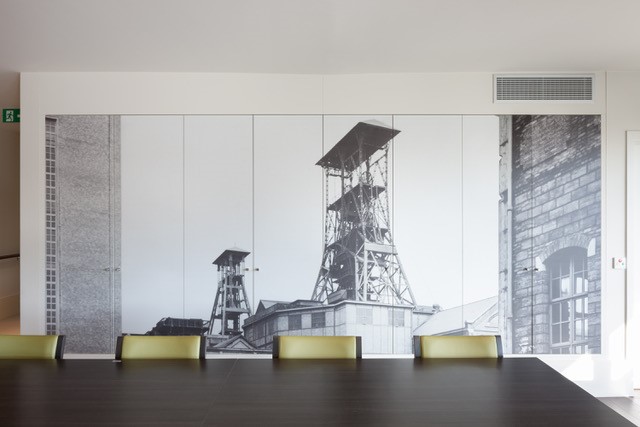
UV printed panel finish suited to office and commercial furniture
Substrate First

The Board Decides the Process — "Furniture" Doesn't

Two tabletops that look identical from across the room can need completely different prep, because the material underneath the finish is different.

Wood, MDF & Plywood

Raw or veneered wood panels are the most direct print surface for case goods and tabletops — porous enough to key well once sanded and sealed. See our UV printing on wood guide for the prep sequence. This is the right starting point for a solid-wood or veneer furniture line, not for anything already faced in melamine or laminate.

Melamine & High-Pressure Laminate

A huge share of manufactured casegoods — office desking, budget-tier cabinet fronts, retail fixtures — ship pre-faced in melamine or HPL. That resin skin is sealed and low-porosity, which means it needs a chemical adhesion promoter before it takes ink reliably; skip that step and the print looks fine on day one and flakes at handled corners months later. Our melamine and laminate guide covers that prep in full — it applies to a desk panel exactly the same way it applies to a retail fixture.

Solid Surface & Countertop Material

Corian and similar solid surface materials show up on higher-end tabletops, reception desks, and built-in furniture pieces, and they take a different primer path than either wood or melamine. See our Corian and solid surface guide for what that prep involves and where it's a strong fit.

Metal Panel Furniture

Metal-framed furniture with a printed panel insert — accent tables, industrial-style casegoods, retail furniture with a metal face — follows the same degreasing and adhesion-promoter logic covered on our UV printing on metal guide, including the white-underbase requirement on anything but a light-colored panel.

Commercial Use

Durability Expectations for High-Traffic Furniture

A tabletop gets touched, wiped, and loaded far more often than a wall panel, which is why commercial furniture buyers apply their own durability framework on top of whatever finish is on the surface. ANSI/BIFMA X5.5 is the standard the commercial furniture industry commonly references for table testing — static load, impact, and stability on the finished table as an assembly. That standard covers the whole piece: frame, joinery, and top together, not just the printed finish. When a project needs BIFMA-referenced testing, that's a conversation between your furniture manufacturer and their test lab; our part is the printed panel meeting Polyprint's own tested coating standard underneath it.

Cleaning is the other recurring question, especially for restaurant and hospitality tabletops. Laminate and resin tops are generally the easiest commercial surfaces to maintain — a wipe-down with standard sanitizer between uses, avoiding abrasive pads that dull any finish, printed or not. That's not a special rule for UV-printed panels; it's the same care routine any commercial laminate or solid-surface top already needs, and it's consistent with the wipe-down guidance on our durability and care guide.

Thicker tabletop cores also resist warping better under repeated cleaning and load cycling than thin ones — a furniture engineering decision your manufacturer makes independent of the print, but worth flagging if a printed top is going into daily commercial service rather than a low-traffic residential setting.

Ordering

Samples, Turnaround, and Ordering Across a Product Line

Furniture orders behave differently from a one-off sign, mostly because they repeat — the same panel, in the same finish, across dozens or hundreds of units over a product run.

Proof Before the Full Run

A physical sample on the actual substrate — not a screen proof — is worth the extra day on any furniture order, because color and gloss read differently on melamine than on raw wood or solid surface even with identical artwork. This matters more here than on a single sign, since a color drift that's tolerable on one panel becomes obvious the moment fifty identical tabletops sit next to each other in a dining room. Our sample and proofing process guide covers how that step works before a production run is committed.

Reordering the Same Panel Later

Furniture lines get reordered months or years after the first run — a hotel adding rooms, a restaurant replacing damaged tabletops, a manufacturer restocking a catalog item. Keeping the original substrate, coating spec, and color reference on file is what makes a reorder match the original run instead of drifting slightly with each batch; see our reorder process guide for what we keep on record and what to send when a repeat order comes in.

Fit Check

Where This Fits a Furniture Project — and Where It Doesn't

A Strong Fit

  • Flat panel components: tabletops, cabinet and drawer fronts, headboards, desk and counter faces
  • Manufacturers sending cut panels to print before assembly
  • Product lines needing consistent, repeatable color across a run of identical panels

Worth a Second Look

  • Curved or contoured furniture faces — flatbed printing has real limits on relief and curvature
  • Already-finished furniture where the existing coating needs to be evaluated before anything gets printed over it

Not a Good Fit

  • Structural framing, legs, and joinery — that's furniture manufacturing, not printing
  • Upholstery and textile-covered surfaces — that belongs on our leather and fabric printing guide
  • Fully assembled furniture ordered as a finished product from us — we're a component in that supply chain, not the whole thing

What to Confirm Before It Goes to Print

  • The actual board or material — wood, melamine, laminate, solid surface, or metal panel
  • Whether the piece is printed before or after assembly
  • Existing product line color or Pantone reference to match
Tested Standard

Same Coating Standard as Every Polyprint Surface

Furniture panels are finished under the same lab-tested benchmark used across every application.

✏️

Scratch Hardness

6H Pencil

EN 15184 pencil hardness test — relevant to daily wipe-down and object contact on tabletops.

🔬

Wear Resistance

Class 31

DIN EN 14354 Taber Abraser — relevant to repeated hand and cleaning-cloth contact on high-touch surfaces.

💥

Impact Resistance

>60N

EN 438-2 ball impact testing — relevant to dropped objects and daily use on commercial furniture.

☀️

UV Weathering

No Change at 3000h

EN ISO 16474-3 Atlas UV Test — relevant to furniture near windows or in covered outdoor settings.

View Full Testing Data →
FAQ

UV Printing on Furniture — Common Questions

Do you build the furniture, or just print it?

We print flat and rigid panel components — tabletops, cabinet doors, drawer fronts, headboard panels, reception desk faces. We don't manufacture frames, joinery, or upholstery. Most orders come from furniture manufacturers sending a component to finish.

What furniture materials can actually be UV printed?

It depends on the panel underneath. Raw MDF and plywood, melamine-faced board and HPL, solid surface like Corian, and painted metal all print, but each needs different prep. Tell us the actual board or material.

Will a UV-printed tabletop hold up to restaurant or hospitality use?

High-traffic tabletops are a real fit under our standard coating spec — 6H pencil hardness, no surface change after 3000 hours of UV exposure. Commercial furniture buyers often reference ANSI/BIFMA X5.5 for the finished table assembly; that's a conversation with your furniture manufacturer alongside the print spec.

What's the biggest mistake buyers make when ordering printed furniture panels?

Specifying the print before the substrate is locked. A cabinet door ordered as "wood" that's actually melamine-faced needs an adhesion promoter a solid wood door never would — confirm the actual material before the order goes to print.

Can printed furniture panels match an existing product line's finish or color?

Yes — send a Pantone reference or a sample of the existing finish and the print gets color-matched against it. Request a quote here.

Explore More Surfaces

Related Applications

Have a Furniture Panel Project?

Send us the component, the actual board or material, and your artwork. We'll come back with the prep it needs, feasibility, and pricing.

Website by Rank Easy Digital — websites, SEO & AI search visibility for your business. Get a free consult →