Point-of-sale fixtures live on the sales floor for months or years and get handled every day — a different durability bar than a trade show booth that only has to survive one weekend.
Request a Quote →No, not really — both use UV-printed graphics, but a retail display sits on a sales floor for months or years and gets touched, restocked, and cleaned repeatedly by staff and shoppers, while a booth graphic is built, survives a few days, and gets packed away. That difference in dwell time and handling changes which substrates and finishes are worth specifying, even when the artwork brief looks similar.
A shelf-edge strip, a slatwall insert, a standee, or a checkout-counter panel all get handled far more than a booth backdrop ever does — restocked around, wiped down, leaned into by carts, and occasionally bumped by a shopper reaching past it. None of that is dramatic on its own, but it adds up over a year in a way a three-day show floor never tests.
That's why the substrate conversation for retail fixtures leans toward rigid, scratch-resistant materials rather than the lighter, cheaper options that work fine for something struck at the end of a show. It's not that lighter materials print any worse — they just don't hold up the same way under repeat handling. Checkout-counter and directory-style fixtures overlap with permanent wayfinding signage in substrate needs — our signage and wayfinding guide covers the interior vs. exterior split in more depth. Not every piece in a fixture program is rigid, though — header cards and printed inserts that swap seasonally are often flat cardstock rather than acrylic or composite panel. See our UV printing on paper and cardstock guide for what changes when the piece is meant to be replaced, not permanent. Regulated retail categories add their own layer on top of this — our UV printing for cannabis and dispensary retail environments guide covers how display-case and shelving work there stays separate from the state-regulated product packaging itself. Real estate offices ordering leasing directories and reception panels are specifying the same rigid, handled-often materials — see our UV printing for real estate and property signage guide. Auto dealership showroom floors run the same feature-callout and point-of-sale fixture logic around the vehicles themselves — see our UV printing for auto dealerships and showrooms guide. Retail-adjacent service businesses order a similar mix of reception and retail-wall fixtures — see our UV printing for salons and barbershops guide for how that pairs with heavier-duty station panels near the chair. Illuminated point-of-sale — a backlit menu board or light box insert instead of a flat printed panel — is its own file and ink-layering decision; see our UV printing for backlit signage and light boxes guide for how that differs from a standard fixture graphic. Storefront window takeovers sit just outside the fixture category but usually get quoted alongside it — see our UV printing on window film and static clings guide for why that's a printed film decision, not an interior fixture one.
Talk Through Your Fixture Program →
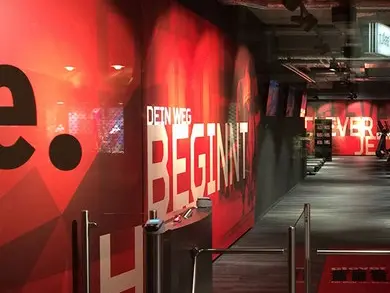
Retail marketing teams that reorder often benefit from splitting a fixture into a reusable structural frame and a printed insert panel — the frame gets built once, and only the graphic panel gets reprinted for a seasonal refresh or a new promotion. That's a different approach from a trade show booth order, where the whole assembly is usually rebuilt or repainted between shows anyway.
Material choice still tracks the surface, not the "retail" label. A printed acrylic panel behaves differently from a composite panel insert, a metal slatwall piece, or a melamine-faced gondola shelving panel — that last one needs its own adhesion promoter step before it takes ink reliably, covered in our UV printing on melamine and laminate guide — and durability and care questions should be checked against the same standard used for any other high-traffic UV-printed surface, not treated as a separate category.
Tell us the fixture count, expected lifespan, and cleaning routine, and we'll come back with a substrate recommendation and a reorder path that doesn't mean rebuilding the whole unit each time. For the mechanics of what actually happens once you're ready to reprint a panel — file retention, color consistency, and how minimums and lead time compare to the original order — see our UV printing reorder process guide.
Convenience store retail runs the same frame-and-insert logic at a fuel site, just with a harder outdoor exposure layered on top of the interior fixture questions above — see our UV printing for gas stations and convenience stores guide for how canopy fascia, pump toppers, and c-store window graphics fit into the same reorder and substrate planning.
Retail fixtures are finished under the same protective coating benchmark used across every Polyprint application.
EN ISO 16474-3 Atlas UV Test — zero surface change after 3000 hours, relevant for window-facing storefront fixtures.
EN 15184 pencil hardness test — rated 6H, matters most for surfaces handled daily by staff and shoppers.
Frame-and-insert design keeps seasonal reprints to the graphic panel, not the full fixture.
Backlit panels need ink opacity and layer order set for transmitted light from the start.
Dwell time and handling. A trade show booth survives one to three days and gets struck; a retail fixture stays on the floor for months or years and gets restocked, cleaned, and touched daily. That points toward more durable substrates than a temporary booth needs.
Generally not for anything customers will handle or that needs to last past one season. It's light and prints well, which is why it suits temporary booth signage, but it dents and delaminates under the repeated handling a permanent fixture gets. Acrylic, composite panel, or Corian usually holds up better.
Yes, but flag it before quoting. A backlit panel needs ink opacity and layer order planned for transmitted light rather than reflected light — retrofitting a print that wasn't designed for that rarely gives an even result.
It varies, but a reusable frame with a replaceable printed insert is common, since the fixture base stays put and only the graphic panel gets swapped for reorders — faster and cheaper than reprinting the whole unit.
Expected install duration, how it's cleaned and handled, whether it needs to be backlit, and whether the design rotates seasonally. Request a quote here.
Send us fixture count, expected lifespan, and how they'll be handled and cleaned. We'll come back with a substrate recommendation and pricing.