Full-color, permanent branding for lobby walls, concession counters, box office directories, and auditorium signage — built to survive a Friday-night crowd and daily cleaning without peeling.
Request a Quote →It fits the fixed physical space — lobby feature walls, concession counters, box office directories, auditorium number plaques, and corridor wayfinding, printed onto panel, acrylic, or laminate and finished with the same protective coating used across every Polyprint application. It doesn't cover theatrical movie posters, which are standardized materials supplied by film distributors as part of a marketing package, and it doesn't replace digital lobby media screens, which run on their own display network rather than a printed surface. A theater project usually needs both categories working alongside each other, not one instead of the other.
Concession counters and condiment stations are the most common request — printed brand graphics, menu framing, and wayfinding built directly into the counter surface rather than added as a sticker or a printed vinyl overlay that lifts under daily butter and soda spills. Box office directory panels and auditorium number plaques follow the same category as any hospitality directory sign, covered more broadly in our restaurants and hospitality guide.
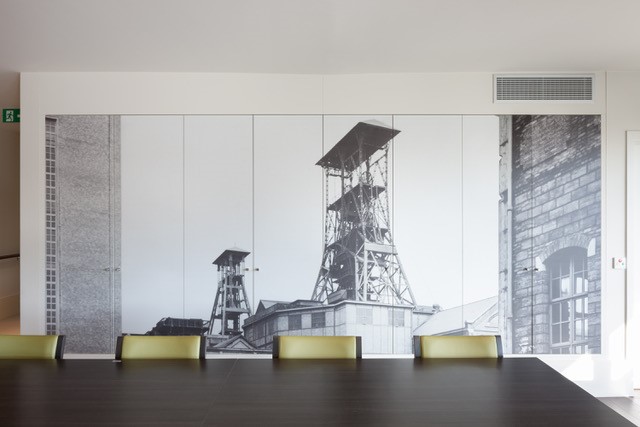
Lobby feature walls and corridor graphics round out most theater orders — large-format brand or franchise-themed panels at architectural scale, the same category of work covered in our large-format tiling and murals guide for installations that exceed a single panel size. Restroom and corridor wayfinding uses the same panel materials at a smaller scale, matched to the theater's overall design standard.
Premium format auditoriums — recliner-seat houses, larger-format screens, bar-and-lounge concepts attached to a theater — tend to order the most design-forward interior panels, since these are the auditoriums a chain uses to justify a higher ticket price and wants to feel distinctly upgraded from a standard house. Arm-rest cupholder branding, entry archway graphics, and premium-lounge bar panels all fall into the same fixed-surface category as a standard concession counter, just with a higher finish expectation.
Talk Through Your Project →
There were roughly 9,036 movie theaters operating in the US as of mid-2026, with California and Florida holding the largest concentrations — a broad, ongoing market of lobby remodels, concession refreshes, and new-build openings. Cinema chains have been expanding in-lobby digital media networks in parallel, but that investment sits alongside physical interior branding rather than replacing it — a digital display in a corridor doesn't cover a concession counter, a directory panel, or a lobby feature wall.
High-traffic areas — corridors, concession stands, box offices, and bar or lounge areas — are where theaters concentrate both digital and physical signage investment, because that's where guests spend dwell time waiting for a showtime. A printed, coated panel in those zones holds up to years of daily crowds in a way a laminated poster or a printed vinyl decal typically doesn't.
Send us the surface, the space, and your chain's design standard if you have one, and we'll come back with what's feasible and pricing.
A single theater with a dozen auditoriums already needs consistent number plaques, directional graphics, and concession branding across every screen and corridor — a single off-color or off-font panel stands out more in a repeated element than it would on a one-off feature wall. Keeping the approved print file, Pantone reference, and substrate spec on record, the same practice covered in our reorder process guide, is what lets auditorium 9's number plaque match auditorium 2's five years later when one gets damaged and needs a single reorder rather than a full-location reprint.
Chains renovating locations on a rolling schedule run into the same consistency question at a larger scale — a refreshed concession counter at one location needs to read as the same brand as an unrenovated location two towns over, at least until the rollout catches up. Locking a single approved design and substrate spec before the first location goes into production avoids a scenario where location three's counter finish doesn't quite match location one's because a color reference got approximated instead of confirmed.
New-build theaters coordinate signage installation with the broader fit-out schedule the same way any hospitality build-out does — concession and box office panels typically go in during finish work, after millwork and before opening, which means panel dimensions need to be confirmed against architectural drawings early enough that production isn't racing the opening date.
Theater interior surfaces get finished under the same protective coating benchmark used on restaurant and hospitality projects.
EN 15184 pencil hardness test — rated for counter traffic and daily bussing.
Clearcoat spec determines resistance to sanitizer and spill cleanup at concession counters.
EN ISO 16474-3 Atlas UV Test — relevant for entrance and window-facing lobby graphics.
Operating in the US as of mid-2026 — a broad, ongoing market for interior branding.
Lobby feature walls, concession counters, box office directory panels, auditorium number plaques, and corridor wayfinding print well on panel, acrylic, or laminate. Distributor-supplied movie posters and digital lobby media screens fall outside UV panel printing.
Roughly 9,036 movie theaters were operating in the US as of mid-2026, with California and Florida holding the largest concentrations — a large, ongoing market of lobby and concession remodels.
Yes — the same 6H-hardness coating used on every Polyprint surface is rated for regular cleaning and counter traffic, covering butter, soda, and general spill cleanup.
No — theatrical one-sheets come from film distributors in standardized sizes as part of the marketing package. UV printing fits the poster case frames and surrounding theater-branded signage, not the posters themselves.
Cinema chains renovating a lobby or concession area, independent theater owners on a rebrand, and general contractors on a new-build fit-out. Request a quote here.
Send us the surface, the space, and your design standard. We'll come back with what's feasible and pricing.