Home Sports Surfaces Testing About Request a Quote
Surface Guide

UV Printing
on Mirrors.

Logos, wayfinding, artwork, and borders printed directly onto glass mirror and acrylic mirror. The parts you leave unprinted stay reflective, and the printed parts hold full color.

Request a Quote →
The Short Answer

Can You UV Print on a Mirror?

Yes, and it's one of the few print jobs where the empty space matters as much as the ink. A flatbed UV printer puts ink directly onto the front face of a glass or acrylic mirror. White ink goes down first wherever the graphic should look solid, then color goes on top. Anything you leave unprinted stays a working mirror. The decisions that make or break a mirror job come before printing: which mirror substrate to use, where the reflection should show through, and how the printed face will be cleaned once it's installed.

Where It Shows Up

What People Actually Print on Mirrors

Most mirror orders are branding that has to sit on a surface people already use. Salon station mirrors carry a logo in the top corner, gym and studio mirror panels get a brand mark outside the area members use to check their form, and fitting-room mirrors carry a retailer's logo and a size reminder. Hotel and restaurant restroom mirrors carry room names or a decorative border. Bar-back mirrors use white-ink graphics to look etched without sandblasting.

The other big group is display and event work: selfie mirrors at launches, retail window mirrors with reflective cut-outs, and gallery pieces where portrait areas are printed and knocked-out areas let the viewer see themselves. All of these depend on the same idea. You decide exactly where the reflection shows, and the white underbase is what makes that work. Our white ink and underprinting guide covers flood, spot, and double-hit white in detail.

Salon and barbershop station mirrors
Gym and studio mirror panels
Retail fitting-room and window mirrors
Hotel and restaurant restroom mirrors
Bar-back mirrors and event photo mirrors
Talk Through Your Project →
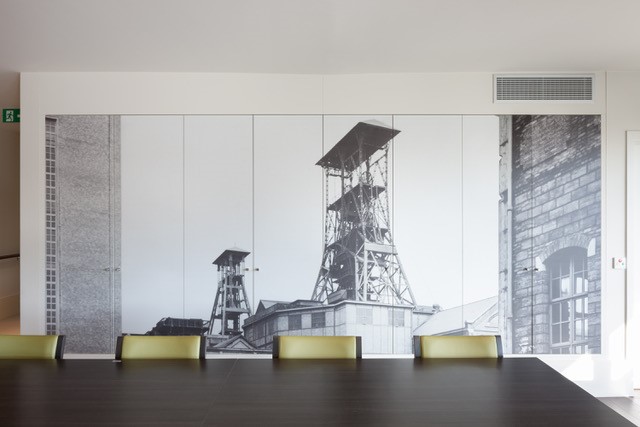
UV printed interior panel finish of the kind used alongside printed mirrors
Substrate Choice

Glass Mirror vs Acrylic Mirror

Glass Mirror

  • A truer, flatter reflection, with the reflective layer protected on the back of the glass
  • A harder face that resists scratching better than acrylic
  • Heavier and breakable. Some locations need safety-backed or tempered mirror, so ask your designer or code official
  • Usually needs an adhesion promoter before UV ink. See our adhesion promoters and primers guide

Acrylic Mirror

  • Roughly half the weight of glass at the same thickness, and it doesn't shatter like glass
  • Comes in common tints including silver, gold, and bronze, and is easier to cut into custom shapes
  • Flexible. It must be mounted flat on a rigid backer or the reflection warps like a funhouse mirror
  • Scratches more easily, and acrylic manufacturers generally warn against ammonia-based cleaners

Neither is the better substrate across the board. Glass is the usual pick for a permanent mirror that customers see up close, like a hotel vanity or a premium fitting room. Acrylic is the usual pick when the mirror gets shipped, handled, hung near kids or athletes, or used for one event. If you're choosing between them for a printed panel, our UV printing on acrylic and UV printing on glass guides cover each base material in more depth.

How It Prints

Underbase, Knock-Outs, and the Float Effect

White underbase decides what's opaque

Color ink printed straight onto a mirror is translucent, so the reflection shows through it and the color looks dark or metallic. That can be the effect you want, for example a tinted logo that still reflects a little. For solid brand colors, a white layer goes under the color wherever the graphic should block the reflection. The artwork needs a separate white channel that matches the color art exactly. If the white is larger than the color, you get a white halo around the edges. If it's smaller, you get a shiny fringe.

Knock-outs keep the mirror working

Any part of the file you want reflective has to be left completely unprinted, with no white and no stray color pixels. In the file, that means areas with no ink at all, not areas filled with white on screen. Mixing these up is the most common prepress mistake on mirror jobs. White on screen often prints as white ink, which covers the exact area the customer expected to stay reflective. When we proof a mirror job we show the white channel separately for this reason.

Why the graphic seems to float

On a glass mirror the silvering is on the back and the ink is on the front, so the thickness of the glass separates them. Looking at an angle, you see the printed graphic on the surface and its reflection slightly offset behind it. Thicker glass makes the gap bigger. Thin acrylic mirror shows less of it. Designers often like this because the logo looks layered and the mirror looks deep. If the brand standard calls for a flat look, plan for thinner stock or bigger solid areas and check it on a sample before ordering a full run.

An etched look without etching

White ink printed at reduced density, sometimes with a textured clear layer on top, can look like a sandblasted or acid-etched mirror. It isn't the same thing. True etching cuts into the glass, and this sits on the surface. What it gives you is the ability to print any design, fine type, and gradients that etching can't do well, plus easier reorders when a location changes. Our spot gloss and raised texture guide explains how the texture layers are built.
Planning a Printed Mirror?

Send the finished size, glass or acrylic, where the reflection should show, and how it will be cleaned. We'll reply with what's feasible and a quote.

Installed Mirrors: Replace, Don't Print in Place

A flatbed UV printer prints with the mirror lying flat on the bed in production. It can't print a mirror that's already glued to a studio wall or screwed into a vanity. If you want a printed graphic on an existing mirror wall, you have two honest options:

For a new build-out or renovation, specify printed mirrors at the design stage. The mirror installer then hangs panels that are already finished, with no second trade on site.

Large Mirror Walls and Seams

Floor-to-ceiling mirror walls are almost always several panels, whether or not they're printed. A printed design has to account for those joints. Type and logos should sit inside one panel instead of crossing a seam, because the reflection on either side of a joint is never perfectly aligned. Continuous artwork across a wall is possible, but it needs a panel layout drawn up front and an installer who knows the graphic has to register. Our large-format tiling and murals guide covers how we split artwork into panels.

Cleaning and Durability on the Printed Face

On a mirror the ink sits on the front face, where hands, spray bottles, and cleaning cloths touch it. That makes cleaning the main durability question:

Our published testing data covers Polyprint's coated surface system. Ask which results apply to the mirror substrate and coating on your quote rather than assuming one figure covers every material. General care guidance is in our durability and care guide.

What to Send for a Mirror Quote

Our file prep requirements and sample and proofing process explain how to set up the white channel and approve a physical sample before the full run. When you're ready, request a quote.

When a Printed Mirror Is the Wrong Choice

FAQ

UV Printing on Mirrors: Common Questions

Can you UV print directly on a mirror?

Yes. A flatbed UV printer prints on the front face of glass or acrylic mirror, with white underbase wherever the graphic needs to look solid. Unprinted areas stay reflective.

Why does the print look like it floats above the reflection?

The ink is on the front and the silvering is on the back, so the glass separates them. Thicker glass makes the offset more visible. Thin acrylic mirror shows less of it.

Glass mirror or acrylic mirror: which should I print?

Glass gives a truer reflection and a harder face. Acrylic is lighter and doesn't shatter like glass, but it has to be mounted flat on a rigid backer or the reflection warps.

Can you print an existing mirror wall on site?

No. Direct UV printing is done in production on a flatbed. Installed mirrors are either replaced with printed panels or covered with an applied film.

How do you clean a UV-printed mirror?

Use a soft microfiber cloth and a mild, non-abrasive cleaner, sprayed on the cloth. Don't use ammonia sprays on acrylic, or abrasives and solvents on the printed areas. Request a quote here.

Explore More Surfaces

Related Applications

Have a Mirror Project to Print?

Send the sizes, the substrate, and where the reflection should stay clear. We'll come back with what's feasible and pricing.