Home Sports Surfaces Testing About Request a Quote
Surface Application

UV Printing on
Window Film & Clings.

Perforated one-way vision film, static cling vinyl, and standard adhesive window graphics — printed with UV-cured ink for storefronts, drive-thrus, and office glass that needs to say something without going dark.

Request a Quote →
The Short Answer

Which Window Product Actually Fits the Job?

Three different materials get called "window graphics," and they behave nothing alike. Perforated one-way vision film is a permanent adhesive product punched with micro-holes so staff can see out while the storefront reads as a full graphic from the sidewalk. Static cling vinyl has no adhesive at all — it clings to glass electrostatically and comes off by hand, which makes it the right call for a promotion that changes every season, not a permanent brand statement. Standard opaque or translucent adhesive film sits between the two — permanent, no see-through requirement, full coverage. Picking the wrong one shows up fast: cling on a storefront window that needs to survive two years of direct sun, or permanent film on a display window that's supposed to rotate monthly.

How It Works

Instant Cure Matters More Here Than on Rigid Surfaces

A UV printer deposits ink onto the film and cures it solid on contact with UV lamps built into the print carriage. On a rigid panel that mostly affects cure speed and production throughput. On perforated one-way vision film it affects something more consequential: whether the perforation holes stay open. Solvent and latex inks stay wet for a meaningful stretch after they hit the film, which gives them time to wick sideways into the perforation holes and partially fill them in — degrading the see-through effect the material exists for. UV ink sets before it has time to migrate, which is why UV printers are the standard choice for this material rather than a fallback option.

That said, UV ink isn't immune to the same problem — it's a question of density, not chemistry alone. Film built for UV printers typically uses a two-layer liner behind the perforated face: the top layer takes the printed image, and a second absorbing layer underneath gives ink somewhere to go besides the holes themselves. Standard single-layer liner stock not built for UV printing is more prone to hole-clogging under heavy coverage. It's a material spec worth confirming before a large storefront order, not an afterthought — see our white ink and opaque underprinting guide for the related tradeoff between ink density and what shows through on any semi-transparent substrate.

Perforated one-way vision — 30–60% open area depending on stock
Two-layer liner film recommended for UV printers
Static cling — no adhesive, indoor-facing, fully repositionable
Standard adhesive film — full coverage, no see-through requirement
Roll widths commonly in the 54–60 in. range for sign-shop print equipment
Ask About Your Window Project →
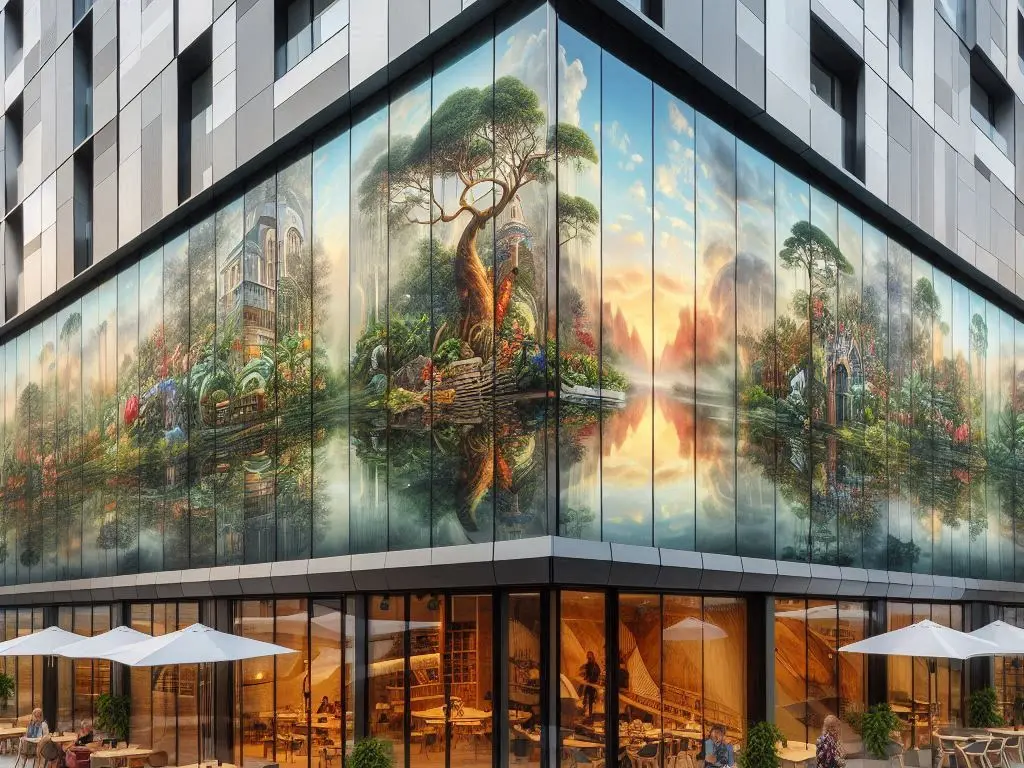
Printed storefront window film with one-way vision graphic
Materials

Three Window Products, Three Different Jobs

Matching the material to how long the graphic needs to stay up and whether anyone needs to see through it.

Perforated One-Way Vision Film

  • White printable face, black adhesive-side liner — the black backing is what makes the image read solid from outside despite the holes
  • Permanent pressure-sensitive adhesive — meant to stay up for the life of the campaign, not swap weekly
  • Right fit for storefront branding, drive-thru order windows, transit vehicle windows, and any glass where staff or customers need to see out

Static Cling Vinyl

  • No adhesive — holds to glass by static and surface contact, peels off clean with no residue
  • Best for seasonal promotions, real estate listing changes, retail sale graphics, and anything with a known end date
  • Meant for interior-facing glass; not rated for sustained outdoor UV and temperature cycling the way adhesive film is
Production

Where Print Decisions Change the Result

The printer settings that matter most are different from a rigid substrate job.

Ink Density vs. Visibility

On one-way vision film, heavier ink coverage produces a bolder, more opaque graphic from outside — but the same density reduces how much light and image passes through from the inside. A design with large solid color fields reads great on the street and dims a room faster than one built around lighter coverage and negative space. This is a conversation worth having before artwork is finalized, not after the film is on the glass.

Mirror Imaging & Viewing Side

Graphics meant to be read from outside through the glass — common on static cling and some interior-applied films — need to be printed mirror-reversed so the correct orientation shows on the exterior-facing side. Getting the viewing side backward is one of the most common and most avoidable production errors on window jobs; it's a confirmation question during file prep, covered generally in our file prep requirements guide.

Application Environment

Glass temperature and cleanliness at install time affect how well film adheres and how long it lasts. Cold or dirty glass produces weaker initial tack and a higher chance of edge lifting later — a problem that shows up months after install, not at the point of blame. Direct south- or west-facing sun exposure also shortens the practical service life of outdoor film versus the same product on a shaded storefront.

Removal & Turnover

For retail spaces that rotate window graphics several times a year, static cling avoids the labor and glass-cleaning cost of stripping adhesive film every cycle. For a permanent storefront identity, adhesive one-way vision film is the more durable, better-value choice despite the harder removal — it's simply not designed to come down often. Multi-location retailers standardizing this across stores follow the same reorder logic as any other Polyprint product — see our reorder process guide for how repeat window graphics get matched to the original file and color.

Tested Durability

Held to the Same Standard as Every Polyprint Surface

UV-printed window graphics meet the same independently tested performance benchmarks that define all Polyprint applications.

☀️

UV Weathering

No Change at 3000h

EN ISO 16474-3 Atlas UV Test — zero surface change after 3000 hours of exposure.

✏️

Scratch Hardness

6H Pencil

EN 15184 pencil hardness test — rated 6H, the highest standard for coating hardness.

💥

Impact Resistance

>60N

EN 438-2 ball impact testing — maximum machine rating with no visible damage.

🔬

Wear Resistance

Class 31

DIN EN 14354 Taber Abraser — achieved classification 31 in tested conditions.

View Full Testing Data →
Where It Performs

Applications for Printed Window Graphics

From full storefront takeovers to a single conference-room privacy panel.

Retail & Storefront

  • Full storefront window takeovers, seasonal sale graphics, new-location announcements
  • Drive-thru order windows and QSR menu-adjacent glass
  • Real estate office listing displays and agent branding

Office & Interior

  • Conference room privacy film with logo or frosted-effect patterns
  • Branded interior glass partitions and lobby dividers

Vehicles & Transit

  • Rear-window one-way vision decals on branded fleet vehicles
  • Transit and shuttle window advertising panels

Why Buyers Choose It

  • Full-color storefront graphics without blocking natural light or sightlines from inside
  • No plate cost — one-off window sets and small multi-location runs are both practical
  • Same tested UV-cure durability as every Polyprint surface application
FAQ

UV Printing on Window Film & Static Clings — Common Questions

What's the difference between perforated window film and static cling?

Perforated one-way vision film is a permanent, pressure-sensitive adhesive product punched with small holes so people inside can see out while the printed image reads solid from outside. Static cling vinyl has no adhesive — it holds to glass through static and surface tension, is opaque or translucent, and comes off cleanly by hand. One is built to stay; the other is built to be swapped.

Can you see through UV-printed window film from inside?

Yes, on one-way vision film — that's the product's purpose. Perforation ratio typically runs 30–60% open area depending on the stock. Heavier ink coverage over those holes improves the exterior graphic but reduces interior visibility, so the two trade off and should be balanced against how much see-through the space needs.

Does printed window film damage the glass or leave residue when removed?

Static cling removes clean with no residue. Perforated film and standard adhesive graphics use a permanent acrylic adhesive; removed within their rated service life they typically come off without damaging glass, though adhesive baked on for years by direct sun can leave residue needing an adhesive remover.

Is UV printing suitable for one-way vision film's tiny perforation holes?

Yes, with one production detail that matters — standard single-layer liner stock can let ink migrate into and partially clog the perforation holes, which is why film sold for UV printers typically uses a two-layer liner to absorb ink before it reaches the holes. UV ink's near-instant cure also helps versus solvent or latex ink, which stays wet longer and has more time to wick into the perforations.

How long does printed window film last outdoors?

Outdoor-grade one-way vision film is commonly rated by manufacturers around two years before UV and weather exposure call for replacement, with south- and west-facing direct sun typically falling short of that. Static cling is an indoor-facing product and isn't built for sustained outdoor exposure. Request a quote here.

Explore More Surfaces

Related Applications

Have a Window Graphics Project in Mind?

Tell us your glass sizes, whether visibility from inside matters, and how long the graphic needs to stay up. We'll recommend the right film and pricing.

Website by Rank Easy Digital — websites, SEO & AI search visibility for your business. Get a free consult →