Custom ornaments are one of the few branded gifts people keep for years, which is why hotels, realtors, banks, schools, municipalities and retailers order them every fall. Here is how UV printing works on flat acrylic, wood and metal ornaments and on round glass and plastic baubles, what each blank does well, and what to send so the proof comes back right the first time.
Short answer: flat ornaments (acrylic, wood, aluminum, ceramic) are the easiest to UV print: they sit in a jig on a flatbed printer and take full-color, edge-to-edge artwork, white ink and per-piece names. Round baubles can be printed too, but on a flatbed they sit in cradles and take a front-facing logo or panel, not a full wrap. Glass and acrylic usually need a primer for adhesion. We print the blanks you choose or source; we don’t quote prices or ship dates until we have seen the blank and the artwork.
With UV printing the ink is jetted onto the surface and cured by UV light in place, so the printer needs the face of the ornament to sit flat and level under the heads. That single fact sorts ornaments into two groups.
If you want artwork all the way around a ball, ask whether a different decoration method suits the design better. If a logo on the front is enough, UV printing on a bauble works well.
Quote an Ornament Run →
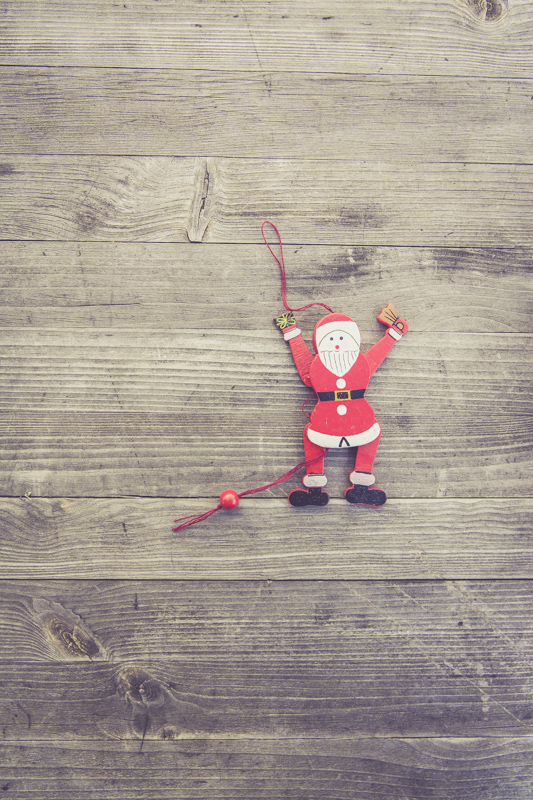
A flat, cut-out wooden ornament with a full-color graphic, the shape that prints most easily on a flatbed. Not a Polyprint project. Photo: Markus Spiske, CC BY 2.0, via Wikimedia Commons.
Acrylic. Clear or frosted acrylic is the most common blank for printed corporate ornaments because it takes photo-quality color and can be printed on the back face so the image reads through the plastic. That reverse-printed look depends on white ink: a layer of white behind the color keeps it opaque and bright instead of see-through. Mimaki notes that acrylic and glass are non-porous and that a printable primer can improve ink adhesion and scratch resistance, and it recommends an ionizer to neutralize static, which acrylic picks up easily. More detail on our UV printing on acrylic page and in white ink and opaque underprinting.
Wood. Basswood, birch plywood and MDF ornaments give a warmer, craft look. Grain and color show through anything printed without white underneath, which can be the point (a logo that looks burned in) or a problem (a brand color that has to match). Tell us which you want and we’ll proof both. Raw wood can also absorb ink differently from sealed or coated wood, so the finish on the blank matters. See UV printing on wood.
Metal. Thin aluminum blanks, often pre-coated in white, silver or gold, give crisp photo ornaments and keepsake plaques for anniversaries, memorials and service awards. The coating, not the bare metal, is usually what the ink bonds to, so we ask for the blank supplier and spec. See UV printing on aluminum.
Glass and ceramic. Glass baubles and flat ceramic or porcelain shapes look premium, but they are the least forgiving. Glass is non-porous and smooth, so adhesion depends on surface prep and primer; a curved face also limits how large the printable area can be before the image distorts at the edges. Read our UV printing on glass guide before committing to a glass run.
Shatter-resistant plastic balls. These are a practical alternative for hotel lobbies, offices and stores where ornaments get handled. Plastics vary a lot in how well ink sticks; our plastic page explains why the resin type decides the prep. Send a sample blank and we will test before quoting.
| Blank | Print area | Good for | Watch for |
|---|---|---|---|
| Flat acrylic | Full face, front or reverse | Photos, logos, names, year dates | Static, scratches before print, primer |
| Flat wood | Full face | Rustic brands, schools, towns | Grain showing through, raw vs sealed |
| Coated aluminum | Full face | Photo keepsakes, plaques, awards | Coating spec from the blank supplier |
| Flat ceramic | Full face | Premium gifts, commemoratives | Glaze adhesion, breakage in handling |
| Glass bauble | Front-facing zone | Logo or short name on a classic ball | Curvature, primer, breakage |
| Plastic bauble | Front-facing zone | Lobbies and stores where ornaments get handled | Resin type and adhesion, test first |
General guidance, not a guarantee for any specific blank. We confirm each material with a proof on the actual piece.
Tell us the blank (or send a sample), the quantity, whether each piece is personalized, and your in-hand date. We’ll proof on the actual ornament and quote the run.
An ornament goes on a tree, comes down in January and goes back up next December. That yearly reappearance is what buyers are paying for, and it is why the same handful of business uses keep coming up:
For broader branded merchandise beyond the holidays, our promotional products page covers pens, drinkware, tech accessories and more.
Jigs are what make a run consistent. Roland DG describes a jig as a template or mold that holds an object in place and flat to the print heads’ path, and recommends one for irregular shapes or larger runs. For ornaments, the jig is cut to the blank’s outline so every piece lands in the same spot and the artwork lines up with the edge or the hanging hole. A new blank shape usually means a new jig, which is one reason we ask for the exact blank before quoting.
Send vector artwork and the die line. Logos should be vector (AI, EPS, PDF or SVG). Photos need enough resolution for the printed size. If the ornament is a custom shape, send the cut file so artwork can be placed inside it with a safe margin away from the edge and the hole. Our file prep requirements lay out the details, including how to mark white ink.
Personalization runs from a list. For names, dates or addresses on each piece, send a spreadsheet with one row per ornament, spelled exactly as it should print. Check it twice; the printer prints what the list says.
Proof on the real blank. Color on clear acrylic, on wood grain and on a gold-coated disc can look quite different from the screen. A physical sample on your actual blank is the only reliable check, especially for a brand color. See our sample and proofing process and color matching pages.
Plan the calendar backward. Ornament orders are seasonal and in-hand dates are fixed. Work back from the date the ornaments must be in your hands: shipping, production, sample approval, and time to source blanks. We give a schedule once we have your blank and quantity; our turnaround times page explains what moves it, and minimum order quantities covers short runs.
Ornaments spend eleven months in a box and a few weeks on a tree, so the realistic wear is scuffing in storage and handling, not weather. Two choices do the most for longevity. Reverse-printing on clear acrylic puts the ink behind the plastic, where it is protected from scratches. On front-printed pieces, a primer on non-porous blanks and a clear or gloss layer over the print add scratch resistance.
Packaging matters as much as print. Individual sleeves or boxes keep printed faces from rubbing against each other, and a branded box turns an ornament into a finished gift. We can print flat packaging too; see UV printing on cardboard and packaging.
Care instructions are simple and worth printing on the card: dust with a soft dry cloth, no solvents or abrasive cleaners, and store wrapped. Our durability and care guide covers UV prints more generally.
Yes, on the front-facing area. On a flatbed UV printer, round baubles sit in cradles in a jig, and the printable zone is the face pointing up at the print heads, so a logo or short name works well. Full 360-degree coverage is not what a flatbed and bauble jig are built for. Glass also usually needs a primer for good adhesion.
For photo-quality color and per-piece personalization, flat acrylic is the most versatile, especially reverse-printed with white ink so the image sits behind the plastic. Wood suits a warmer, natural look, coated aluminum suits photo keepsakes and plaques, and glass or ceramic look premium but are less forgiving to print and ship.
Yes. UV printing is direct digital printing with no screens or plates, so each piece can carry a different name, date or address from a spreadsheet you supply. Send one row per ornament, spelled exactly as it should print.
Tell us what you have in mind. We can print blanks you source, and we will ask for the exact blank or a sample either way, because the material, coating and shape decide the prep, the jig and the proof.
We quote after we know the blank, the quantity, the print area, whether pieces are personalized and your in-hand date. We don’t publish standard prices or lead times for ornaments because those variables change both a lot. Ask early in the season.
Sources: Roland DG, “How to Make Jigs for UV Printing”; Mimaki Europe, “Glass & acrylic printing” (primer, ionizer and KEBAB rotary notes); Twiddleys bauble printing jig product pages (cradle jigs for 53–82 mm baubles on Roland and Mimaki flatbeds); all checked November 7, 2026. General guidance only; every material is confirmed with a proof on the actual blank.
Send the blank, the artwork and the in-hand date. We’ll proof on the actual ornament and quote the run.