Every storage room, cabinet, tank and lab door has its own list of hazards, and the sign on it has to say so in a way people read in a second. Here is what OSHA’s Hazard Communication Standard allows for workplace labels, how GHS pictograms and NFPA 704 diamonds differ, and where a printed rigid sign fits.
Short answer: the label that ships on a chemical container comes from the manufacturer, but the signs and workplace labels around your own storage and handling are yours to make. 29 CFR 1910.1200(f)(6) and (f)(7) allow workplace labels and, for stationary process containers, signs and placards, as long as they identify what they cover and convey the required hazard information where employees can see it each shift. UV printing is a strong fit for the rigid, custom, per-room versions of those signs. It does not classify your chemicals or make a sign compliant on its own.
OSHA’s Hazard Communication Standard, 29 CFR 1910.1200, splits labeling between the company that makes or sells a chemical and the employer who uses it. Paragraph (f) is where the split is written down, and it is short enough to summarize line by line:
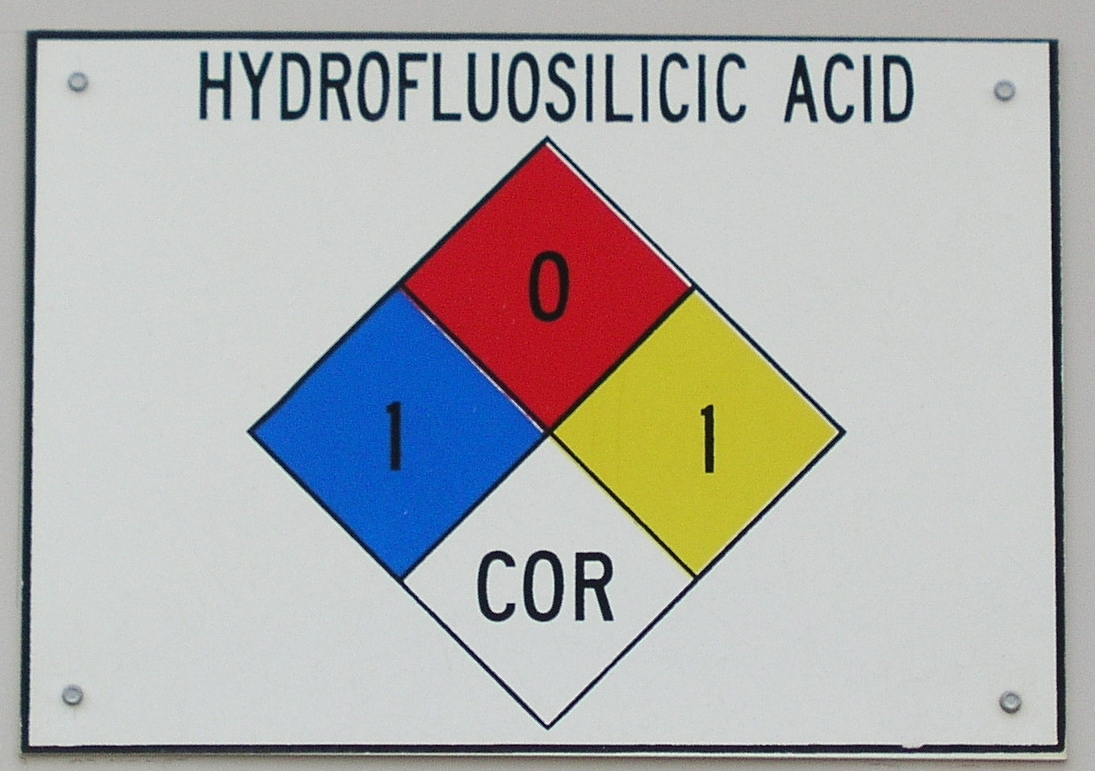
A rigid mounted sign with a product name and an NFPA 704 diamond, the kind of placard used on storage rooms and tanks. The ratings and symbols on it belong to that sign, not guidance for yours. Not a Polyprint project. Photo: killbox, CC BY 2.0, via Wikimedia Commons.
The standard defines a pictogram as a composition that may include a symbol plus other graphic elements, such as a border, background pattern or color, intended to convey specific information about the hazards of a chemical. It designates eight pictograms for application to hazard categories. OSHA’s label brief describes the required look on shipped containers: a red square frame set at a point, with a black hazard symbol on a white background, large enough to be clearly visible. A red frame without a symbol is not a pictogram and is not permitted on the label.
The eight OSHA enforces are the exploding bomb, flame, flame over circle, gas cylinder, corrosion, skull and crossbones, health hazard and exclamation mark. The GHS has a ninth, the environment pictogram, which OSHA does not enforce but allows as supplementary information. Which pictogram applies to which hazard class and category is set out in Appendix C of the standard, and the product’s safety data sheet tells you what the manufacturer classified, so your sign copy starts there.
Two details matter to anyone laying out a workplace sign. First, OSHA says that when an employer uses the Appendix C pictograms on workplace labels, they may have a black border rather than a red one. Second, employers may add instructional symbols that are not part of the HCS pictograms, for example a person wearing goggles to show eye protection is required, and may use HMIS-style PPE pictograms. The brief says including both types on a workplace label is acceptable. What the sign may not do is contradict or crowd out the information the standard requires.
Most chemical storage rooms and tanks you walk past show a colored diamond rather than a row of red-bordered pictograms. That is the NFPA 704 placard. NFPA describes the standard, Standard System for the Identification of the Hazards of Materials for Emergency Response, as addressing the health, flammability, instability and special hazards presented by short-term, acute exposures that could occur because of a fire, spill or similar emergency involving the materials present.
The layout is fixed. Per NFPA’s own explanation, health sits at the nine o’clock position in blue, flammability at twelve o’clock in red, and instability at three o’clock in yellow. Each carries a rating from 0, a minimal hazard, to 4, a severe hazard. The six o’clock position has a white background for special hazards, and the symbols NFPA lists as in use are W (unusual reactivity with water, a caution about using water in firefighting or spill control), OX (an oxidizer) and SA (a simple asphyxiant gas). Because the colors and positions are the code, a diamond is a place where print quality and color accuracy matter: a muddy red or a yellow that reads as orange invites mistakes in a hurry.
OSHA’s position is that employers may continue to use rating systems such as NFPA diamonds or HMIS for workplace labels as long as they are consistent with the Hazard Communication Standard and employees have immediate access to the specific hazard information. It also says an employer using NFPA or HMIS labeling must, through training, ensure employees are fully aware of the hazards of the chemicals used. In other words, a diamond alone does not tell a worker how to handle the material, and it does not replace the program behind it.
One more distinction for storage and transport: OSHA’s label brief notes that the pictograms do not replace the diamond-shaped U.S. Department of Transportation labels required for transport of chemicals, which go on the outside of shipped containers under 49 CFR Part 172, Subpart E. A DOT label, an NFPA 704 placard and a GHS pictogram are three different things with three different jobs, and a facility can legitimately have all three.
A chemical storage room is not a place for a peeling paper notice, and a laboratory is a place where every door has a different list of hazards. UV printing, which cures ink under UV light directly on the panel, fits that kind of work in a few specific ways. This is what it does well:
We do not claim a printed panel makes a facility compliant. Compliance comes from the hazard communication program, the classification on your safety data sheets, training, and the labels on the containers themselves. The printed sign is how that program reaches people at the point of use.
Send your approved artwork or the hazard information you are working from, the number of rooms, tanks or cabinets, sizes and mounting method. We’ll proof each sign on your substrate and quote the run.
The numbers in an NFPA diamond and the pictograms on a label come from your safety data sheets, your hazard communication program and, where one is involved, your fire marshal or insurer. We print the artwork you approve. If you are unsure what a room should carry, ask your safety officer or local fire official before ordering, not after.
The chemical manufacturer, importer or distributor is responsible for the label on the container that leaves their workplace, with the elements listed in 1910.1200(f)(1). Employers must not remove or deface those labels. Our signs sit around them, not in place of them.
Laboratory and storage environments see splashes, wipe-downs and sometimes solvents. How a UV-cured print holds up depends on the ink and substrate, the cleaning product, the contact time and how often it happens. We do not publish a blanket chemical-resistance claim. If a sign will be wiped with a particular disinfectant or solvent, tell us which, and ask for a sample to test in your own conditions. Our guides to durability and care and the sample and proofing process explain how that works.
OSHA is the federal workplace baseline. Fire codes, building owners, insurers and state or local programs often have their own rules for posted signs, including placards at storage rooms, tanks and building entrances. Follow whatever your fire official specifies and send us that format.
Permanent room identification signs fall under the ADA Standards, with their own tactile and Braille rules. A laboratory hazard sign on the same door is a separate item. See our guide to ADA signage compliance if you need both.
Not by that name. 29 CFR 1910.1200(f)(6) requires the employer to ensure each container of hazardous chemicals in the workplace is labeled, tagged or marked, and (f)(7) lets the employer use signs, placards, process sheets, batch tickets, operating procedures or other written materials in place of labels on individual stationary process containers, as long as the alternative identifies the containers it applies to and conveys the information a workplace label must carry, and is readily accessible to employees in their work area throughout each shift. Room-door signs, fire-department placards and lab entrance signs are often required by building and fire codes or insurers, so check with your fire official and safety officer.
Not on its own for shipped containers, which carry the manufacturer’s label. For workplace labeling, OSHA’s HazCom label brief says employers may continue to use rating systems such as NFPA diamonds or HMIS for workplace labels as long as they are consistent with the Hazard Communication Standard and employees have immediate access to the specific hazard information. It adds that an employer using NFPA or HMIS labeling must, through training, ensure employees are fully aware of the hazards of the chemicals used. NFPA 704 is aimed at emergency response, so many sites post both.
They answer different questions. A GHS pictogram, a red-bordered square set on a point with a black symbol on white, is part of the hazard communication label and tells a handler what kind of hazard the chemical presents. The NFPA 704 diamond rates health, flammability and instability from 0 to 4, with a white quadrant for special hazards, and is meant for people responding to a fire, spill or similar emergency. A material can need both on a storage room or tank.
Yes. OSHA’s HazCom label brief says that if the employer chooses to use the Appendix C pictograms on workplace labels, they may have a black border rather than a red border. Shipped-container labels from the manufacturer, importer or distributor use the red border.
No. The chemical manufacturer, importer or distributor is responsible for the label on a shipped container, with its required elements. Our work is the rigid signage around your own storage and handling: room and cabinet signs, stationary tank and vessel placards, and laboratory door signs you design from your safety data sheets and fire official’s requirements.
You do, from your safety data sheets, your hazard communication program and your fire marshal or safety officer. We print the artwork you approve. We do not classify chemicals, assign NFPA ratings or certify that a sign satisfies a code, and a proof is not a compliance review.
Sources: 29 CFR 1910.1200, Hazard communication, paragraphs (f)(1), (f)(6)–(f)(10) and the definition of pictogram (OSHA, eCFR); OSHA Brief, Hazard Communication Standard: Labels and Pictograms (OSHA 3636); NFPA, “Signs and Symbols in NFPA 704 and NFPA 170” (2025); NOAA CAMEO Chemicals, NFPA Diamond reference. This page summarizes federal requirements and is not legal or safety advice; confirm requirements with your safety officer, fire official and OSHA.
Send the artwork, the locations and the sizes. We’ll proof each sign on your substrate and quote the run.