Home Sports Surfaces Testing About Request a Quote
Industry Application

UV Printing for
Museums & Galleries.

Interpretive panels, exhibit graphics, and wayfinding printed on rigid, fade-resistant substrates — built to hold color and flatness through years of gallery lighting, not just the opening weekend.

Request a Quote →
The Short Answer

What Makes Museum Graphics Different From Retail Signage?

Longevity and readability under controlled but imperfect lighting. A retail sign gets replaced every season; a museum interpretive panel is often expected to stay up, unchanged, for years, under gallery lighting the curatorial team doesn't fully control. That pushes the material choice toward rigid, dimensionally stable substrates and non-glare finishes rather than whatever's cheapest per square foot. It also raises the stakes on color consistency — a traveling exhibit that looks slightly different at each venue undermines the exhibit design in a way a single-location retailer never has to think about. UV printing fits this brief well: fade-resistant cured ink, a wide range of compatible rigid substrates, and no plate cost standing in the way of the small, exacting print runs exhibit work usually calls for.

How It Works

Fade Resistance Is the Whole Point

A UV flatbed printer cures ink instantly under UV lamps as it prints, bonding it to the substrate as a solid polymer layer rather than a dye that sits loose in the material's fibers. That cured-ink structure is meaningfully more resistant to fading under sustained indoor lighting than dye-based or aqueous prints, which is the property that matters most for a panel meant to stay on a gallery wall for years rather than a single exhibition run. It isn't a claim that color never shifts under any lighting condition over an unlimited timeline — it's that UV-cured ink is a large step up from print methods that were never built for that kind of duration.

Substrate choice does as much work as the ink. Rigid foam board, acrylic, and aluminum composite panel all print cleanly and hold flatness through the humidity swings a gallery HVAC system doesn't always fully iron out — warping is one of the more common, avoidable failure modes on long-run exhibit graphics, and it usually traces back to substrate choice rather than the print itself. See our foam board, acrylic, and composite panel guides for how each substrate handles that differently — foam board is the lightest and most budget-friendly for temporary installs, acrylic gives the cleanest premium look for permanent label cases, and ACM holds up best for anything mounted near an exterior wall or a less climate-stable space.

Rigid foam board, acrylic, or aluminum composite panel — the three most common exhibit substrates
Non-glare or matte finish recommended for interpretive label readability
No plate cost — small, exacting exhibit runs are practical to print
Color profile and file retained for consistent reprints across venues
Reversible mounting hardware available for rotating or traveling installs
Ask About Your Exhibit Project →
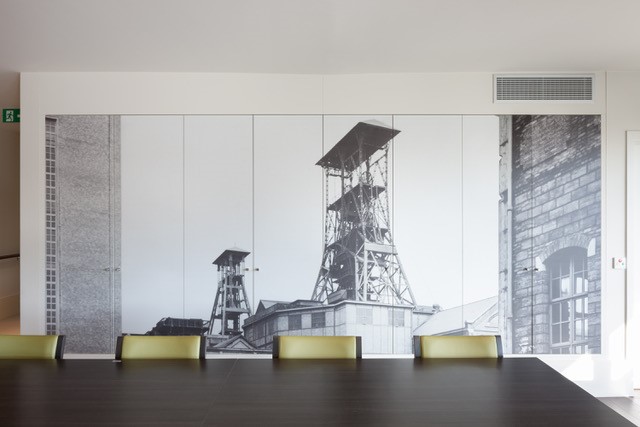
UV printed interpretive panel mounted on gallery wall
Considerations

What Curatorial and Exhibit Teams Actually Plan Around

The print itself is one part of a longer install-and-maintain lifecycle.

Readability Under Gallery Lighting

  • Non-glare or matte finishes reduce spotlight and case-glass glare that makes glossy labels hard to read from an angle
  • High-contrast type and generous white space matter more under variable, sometimes dim gallery lighting than they would in a brightly lit retail space
  • Label height and placement typically follow the venue's own accessibility guidelines, not a generic sign standard

Rotating & Traveling Exhibits

  • Reversible, acid-free mounting hardware lets panels come down clean when an exhibit rotates out
  • Reprints for a multi-venue tour need the original file, substrate, and color profile on record to match the first run
  • Standardized panel sizes across a touring exhibit simplify crating and reduce venue-to-venue install variation
Accessibility & Consistency

Two Problems That Compound If Skipped

Neither shows up as a defect in the print itself — both show up as a problem for the visitor.

Accessible Wayfinding & Labels

Public and municipal museums in particular need wayfinding and directional signage that meets accessibility standards for mounting height, contrast, and — where required — tactile or raised elements. That's a separate compliance question from print quality; see our ADA signage compliance guide for what actually needs to be specified before artwork goes final, and our signage and wayfinding guide for how a facility-wide wayfinding system typically gets structured.

Cross-Venue Color Consistency

A touring exhibit that looks slightly different at each stop undermines the design intent in a way most single-location signage never has to account for. Locking a color profile and substrate spec at the first print run — and referencing it for every reprint — is the same discipline covered in our quality control and color consistency guide, just with higher stakes given how visibly panels get compared side by side.

Shipping Multi-Panel Installs

Large-format panels and multi-piece exhibit sets need crating that protects both the substrate and the printed surface in transit between venues — corner damage and surface scuffing are the two most common transit failures on rigid panel work. See our shipping and crating guide for how that's typically handled for large or multi-panel jobs.

Budget Reality for Nonprofits

Many museums and galleries operate on grant funding and tight exhibit budgets, which makes the no-plate-cost economics of UV flatbed printing a practical fit — a 12-panel interpretive install and a single replacement label cost the same per-unit setup, unlike screen printing where short runs carry a fixed cost penalty.

Tested Durability

Held to the Same Standard as Every Polyprint Surface

UV-printed exhibit graphics meet the same independently tested performance benchmarks that define all Polyprint applications.

☀️

UV Weathering

No Change at 3000h

EN ISO 16474-3 Atlas UV Test — zero surface change after 3000 hours of exposure.

✏️

Scratch Hardness

6H Pencil

EN 15184 pencil hardness test — rated 6H, the highest standard for coating hardness.

💥

Impact Resistance

>60N

EN 438-2 ball impact testing — maximum machine rating with no visible damage.

🔬

Wear Resistance

Class 31

DIN EN 14354 Taber Abraser — achieved classification 31 in tested conditions.

View Full Testing Data →
Where It Performs

Applications for Museum & Gallery Graphics

From a single rotating label to a full multi-room exhibit build-out.

Exhibit Graphics

  • Interpretive panels, artifact labels, and didactic text panels
  • Large-format backdrop graphics and gallery entrance signage
  • Touring and traveling exhibit panel sets built for repeat install

Wayfinding & Facility

  • Directional wayfinding, gallery numbering, and accessible signage
  • Donor recognition walls and membership program displays

Gift Shop & Programming

  • Gift shop point-of-purchase displays and event program signage
  • Education-program panels for school-group and family visitor tracks

Why Curators Choose It

  • Fade-resistant color built for panels that stay up for years, not months
  • No plate cost — a single replacement label costs the same setup as a full panel run
  • Consistent reprints across venues for touring and rotating installs
FAQ

UV Printing for Museums & Galleries — Common Questions

What print materials are used for museum exhibit graphics?

Rigid, dimensionally stable panels are the default for anything permanent: aluminum composite panel, acrylic, and rigid foam board are the most common because they stay flat through humidity and temperature swings a gallery HVAC system can't always fully control. Fabric and paper-based prints appear for temporary or budget-limited installs but hold flatness less well over a long run.

Does UV printing fade under gallery lighting?

UV-curable ink resists fading meaningfully better than dye-based or aqueous prints under sustained gallery lighting, which is why it's the standard choice for interpretive panels meant to stay up for years. It isn't immune to any color shift over an unlimited timeline, but it's a substantial step up from print methods never built for indefinite indoor display.

Can UV-printed panels be removed without damaging walls or cases?

That depends on the mounting method, not the print. Panels installed with reversible, low-tack, or acid-free hardware come down clean when an exhibit rotates. Panels glued or permanently fastened to a wall or case don't, regardless of what's printed on them — mounting method should be specified before install.

Is UV printing good enough to reproduce fine art?

For exhibit graphics, wayfinding, and interpretive labels, yes. For reproducing an actual artwork where color-critical accuracy against the original piece is the point, dedicated giclée printing on archival photo paper or canvas is the more established standard for that specific use case.

How are traveling exhibit graphics reprinted consistently across venues?

By keeping the original print file, substrate spec, and color profile on record so each venue's reprint matches the first run rather than drifting. Request a quote here.

Explore More Surfaces

Related Applications

Have an Exhibit or Gallery Project in Mind?

Send us your panel sizes, substrate preference, and whether the install needs to travel or rotate. We'll come back with the right materials and pricing.

Website by Rank Easy Digital — websites, SEO & AI search visibility for your business. Get a free consult →