Full-color graphics bonded directly to the aluminum face of ACM and dibond panels — no laminate film, 7 to 15-plus years of outdoor color life, and the standard specification for permanent exterior signage.
Request a Quote →Aluminum composite material — dibond, alucobond, reynobond, and equivalent products all fall under the same category — pairs a smooth, weather-resistant aluminum face with a light, dimensionally stable core, which is exactly the combination permanent exterior print applications need. UV ink bonds directly to that aluminum face and, sealed under a protective clear coat, holds color for 7 to 15-plus years outdoors. What it doesn't do well is bend into a compound curve or dodge fire-code core requirements on a facade — those are the two places we'll usually point you toward a different substrate instead.
The composite construction — two thin aluminum skins around a polyethylene or mineral core — gives ACM exceptional flatness at scale, which matters most on large-format work where panel bow or print registration errors between tiled panels become visible fast. It's also considerably lighter than solid aluminum sheet of equivalent stiffness, which changes what mounting hardware and structural support a large installation actually needs.
Outdoors, that aluminum face is the whole advantage: it doesn't absorb moisture, warp, or delaminate the way wood, foam, or paper-based substrates can under repeated wet-dry cycling. Combined with UV-stable ink and a protective top coat, that's what gets a printed ACM panel to 7-15+ years of exterior service without a laminate film to lift or discolor — see our UV printing vs. vinyl wrap comparison for how that no-laminate approach plays out over years outdoors. When a single graphic spans more panels than one press bed can hold, our large-format tiling and murals guide covers how the file gets split, registered, and kept color-consistent panel to panel. That same weather resistance is why ACM is the standard material behind a real estate yard sign or rider that has to survive multiple listing seasons outdoors — see our UV printing for real estate and property signage guide.
Request a Quote →
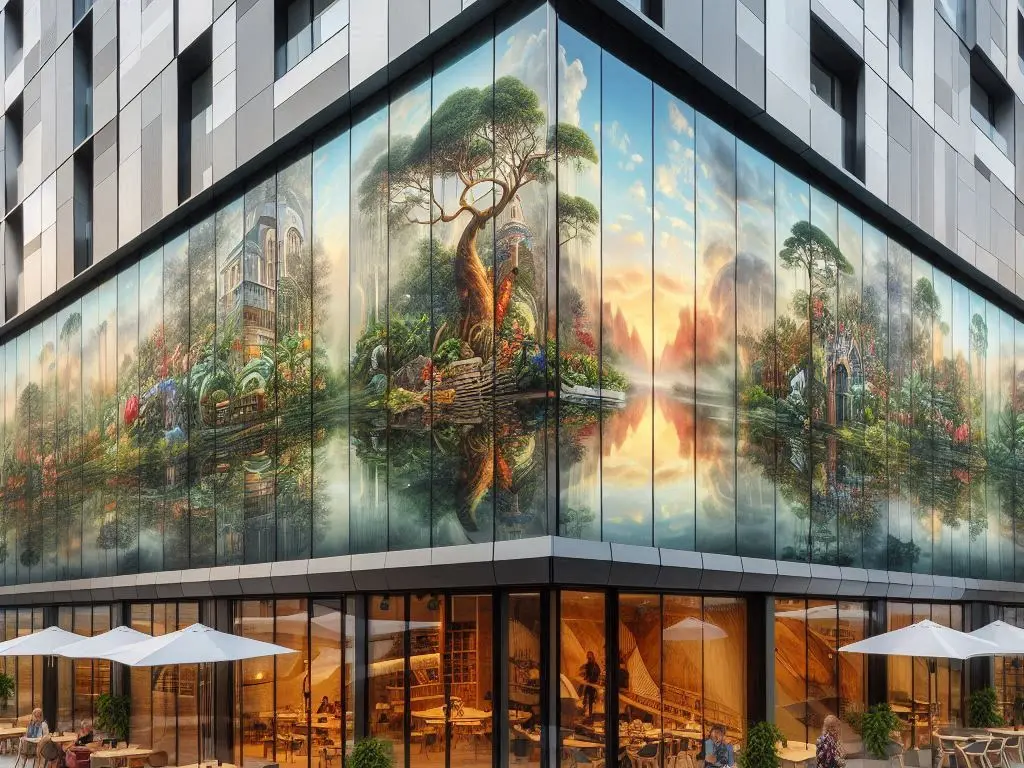
What to confirm before a run — thickness, face, core, and coating each affect cost, lead time, and code compliance.
| Specification | Standard Options | Notes |
|---|---|---|
| Thickness | 2mm, 3mm, 4mm | 3mm is most common for signage; 4mm for larger panels and structural spans |
| Face material | Pre-painted aluminum or mill finish | Pre-painted white is standard for a UV printing background |
| Core material | Polyethylene (PE) or fire-resistant mineral (FR) | FR core is often required by code for facade use above ground floor |
| Panel sizes | Up to roughly 1500mm × 4050mm | Custom sizes and gang-printing of multiple panels per sheet available |
| Protective coating | Gloss, satin, or matte UV-stable clear coat | Required for exterior use; optional indoors |
| Fabrication | CNC cut, V-groove, drill, fold | Done after printing for dimensional accuracy of the finished panel |
Fire-resistance note: facade cladding fire-resistance requirements vary by jurisdiction and building type. If ACM is going up as building cladding, confirm the fire classification your project needs before specifying standard PE-core panels — FR core may be mandated and changes both cost and lead time.
ACM's mix of longevity and print quality covers a wide range of exterior and high-durability interior work.
ACM earns its premium on exterior longevity — it isn't the default answer for every project.
ACM V-grooves and bends cleanly on a single axis for folded returns and box signs, but it doesn't form compound curves. Wrapped columns or domed surfaces need a different substrate or fabrication method entirely.
Many jurisdictions require FR (fire-resistant mineral core) panels rather than standard PE-core ACM above ground floor. That changes cost and lead time — confirm the building's fire classification before specifying standard core. If fire rating is driving the spec rather than weight or panel size, UV printing on fiber cement is worth comparing directly — it clears most fire codes without an FR-core upcharge, at the cost of a heavier panel and its own prep requirements.
For a trade show panel or indoor sign that will never see weather, foam board is lighter, cheaper, and just as durable for that use case. ACM's premium is only worth paying when exterior exposure or long service life is actually required. If the panel is one piece of a larger booth order, see our trade show displays guide for how backdrop, tabletop, and floor graphics get scheduled against a fixed show date.
ACM is an aluminum-skinned sandwich panel, not a fiber-reinforced composite — a different substrate family than carbon fiber. If the project is a carbon composite part rather than an ACM panel, see UV printing on carbon fiber; the surface being printed is cured resin, not aluminum, and prep requirements follow accordingly.
Printed ACM meets the same independently tested benchmarks that define all Polyprint applications.
EN ISO 16474-3 Atlas UV Test — zero surface change after 3000 hours of exposure.
EN 15184 pencil hardness test — rated 6H, the highest standard for coating hardness.
EN 438-2 ball impact testing — maximum machine rating with no visible damage.
DIN EN 14354 Taber Abraser — achieved classification 31 in tested conditions.
A sandwich panel — sold as dibond, alucobond, reynobond, and similar trade names — with two thin aluminum skins bonded to a polyethylene or fire-resistant mineral core. The aluminum face gives a smooth, dimensionally stable, weather-resistant surface UV ink bonds to directly. Standard thicknesses are 2mm, 3mm, and 4mm.
With UV-stable ink and a protective clear coat, typically 7 to 15-plus years of color fidelity under normal weathering. The aluminum face doesn't warp, absorb moisture, or delaminate — considerably more durable outdoors than foam, wood, or paper substrates.
Three cases come up regularly: curved or compound-curve installations, above-ground facade cladding in jurisdictions requiring FR core instead of standard PE core, and short-run indoor graphics where foam board is lighter, cheaper, and equally durable since the panel won't see weather.
Dibond and other ACM products are lighter than solid aluminum sheet of equivalent stiffness, which makes large-format signage and cladding more practical to handle, mount, and support structurally. UV printing gives the same visual result on either.
Yes — CNC cut, routed, V-grooved for folded returns, and drilled after printing, so the printed area lines up precisely with the finished panel dimensions. We can supply flat printed panels for your fabrication shop or coordinate fabrication as part of the project.
A UV-stable protective clear coat in gloss, satin, or matte finish, specified to match the panel's environmental exposure and expected service life. Request a quote here and tell us the install environment.
Share your panel dimensions, quantity, intended application, and environment. We'll confirm substrate and coating specification and return pricing and lead time.